
So You’ve Got the Facility, But Your Yields Are Flat. What’s Actually Stealing Your Harvest?
We see this pattern replay every single year. A grower in Michigan calls us in late February 2025, frustrated. They’ve spent six figures on HVAC, irrigation, genetics, and automated dosing systems. Yet, the energy bill is climbing faster than their grams-per-square-foot numbers. The culprit, nine times out of ten, isn’t the nutrients. It’s the ceiling.
I’m talking about the lighting decision you locked in three cycles ago. Maybe you grabbed the most affordable PPFD map you could find, or you’re still limping along on High Pressure Sodium (HPS) fixtures from a 2018 retrofit because “they still turn on.” In 2026, light is your single most valuable production input—and the easiest one to get wrong by just a 5% margin that compounds into a 20% revenue leak.
This isn’t a textbook lecture. We’ve been manufacturing LED fixtures in California since 2004, and if there’s one thing the shift from magnetic ballasts to smart controllers taught us, it’s that buyers often fix the wrong bottleneck. Let’s drill into the five fixes that actually move the needle.
Why Are We Still Arguing About HPS vs. LED? The Efficiency Gap Isn’t Small Anymore
Is the argument over HPS vs. LED truly settled for high-performance commercial grow lights? For a long time, the old-school grower saying was, “HPS gives you weight.” That was true in 2015. It is not true now.
A 1,000W double-ended HPS fixture, running at full blast on a 120V circuit, typically delivers a photon efficacy of about 1.7 µmol/J, which is average at best compared to modern LEDs. The real killer isn’t the light; it’s the radiated heat. You end up spending money on air conditioning to remove the 500+ watts of infrared heat the fixture dumps onto the canopy. You’re essentially paying for electricity twice.
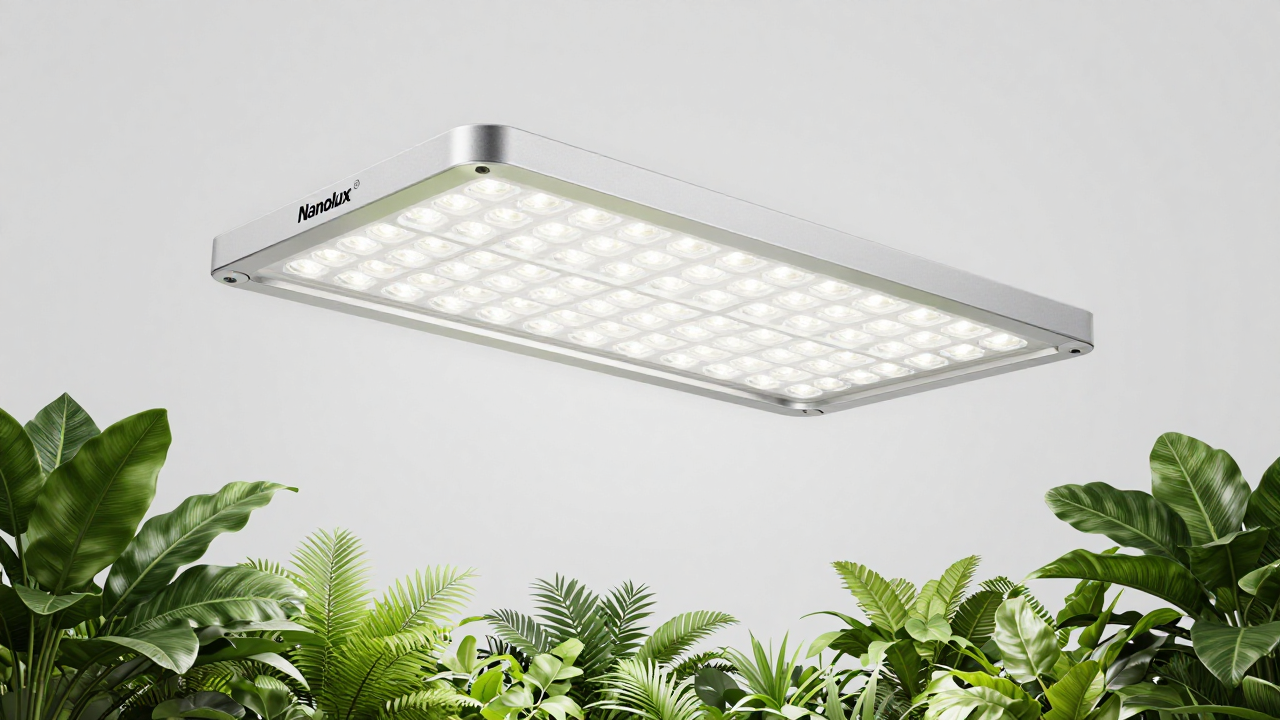
Modern top-lighting LEDs, specifically the fixture architecture we switched to around 2019 with the Nanolux NXT 2 series, push past 3.0 µmol/J. This isn’t a 10% efficiency jump that some marketing material might suggest; it’s a 60-70% reduction in power draw for the exact same photosynthetic photon flux density. When you’re running 500 fixtures in a warehouse in Denver, a difference of 1.3 µmol/J translates to keeping an extra $30,000 to $50,000 in your pocket per room, per year. Just on cooling savings alone.
The hang-up we see is spectrum anxiety. Growers worry that losing the HPS yellow-orange spike hurts development, but in reality, a well-tuned broad-white LED spectrum with elevated reds (around 660nm) gives you tighter internodal spacing and avoids the “stretch” you get with HPS during the first two weeks of flower. It’s a control lever, not a compromise.
The Budget Says $400 Per Unit, But What’s the Real Cost of a Cheap Fixture?
We shipped a small batch of budget fixtures to a greenhouse operation in Salinas in March 2021 as a stress test—not ours, but a generic import board a client wanted us to benchmark. It was rated for 720W at the wall. Independent lab sphere testing and an ammeter in our warehouse showed they barely pulled 580W. Worse, the PPF output deteriorated by 4% after just ten 12-hour cycles. Ten.
The replacement cycle is where cheap fixtures kill your P&L. A photon doesn’t care about warranty paperwork. It changes quality and quantity. If your $400 fixture has a driver that flickers in damp environments (common in commercial cultivation facilities), you’re not just paying an electrician to swap it out. You’re losing canopy uniformity. Uneven light creates a 10-15% variation in flower density across a single bench. Hand trimmers see it immediately.
Here’s our bias—and we see it reflected in operational data across the industry—you should be buying based on the 5-year cost per photon. Acrylic lenses yellow. Drivers rated for 50,000 hours might fail at 15,000 if the internal caps are heat-soaked. When you’re comparing offerings for commercial grow lights, ignore the initial sticker shock and pull the spec sheet for driver efficiency and lens material. Glass optics and Mean Well or Inventronics drivers aren’t luxury add-ons. They’re insurance against a facility-wide dimming event in week 5 of flower, which, if you’ve been through one, is a sickening feeling.
Everyone Talks About PPFD Maps, So Why Do Canopies Still Have Hotspots and Shadowed Corners?
You’ve seen the perfect rectangle heat map on a brochure. It’s a simulation, usually done in a black vacuum with zero reflectance and a light hung exactly 36 inches high. It’s a lie if you have walls, rolling benches, or trellis nets.
In April 2022, a vertical farm in New Jersey reported lower yields on the bottom shelf even though the PPFD map, shown to them during the sale, looked uniform. On-site inspection revealed the issue. The light map was calc’d for an open room, but the actual setup had dense metal racking and Mylar walls. The reflected photons were colliding and creating a +200 PPFD hotspot along the center seam while leaving the edges—where the HVAC airflow was also highest—in a deficit.
We’ve started telling growers to ignore the perfect map template and look at the center-to-edge ratio. A fixture that drops from 1,000 PPFD in the center to 600 PPFD at the edge is not a “high uniformity” fixture, even if the average number looks good. You need optics. Secondary lenses that take those photons leaving the diode at 120 degrees and push them outward at a 90-degree angle. It seems counterintuitive to block a little light to direct it, but overlapping beams between fixtures create a flatter average. In practice, this means fewer “lanky” plants on the wall edges and fewer bleached tops in the middle row.
To clean this up in an existing room without buying new lights:
Honestly, that last fix—under-canopy—was something we didn’t believe in until 2019. We thought it was a gimmick. But by driving light upward into the stomata-laden bottom of leaves, you keep the lower foliage photosynthetically active instead of it going cannibalistic or dying off, directly increasing biomass.
The Electric Bill for 2026 Is Coming—Can Lighting Controls Actually Save a Crop?
“Set it and forget it” became popular advice in hydroponics stores a decade ago. For commercial grow lights, it’s terrible advice. Plants don’t eat a static amount of energy. They have diurnal cycles.
During the West Coast heatwave of June 2021, a grower in California experienced rising heat inside a sealed room because the ACs couldn’t keep up with 120°F exterior ambient temperatures. Their HPS lights were at 100%, dumping heat. Their only option was to kill the circuit and send the plants into an abrupt darkness, causing a spike in humidity and immediate powdery mildew pressure.
A programmable controller would have saved them. Not a timer—a control system with a sunrise/sunset ramp and temperature-triggered auto-dimming. By tying the output of the lights to a leaf surface temperature sensor, you can “cruise control” your canopy temperature. If the room hits 82°F, the system dims the LEDs by 15% over five minutes. The ambient temp drops, the plant doesn’t lock up with heat stress, and you keep the lights on. You lose 15% of light, not 100%. This is the difference between a moderate yield week and a catastrophic larf-filled harvest.
Checklist for a lighting control setup in 2026:
Nobody Calibrates Anymore—Why Is Your Room Half the PPFD You Think It Is?
This is the problem I hate the most because it often results from good horticulturists receiving lousy data. You have a PAR meter. Maybe a $150 handheld spot checker you bought in 2018. The sensor dome is hazy from sulfur burners. The battery is low. The calibration is off by 15%.
In February 2026, a Tier 2 cultivation facility in Missouri was running a “1,200 PPFD” flower room based on their old meter. A fresh Apogee MQ-610 calibrated for LED spectra revealed the truth: they were hitting 850 PPFD at the canopy. They’d been under-lighting by almost 30% for three harvest cycles. That’s a ton of lost potential.
You can’t manage what you can’t measure. Dark calibration of the sensor (zeroing it out) before every use is non-negotiable. For LED-specific measurements, that meter must be calibrated for an extended red spectrum. Silicon sensors degrade. In a grow environment with high humidity, the sensor’s filter ages.
And because we’re on the topic of numbers—let’s make sure the daily light integral (DLI) math isn’t being corrupted by your assumptions. The clean math is simple:
DLI = PPFD × (3600 × photoperiod hours) / 1,000,000
If you have 900 PPFD for 12 hours:
900 × 43,200 / 1,000,000 = 38.9 mol/m²/day
If you’re off by 30% on your PPFD reading, you’re feeding your crop a DLI of 27 instead of 39. That’s not just a lighting error. That’s a nutrient uptake error and a irrigation scheduling problem, because the stomatal conductance is entirely different. All because of a sensor that costs $300 to replace.
We always tell new facility managers to put a sensor replacement line item in the annual budget. It’s the cheapest way to protect a multi-million-dollar canopy.
