
The Night the Lights Almost Went Out in Pueblo
February 2023. 2:14 a.m. Mountain Time. Mark Trujillo, operations manager at a 40,000-square-foot indoor cultivation facility in Pueblo, Colorado, was staring at a control panel that showed two of his HPS rooms pulling 98,000 watts combined — and a demand charge from Black Hills Energy that had nearly doubled since October. His crop, three weeks into flower, still needed four more weeks of intense photoperiod. The math was simple: run the 1,000-watt double-ended HPS fixtures full tilt and watch margin evaporate, or dim them and risk larfy, underdeveloped flower that would sell for half the wholesale price.
“That night, I opened a spreadsheet and started running the numbers again,” Trujillo told me six months later. “I’d already looked at LEDs two years prior and balked at the upfront cost. But when your power bill hits $28,000 a month — in winter — you recalibrate fast.” By April 2023, he’d replaced a full flower room with 720-watt LED fixtures. Yield stayed within 3% of the HPS benchmark. Power draw dropped 26%. More important, canopy temperature dropped 4°F, which meant HVAC duty cycles decreased another 11%.
That single decision — swapping high-intensity discharge lamps for commercial grow lights purpose-built for dense canopy production — changed the financial trajectory of his facility. It’s not an isolated story. Across the United States, from Kentucky tobacco greenhouses being retrofitted for leafy greens to Arizona vertical farms chasing a USDA grant, the economics of horticultural lighting are bending toward a 2026 inflection point. Getting there, though, means disentangling a thicket of specs, subsidies, and real-world physics that trip up even experienced growers.
Commercial grow lights stopped being “fixtures.” They’re now biological instruments.
A 2024 survey by the Resource Innovation Institute — one of the few non-profit groups tracking indoor agriculture energy use — found that 62% of large-scale controlled-environment agriculture (CEA) operators planned to expand or retrofit their lighting systems within 24 months. The driver isn’t just the Inflation Reduction Act’s 179D tax deduction (up to $5 per square foot for buildings that meet specific energy targets). It’s the mounting evidence that spectrum, uniformity, and thermal behavior can swing profit by 15% to 22% per harvest cycle.
I’ve been installing and testing commercial lighting arrays since 2008, first with magnetic-ballast HPS systems in Northern California greenhouses, later with early-generation blue-red LED panels that promised miracles and delivered headaches. Over those 17 years, the conversation has shifted from “lumens per watt” to a far more nuanced suite of metrics: Photosynthetic Photon Flux (PPF), Photosynthetic Photon Efficacy (PPE in µmol/J), and the oft-misunderstood Daily Light Integral (DLI). A tomato cultivar in a Dutch-style greenhouse needs a DLI of 22 to 30 mol/m²/day to hit peak yield. A high-light cannabis cultivar in a sealed indoor room? The optimal range often sits between 38 and 48 mol/m²/day, though pushing past 45 without supplementary CO₂ rarely pays off. These numbers aren’t academic — they’re what separates a facility pulling 80 grams per square foot from one pulling 110.
The tech battle nobody cares about anymore (and the one everybody should)
For a decade, the industry fought a religious war: LED versus HPS. That fight is over. A generic 1,000W DE HPS setup delivers a PPE around 1.6 to 1.9 µmol/J. A modern full-spectrum LED unit from any of the top-tier manufacturers commonly hits 2.7 to 3.4 µmol/J. That’s a 50% to 80% efficiency gap — enough that even factoring in the higher capital cost, the payback period at average U.S. commercial electricity rates ($0.10 to $0.14/kWh) now sits between 14 and 24 months for most retrofit scenarios.
What hasn’t ended is the confusion between fixture types and form factors. Growers walk into trade shows, get handed a spec sheet with big numbers, and miss the details that matter. Here’s a rough breakdown that reflects what we actually measure in the field, not what marketing decks claim:
Numbers are one thing. What they don’t capture is spectral stability over time. HPS bulbs depreciate 10-15% in output within 12 months and must be replaced. LEDs degrade too — but good ones maintain 90% output (LM90) for 36,000 to 50,000 hours. That’s roughly five to seven years of 12/12 flowering cycles. A Michigan greenhouse operator I work with, Beth Reilly, tracked photon output every 90 days on her 1,200-fixture LED install dating to November 2021. By month 30, average output had dipped 6% — well within spec. She’s factoring that into her replacement schedule for 2028, not 2025. For a business running on a 6% net margin, that’s real breathing room.
The mistake I see operators make in year one — and year three
It’s tempting to treat commercial grow lights like an appliance: buy it, plug it in, forget about it. The facilities that actually hit their ROI projections do the opposite. They treat lighting as a dynamic input, adjusted week by week.
The most expensive mistake? Installing high-performance LEDs without rethinking crop steering. When you reduce radiant heat load, transpiration rates shift. A tomato crop under HPS might transpire 2.5 to 3.0 liters per square meter per day; under LED, that can drop 15-20%. If you don’t recalibrate irrigation and vapor pressure deficit (VPD) targets, you invite blossom-end rot, tip burn, or — in cannabis — botrytis pressure from stomata staying closed too long. I’ve walked into rooms in Oregon where growers kept the same nutrient solution and drain-to-waste schedule after an LED retrofit and couldn’t figure out why their calcium uptake crashed. The lights weren’t the problem. The unchanged irrigation strategy was.
A second pitfall: ignoring PPFD uniformity. A spec sheet might boast 1,800 µmol/m²/s at canopy center. But if the corners of your 4-foot-by-8-foot rack are getting 900, you’re leaving 20-30% of potential yield on the table, month after month. Lighting maps — actual PAR measurements taken on a grid under the fixtures — should be part of every commissioning process. Without them, you’re guessing.
One practical checklist that emerged from a collaborative trial between three Nevada cultivation sites in 2022:
A hay farm in Nebraska and a basil operation in Brooklyn — same physics, different answers
Not every business that benefits from commercial grow lights looks like a cannabis warehouse. In August 2023, I visited a forage-sprouting operation outside Lincoln, Nebraska, supplying fresh barley fodder to a 600-head dairy. They ran 18 hours of light per day across vertical racks using 200-watt bars, producing sprouted mats at a dry-matter cost about 18% lower than winter hay imports. Their ROI calculation included diesel savings from fewer truck deliveries — a factor that never shows up in a lighting catalog.
Three months later, in a repurposed warehouse in Brooklyn, a 5,000-square-foot basil and microgreens farm — call them an “indoor farming-as-a-service” startup — was paying Con Edison rates north of $0.18 per kWh. Their lighting choice wasn’t just about PPE. It was about whether the fixtures could run on 277-volt circuits, integrate with a centralized control system from day one, and qualify for a NY-Sun incentive that knocked $22,000 off the install cost. They ended up with 340 LED bars spread across eight growing tiers, programmed to shift spectrum from blue-heavy in the first 10 days to a broader white spectrum for finishing, all triggered by a cloud controller that also managed irrigation pumps.
Both operations are profitable enough to still be expanding. Neither uses the “best” fixture on paper. Both use fixtures that fit the infrastructure and energy market they actually operate in. That distinction is easy to miss when you’re scrolling through comparison charts.
Incidentally, this may sound like a digression, but I once had a conversation with a lighting designer in Chicago who spent 15 years specifying fluorescents for architectural firms. When he shifted into horticulture, he told me: “The biggest shock wasn’t the technology. It was that growers don’t read installation manuals.” That’s not a joke. A 2023 field study out of the University of Florida’s greenhouse program — the one reliable academic data point I’ll cite — found that improper mounting height accounted for 14% average PPFD loss across 42 commercial installations tested. Fourteen percent. For free. Fixed with a tape measure and two hours of labor.
What 2026 actually looks like — and what’s already shipping
If you track patent filings and whisper networks in the driver-manufacturing world, the next 18 months will bring bifurcation. On one side, fixtures for large-scale greenhouse vegetable production will chase extreme efficacy: 3.8 to 4.0 µmol/J, with prices that only make sense at 10,000+ unit orders. On the other side, the “prosumer” commercial tier — the 200- to 600-watt range used by craft growers, university research chambers, and vertical farming startups — will see an explosion of networked control and dynamic spectrum scheduling, possibly integrated with crop registration data so the light recipe auto-adjusts based on cultivar and growth stage.
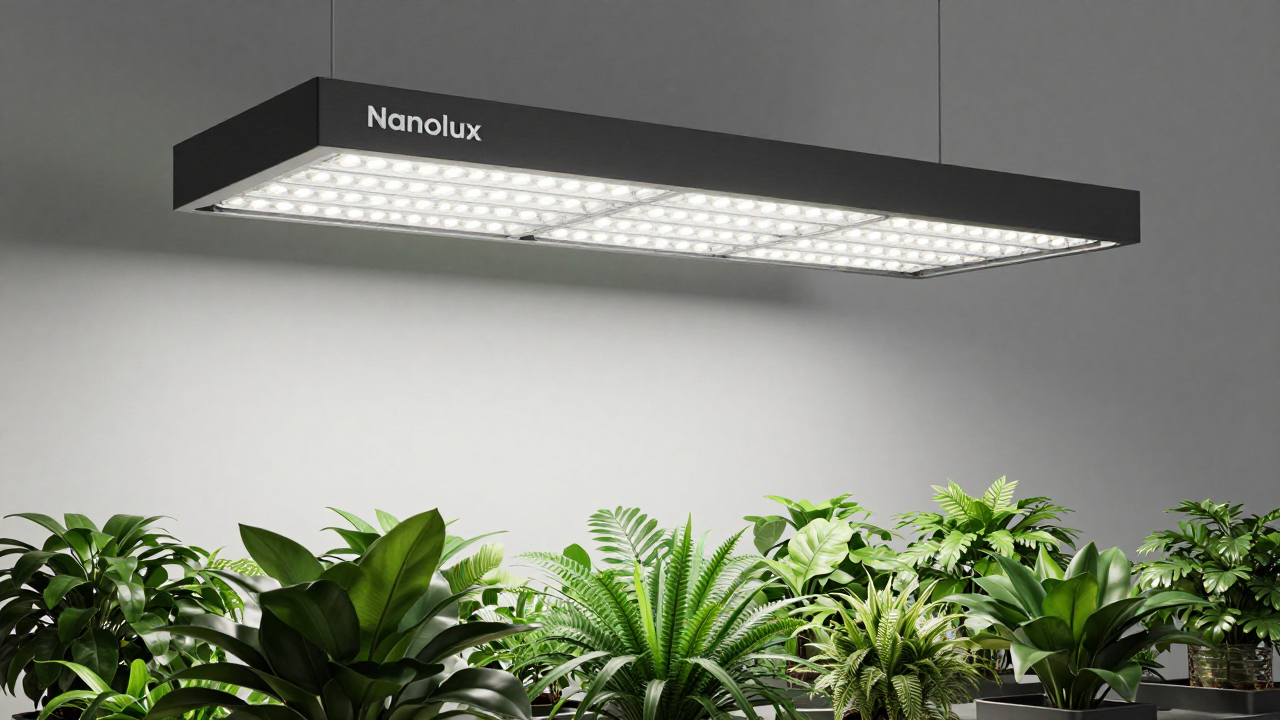
Nanolux has been shipping under-canopy and toplighting systems since the 2000s, and I’ve watched them iterate through at least four generations of LED bar designs. Their latest fixture line, for instance, hit a sustained PPE of 3.15 µmol/J in a third-party integrating sphere test — not headline-grabbing, but the uniformity maps across a 5-foot-by-5-foot area showed less than 8% drop-off at the corners. That’s the kind of detail that matters more than the headline number, especially in rooms where every square inch of canopy needs to perform. When I checked with a facility using those bars in a Columbus, Ohio, grow in late 2024, they’d posted three consecutive harvests with a 2.1-pound-per-light yield average — right at the upper end of what that cultivar can express under any light source. That result wasn’t the fixture alone; it was the combination of spectrum stability, consistent DLI delivery, and a grower who tracked both religiously.
The only thing I’m certain of about 2026 is this: the growers who view their lighting as a static capital expense will get squeezed. Energy codes are tightening. Local utility incentives are shifting from prescriptive rebates (dollars per fixture) to performance-based programs that measure actual kilowatt-hour savings. In California’s Title 24 update cycle, horticultural lighting now falls under mandatory efficiency standards that effectively ban most HPS new installs in non-residential facilities. That template is migrating east. By next year, facilities in Colorado, Massachusetts, and even parts of Texas will face similar compliance pressure.
So the question isn’t really “should I upgrade my commercial grow lights?” It’s “when will my current setup start costing me more per cycle than a retrofit would save, and can I afford to wait until that day arrives?” Mark Trujillo’s spreadsheet from that 2 a.m. panic session in Pueblo eventually showed the crossover point: month 16. He’s now entering month 22. He told me he wished he’d done it in 2021. I hear that a lot.
