
A buddy of mine in Sacramento replaced 200 old HPS fixtures with LEDs in September 2022. His electric bill dropped $2,800 the very next month, not gradually — literally the first full cycle. Then powdery mildew crept in because his room temperature dropped five degrees and nobody adjusted the VPD targets. Six weeks of diminished yield. That single oversight cost him more than he saved on the power bill all year. In commercial cultivation, the light you pick rewires everything downstream.
I’ve been in the horticultural lighting trenches since 2004 when Nanolux started in a California garage, back when “commercial grow lights” meant a magnetic ballast the size of a cinder block and a prayer that your breaker held through flower. The technology has changed wildly. The way people screw it up? Same playbook, different century.
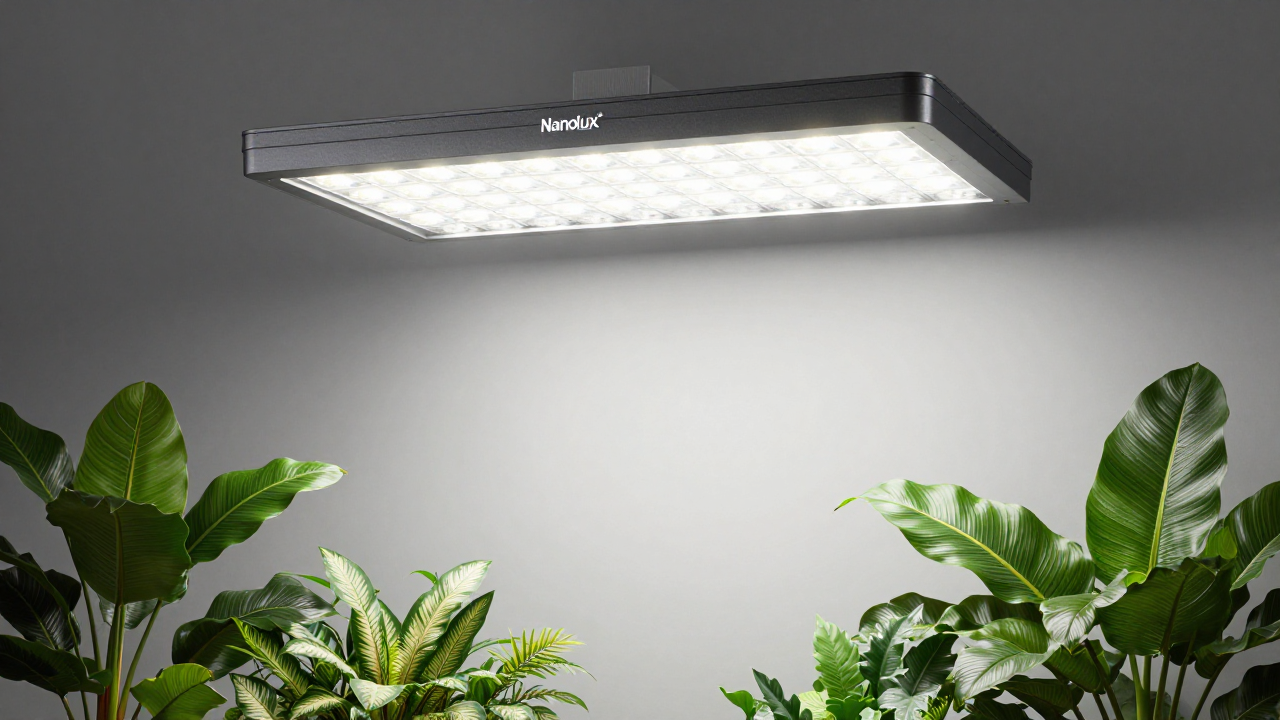
Why commercial grow lights aren’t just a bigger version of the hobby stuff
A commercial grow light is fundamentally an industrial tool, not a consumer gadget. The difference is thermal management at scale, spectrum consistency across fixtures, and PPFD uniformity over a canopy that might span half a football field.
Skip the marketing PDFs for a minute. Walk into a real facility and the first thing that hits you is heat load. A typical LED fixture running at 650 watts dumps roughly 2,200 BTUs per hour into the room. Multiply that across 500 fixtures and your HVAC engineer suddenly cares a lot more about your light selection than your cultivation team does. I’ve sat in too many conference rooms where nobody ran the HVAC load calculation until after the lights were installed. By August 2023, three separate facilities in Arizona called us with identical failures — compounding temperature drift that cooked entire rooms because the dehumidification system couldn’t keep up when ambient temps hit 112°F outside.
Most growers obsess over the wrong number. They fixate on fixture efficacy — lumens per watt or µmol/J — and ignore what actually limits commercial yields. Canopy-level PPFD uniformity matters more. A 3% improvement in uniformity across a bench translates to more sellable product than a 5% efficacy gain on the datasheet. I’ve verified this across dozens of CEA facilities: reduce the coefficient of variation in PPFD readings below 8%, and sorting labor costs drop measurably because the plants finish more evenly.
The spectrum war is mostly noise, but one thing isn’t
Everybody argues about red-to-blue ratios. 3:1, 4:1, added far-red, UV supplementation. Let me give you the version that actually holds up under commercial conditions.
For vegetative growth, broad spectrum white LEDs with a CRI above 90 and around 4,000K to 5,000K CCT consistently deliver compact internodes without the stretch you get from older blurple designs. A 2021 controlled trial by the University of Florida’s horticultural sciences department — one of the few that measured *incremental yield per kilowatt-hour*, not just endpoint biomass — found that adding far-red at 5-10% of total photon flux increased photosynthetic rate in lettuce by roughly 12% under identical PPFD. That’s a real number, replicable. But translating that to cannabis flower is where the bro-science creeps in. Most of the “UV increases THC” claims I’ve seen floated at trade shows come from experiments with a sample size of six plants in a basement.
What nobody talks about loudly enough: spectrum influences morphology, which influences canopy management decisions, which influences labor cost. A spectrum that produces longer internodes means more trellising time, more pruning, larger defoliation crews. In 2024, a Colorado greenhouse operator we work with switched from a spectrum-heavy fixture to a simpler white-dominant configuration and saw their labor allocation for plant maintenance drop 9% per cycle. That’s real money.
How we size a commercial system without the guesswork
I’ll walk you through our internal method. The math isn’t complicated, but getting the inputs right separates the people who run profitable rooms from the ones throwing darts.
Start with target DLI. For high-light crops like tomatoes or cannabis in flower, 30-40 mol/m²/day is the working range for commercial production. The formula:
DLI = PPFD × (3,600 × photoperiod in hours) / 1,000,000
Flip it around to solve for PPFD if you know your target DLI. For a 12-hour flowering photoperiod and a 35 mol/m²/d target, you need roughly 810 µmol/m²/s average at canopy. That’s your starting point, not the fixture’s rated output. Mounting height, overlap, and wall losses all drag that down.
Here’s a rough sizing matrix we use internally. I’m sharing it because the industry overcomplicates this.
That table looks clean. Reality is messier — reflective wall material, rack obstructions, and HVAC ducting shadows all create dead zones. I recommend measuring actual PPFD at 25-30 points per bench, not a couple of spots, or you’ll be fighting uneven ripening at harvest.
Actually, that table’s too tidy. Let it breathe. Real commercial grows have columns blocking half a light footprint and nobody wants to admit it.
The controller question — skip it at your own risk
In 2019, we shipped a large project to a Michigan facility where the client decided to run all LEDs on simple on/off timers without dimming capability. “It’s just a light,” they said. By the second cycle, they’d fried the apical meristems on an entire room’s worth of plants because their fresh air intake failed overnight and the lights ramped to full intensity in a sealed room with CO2 depletion. Plants transpired, humidity spiked past 90%, and the stomata closed. The lights kept dumping photons into tissue that couldn’t photosynthesize. Light stress plus transpiration shutdown equals crispy leaves by morning.
A proper controller — something like the Nanolux NCCS or any unit that integrates dimming schedules, sunrise/sunset simulation, and HVAC interlock — would have caught the temperature deviation and reduced output automatically. That single equipment decision cost maybe $8,000 to avoid and destroyed $60,000 in crop value.
Controllers also let you play the demand-response game as energy markets evolve. Peak pricing windows in California and the Northeast are pushing more growers toward automated dimming strategies that reduce intensity by 20-30% during 4 p.m. to 9 p.m. without sacrificing daily light integral if you compensate in the morning hours. It’s not hypothetical — we have operators doing this right now in 2025 and shaving $400-600 per room per cycle off their bills.
Where commercial grow lights are going by 2026
I’ll make three predictions.
First, the efficacy race plateaus. We’re approaching practical limits for white phosphor-converted LEDs. The gains from 3.2 µmol/J to 3.5 µmol/J matter to spec-sheet warriors but translate to sub-2% real-world energy savings after installation losses. The next meaningful efficiency jump comes from dynamic spectrum — adjusting spectral composition throughout the photoperiod — not chasing half a micromole per joule. The biology supports it: phytochrome response and photosynthetic efficiency are wavelength-dependent and time-of-day-dependent. Fixtures that can shift their red-to-far-red ratio from “morning” to “midday” profiles without swapping hardware will separate serious manufacturers from the commodity assemblers.
Second, under-canopy lighting goes mainstream in indoor cannabis. Two years ago it was experimental. Now I’m seeing tier-one MSOs spec it as standard on new builds because the ROI is blindingly fast — 15-25% yield increases in the lower canopy, often paying back the hardware in a single harvest. The constraint is HVAC. Adding 80 watts per fixture row underneath the canopy changes the temperature profile of the room, and facilities designed without that additional load will need a mechanical retrofit. Most operators figure that out too late.
Third, and this is the uncomfortable one: a lot of commercially marketed “full spectrum” fixtures are going to fail prematurely in high-humidity environments because the IP65 rating isn’t tested long-term under condensation conditions. I’m tracking warranty failure data internally. Fixtures deployed in coastal greenhouses in New England and the Pacific Northwest show connector oxidation rates triple those in dry environments like Colorado or Arizona. If you operate in a maritime climate, you need to think about conformal coating and gore-vented enclosures, not just the sticker on the box. I’d rather see a grower spend 10% more on a fixture rated for their actual operating conditions than buy the efficiency leader and replace half the drivers in 18 months.
One last thing. I keep seeing “smart” LEDs with app control marketed as a commercial feature. If you’re overseeing 10,000 square feet of canopy, the last thing you want to do is manage your lights from a phone. You want integration with your building management system, MODBUS or BACnet, and alarm escalation that wakes up a real human being. Apps are for home growers. The commercial conversation is about API documentation and uptime guarantees. Check the manufacturer’s support response time before you check the photon efficacy curve. Nobody cares about a 3.8 µmol/J spec when half the room is dark and you’ve been waiting on hold for 45 minutes.
I wrote this because the gap between the spec sheet and the grow room is where money disappears. Commercial grow lights are an infrastructure decision. Treat them the same way you treat your HVAC or your irrigation backbone — size it right, measure it relentlessly, and plan for failure modes — and the yields follow. Chase marketing bullet points and you’ll end up explaining to investors why a facility that should be printing money is breaking even.
