
If you’ve been sourcing commercial grow lights longer than a week, you’ve probably learned one thing the hard way—the spec sheet lies. We’ve sat in on enough procurement meetings where the PPF numbers looked perfect on paper, only to watch a room of operators stare at a $200,000 installation and mutter, “Why the hell isn’t this producing?”
That’s not a failure of technology. It’s a failure of buying logic. The commercial indoor farming market is moving toward 2026 at a pace that punishes guesswork, and the lights you lock in today will define your margins for the next three to five years. Not all of that pressure lands on price per fixture—most of it lands on decisions you make before the PO gets signed.
So forget the glossy catalog language for a minute. This is the procurement-side framework we use internally at Nanolux when matching a facility to a lighting system. It’s built on some painful field lessons, a few dozen warehouse visits, and a real appreciation for what can go sideways after installation.
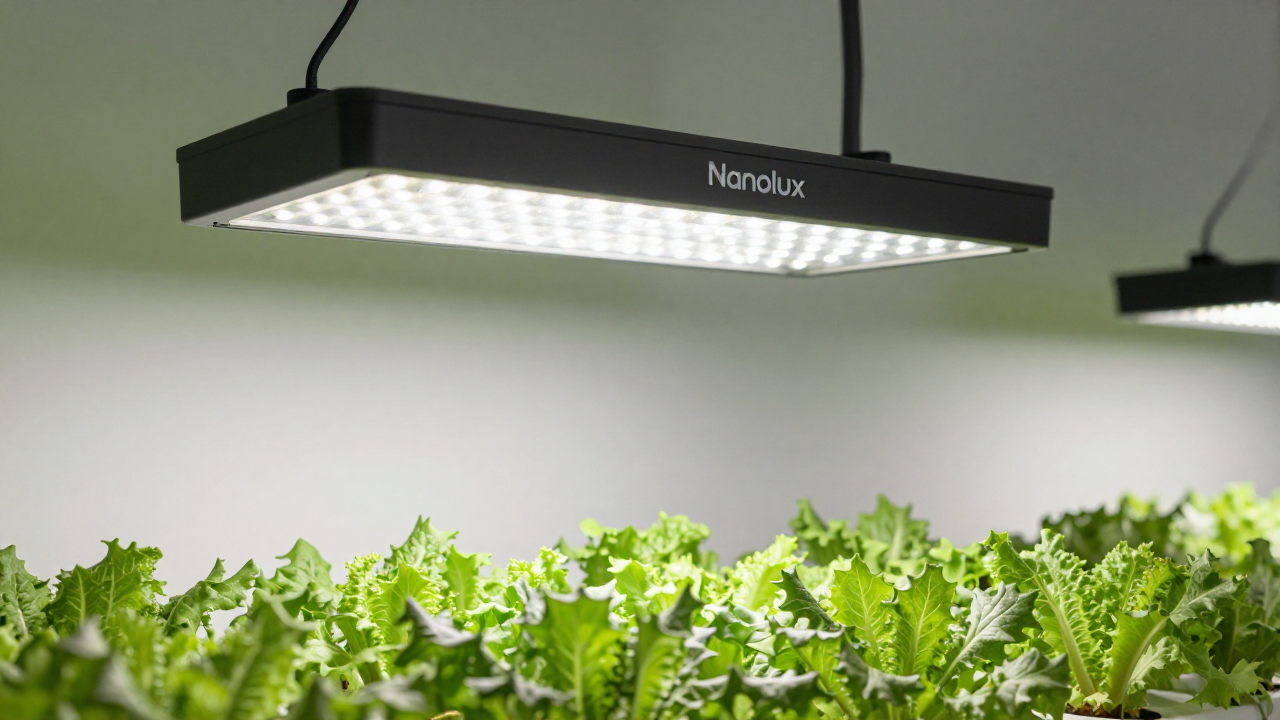
What Nobody Tells You About Spectrum When You’re Buying at Scale
Most buyers start their search by chasing “full spectrum white light” because it’s comfortable. You can see your plants, the staff doesn’t complain, and your Instagram photos look right. The problem? Outdoor sunlight changes spectra four times a day, and your static white LEDs won’t.
We tracked a 2022 project in an Arizona greenhouse where the crop manager insisted on 4000K fixtures end-to-end for leafy greens. Yield per square foot flatlined at about 82% of the target after two cycles. Digging into it, the blue:red ratio at the canopy was roughly 30% heavier in the blue region than what DLI-equivalent outdoor trials would suggest for that crop stage. Nobody’s fault—just a textbook case of ignoring how spectrum works as a growth signal, not just an energy source.
When you evaluate a fixture, don’t stop at “full spectrum” or CCT. You need the spectral power distribution chart and you need to map the peaks against what your cultivar actually uses. For most commercial leafy greens, a photon-weighted optimization in the 450nm (blue) and 660nm (red) bands, with enough green to push through the upper canopy, will outperform a generic 80 CRI white LED. For fruiting crops like tomatoes or cannabis, red dominance becomes non-negotiable during flowering. A typical commercial recipe we’ve seen deliver consistent results is a 3:1 red:blue ratio in the flowering zone, with white diodes blended in for scouting visibility.
That’s not magic. It’s photomorphogenesis, and every lighting manufacturer knows the vocabulary. What separates the serious ones is whether they can show you in-field PPFD uniformity at your target hanging height, not just the center-beam reading at 12 inches.
The Comparison You Actually Need (Without the Sales Fluff)
I’ve lost count of how many RFPs we’ve reviewed where the “LED vs. HPS” section was copy-pasted from a 2019 blog post. It’s 2025 now, and the assumptions that made HPS dominant ten years ago don’t hold in a facility designed for climate control and tight labor budgets. But LED isn’t automatically the answer either. Here’s a trimmed-down comparison that respects real-world cost of ownership.
You’ll notice I didn’t put “yield” in the table. That’s because yield follows light uniformity and environmental control—not just the light source itself. A well-cooled, uniform HPS room can still outperform a poorly laid-out LED installation that leaves hotspots and dark corners. In 2024, we audited a Michigan cannabis facility that switched from HPS to LEDs but left the same layout grid. They gained 10% on gram per watt but lost overall yield per room because the new beam angles created a 15% dip in PPFD at the edges of their rolling benches. The fix wasn’t a different light; it was a different layout and some under-canopy supplements.
That leads me to the decision tree I wish every procurement team had on the wall during the evaluation phase.
How to narrow down your options—a no-nonsense flow:
1. Identify your target DLI (Daily Light Integral) for each crop phase. If you don’t have that number, stop buying lights and talk to your agronomist.
2. Calculate required average PPFD from DLI = PPFD × (3600 × photoperiod) / 1,000,000.
3. Map your facility’s mounting height flexibility and bench configuration.
4. Short-list fixtures that can deliver that average PPFD with a uniformity ratio of 85% or better at your planned height, not just the peak reading.
5. Run HVAC calculations for each candidate: watts per fixture × 3.412 = BTU/hr. Overlay that on your cooling capacity.
6. Calculate three-year cost of ownership including bulb/unit replacements, energy, and estimated labor for maintenance.
7. If LED upfront cost is a hurdle, compare fixture layout density. Sometimes fewer high-output LEDs with good overlap beat many low-output units on total cost.
That seventh point saved a large-scale tomato greenhouse in Ohio about $40,000 in 2023—just by shifting from 400W fixtures on a 4×4 grid to 650W fixtures on a 5×5 grid while maintaining canopy-level PPFD.
Underrated Ways to Bleed Money After Installation
I’m going to list a few things that will trip up even a well-specified grow light system. None of this is rocket science, but I’ve seen these failures enough that they deserve a place in every buyer’s checklist.
I’ll admit, that last one is a pet peeve. We’ve had to fight suppliers on behalf of growers more times than I care to remember, and it’s never the diode that fails first—it’s always a $75 driver that takes down a $600 fixture.
2026 Won’t Wait—What’s Already Changing in Commercial Lighting
If 2020 to 2024 was the LED adoption wave, 2025 to 2028 is the optimization wave. Three trends are quietly reshaping how smart buyers spec out their next rack of commercial grow lights.
First, multi-layer and under-canopy lighting is moving from cannabis into leafy green and strawberry operations. A couple of big vertical farming companies have publicly shared data showing that adding low-profile, IP65-rated inter-canopy bars increased lower-leaf photosynthetic contribution by 18-25% in indeterminate tomato trials—without increasing top-light wattage. That changes how you calculate ROI because now you’re buying two types of fixtures, not one, but the yield bump can justify the added capital.
Second, networked spectrum control is inching out of the “nice to have” category. The ability to push far-red at end-of-day for stem elongation control, or to flash UV-B for secondary metabolite enhancement, is starting to appear in mid-tier commercial fixtures. It’s still early, and you need an operation disciplined enough to build recipes, not just wing it. However, facilities with a dedicated cultivation scientist are already leveraging this to differentiate product quality.
Third—and this one makes bean counters nervous—the cost gap between top-tier LED brands and budget imports is shrinking at the fixture level but growing at the facility level. A cheap light shipped from overseas might save you 20% on the invoice but cost you 5% in uniformity and another 8% in HVAC escalation over three years. Sophisticated buyers are starting to factor in “cost per uniform µmol delivered over five years” instead of just “cost per fixture.”
We launched Nanolux with that exact equation in mind back in 2004, when most of the industry was still arguing about magnetic vs. electronic ballasts. Back then, the conversation was about starting reliability and lamp life. Today’s conversation is about photosynthetic photon efficacy and control resolution. The tools changed, but the procurement discipline hasn’t: measure twice, test in your own environment, and if a supplier can’t hand you a detailed PPFD map for your exact room dimensions before you cut a check, walk away.
The growers who crush 2026 aren’t the ones with the flashiest lights—they’re the ones who treat their lighting purchase as a system engineering problem, not a shopping list. That means running the numbers on uniformity, heat, and spectrum as a single package. It sounds obvious when you write it down, yet every year we see multi-million-dollar indoor farms make the same avoidable mistakes because someone got seduced by a shiny catalog and a low upfront price. Don’t be that facility.
