Urban gardeners are playing Mozart for Monstera or using “plant translators” that turn bioelectric pulses into music, claiming to reveal plants’ “inner thoughts.” These ideas also connect to the logic of light, as plants respond to different light wavelengths for growth.
This attempt to forge a cross-species emotional bond is quintessentially human—a romantic longing to find a “soulful resonance” through melody with the silent botanical world.
However, if we peel back the fog of sentimentality and step into a cutting-edge laboratory, we find a reality that is perhaps less poetic but far more staggering: Plants do indeed “sense” their environment, but they are tone-deaf to music. The true conductor of their life is a “language of light”—a precise, almost mathematical “logic of light”—that humans have only recently begun to decode. This light-based communication between plants and their environment forms the foundation of their growth and survival, a system of signals far more complex than any auditory cues.
1. The Reality of “Hearing”: Physical Stress, Not Artistic Appreciation
Science does not deny that plants respond to sound, but the nature of this perception is far from “listening.”
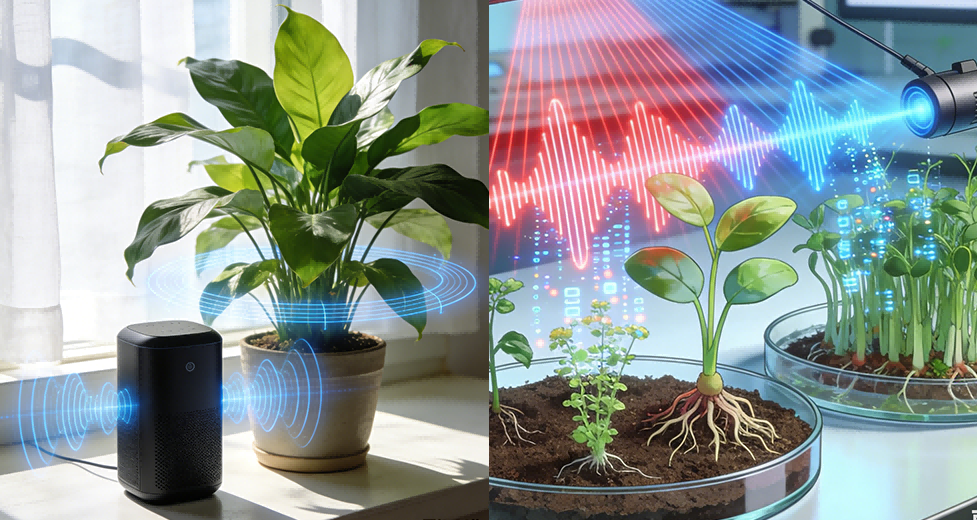
A breakthrough 2025 study using Optical Coherence Tomography (OCT) pulled back the curtain. When scientists subjected plants to low-frequency sound waves at 100 Hz, they observed a significant spike in internal biological activity—a phenomenon confirmed at the microscopic level in plants like arugula.
Even more telling, corn root tips have been observed growing toward specific sound frequencies—not because they are “fans” of the tone, but because that frequency perfectly mimics the vibration of flowing underground water. To a plant, sound is not a melody to be enjoyed; it is a physical probe critical for survival. Lacking a neural network to parse pitch or harmony, “musical yields” remain, in the eyes of rigorous science, a product of human wishful thinking.
2. Light: The Only “Logic Mother Tongue” in the Green World
If sound is a clumsy, one-way shout from humans to plants, then light is the “mother tongue” that plants understand and execute with pinpoint precision.
Plants have evolved a highly efficient “optical decoding system.” Take phytochromes as an example; they function like precision sensors installed within the cell:
- Environmental Surveillance: They are acutely sensitive to the ratio of red to far-red light. If the proportion of far-red light rises, the plant immediately realizes “a neighbor is blocking my sun” and triggers a “shade avoidance response,” rapidly elongating its stem.
- Growth Instructions: Research from the Chinese Academy of Sciences has clearly shown that red light activates specific phytochromes to protect the key protein BP, which in turn lowers the concentration of Abscisic Acid (ABA)—the “dormancy hormone.”
In short, light provides more than just energy; it acts as a real-time survival guide, commanding the plant when to wake up, when to flower, and how to avoid competition.
3. From “Illumination” to “Programming”: The Precision Light Recipe
The evolution of modern agriculture is, in essence, the evolution of our mastery over this “light language.” In today’s smart plant factories, we are no longer just providing “sunshine”; we are performing “spectral programming.”
In elite vertical strawberry farms, yields can reach dozens of times those of traditional soil farming. The core secret is the “Light Recipe”:
- Deep Red Light: Acts as a high-efficiency power source, directly driving photosynthetic rates.
- Deep Blue Light: Acts as a “morphological sculptor,” strengthening the plant and inducing the accumulation of nutrients like anthocyanins.
- Far-Red Light: Acts as a “biological alarm clock,” precisely regulating the ripening cycles of the fruit.
This spectral control allows crops to bypass seasonal limits, growing perfectly according to a logic set by human designers.
4. Laser Agriculture: The Era of “Point-to-Point” Dialogue
The quest for the language of light has not stopped at LEDs. In 2025, researchers from the University of Tokyo pushed laser technology to the agricultural front lines.
Unlike the relatively broad spectrum of LEDs, a 660nm laser can compress its spectral width to the absolute limit. This “pure” light hits the peak of chlorophyll absorption with zero waste from ineffective wavelengths. Experimental data shows that plants under laser illumination increase their net photosynthetic rate by nearly 20% compared to those under traditional LEDs.
This marks the transition of agriculture into an era of “precise dialogue”: using the purest light to achieve the most efficient harvest.
Conclusion
In the quiet, futuristic halls of a plant factory, the interlocking flickers of red and blue light are silent, yet they represent a profound second-by-second conversation with the crops.
Playing music for a plant is a sentimental gesture of human tenderness; “programming” a plant with light is a rational tribute to the laws of nature. Compared to a magnificent but unreachable symphony, a beam of precisely calculated light is the most effective “love letter” we can send to these green lives.