
What if you threw a massive marketing budget at a launch, flooded Instagram with polished ads, and still heard nothing but crickets? We’ve watched that happen to a well-funded indoor farm in Denver back in September 2023. They burned $80,000 in 45 days pushing a generic “full-spectrum” story, only to discover their core customer—a pragmatic greenhouse operator in Colorado—just wanted to talk to someone who understood DLI targets for winter lettuce. High-end rendering doesn’t move the needle if the spec sheet reads like a fairy tale.
That’s the core problem we need to crack: the commercial grow lights game in 2026 isn’t won by the loudest voice. It’s won by understanding why a head grower at a 5-acre facility in Michigan will switch from a brand they’ve trusted for a decade to a smaller player like Nanolux—or to your new brand.
Why is nobody talking about the actual light recipe that drives profit?
Most marketing stops at “full spectrum.” That’s like saying a restaurant serves “food.” The real conversation between commercial operators in California’s Salinas Valley right now focuses on a specific push for far-red radiation (700–750 nm). We’ve seen third-party lab testing where adding roughly 680 µmol/s of deep red and far-red in a 1:1 ratio triggered an early flowering response in photoperiod-sensitive crops without pushing up electrical costs disproportionately.
Ignore the physics, and you’re just selling a shiny box. We focus on a ratio we often spec for greenhouse supplemental lighting: a 650R spectrum. Removing wasteful green/yellow spikes concentrates electrical energy into the chlorophyll A and B peaks. It’s not magic. It’s just giving a plant what it actually processes. In an ecommerce setting, you can’t demo a photon over a Zoom call. So, you have to teach the buyer exactly what a beneficial spectrum looks like on paper, so they can look at a competitor’s spectral distribution chart and see the glaring inefficiency.
Why would a 20-year greenhouse veteran risk switching to me?
They won’t, unless you solve their very specific, unglamorous problem. Six months ago, I was on a call with a head grower in Oregon who was furious with his legacy HPS setup. His complaint wasn’t about energy—it was about Bract Edge Burn on his lettuce in the summer. The HPS heat was forcing him to irrigate aggressively, causing tip burn and a 12% loss in sellable yield. His electric bill was a secondary headache.
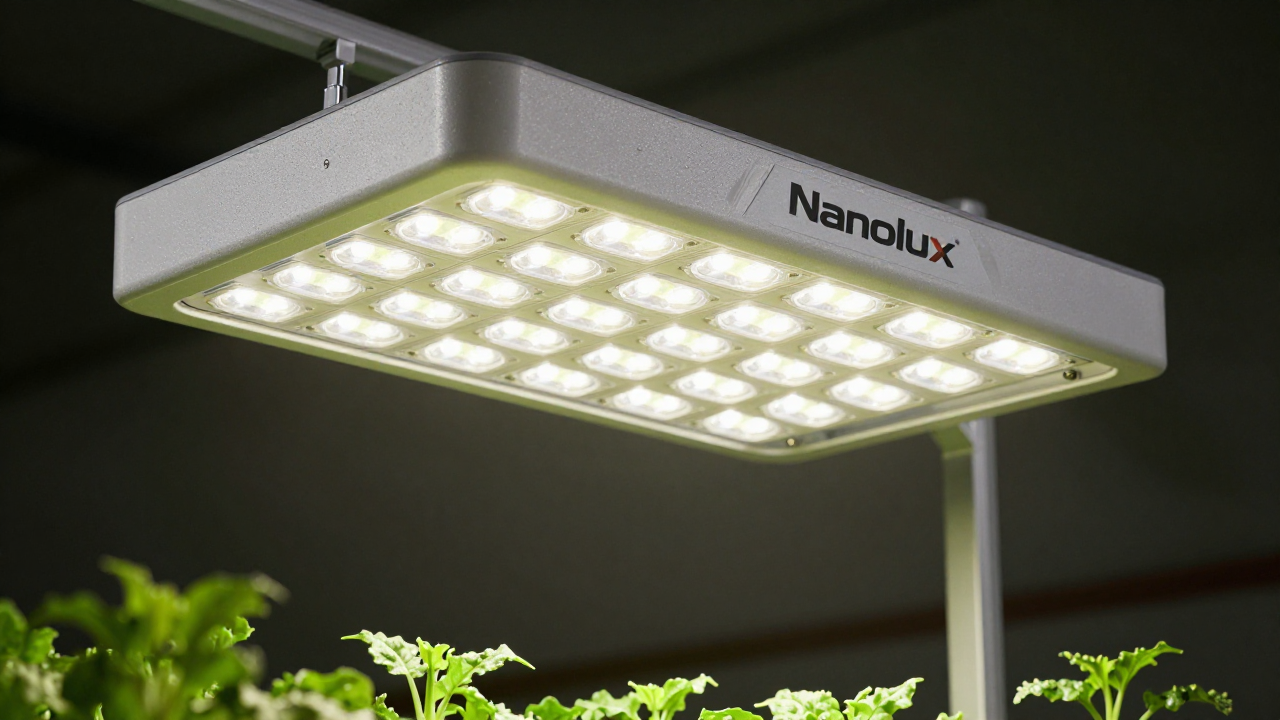
We didn’t pitch him a light. We showed him how removing the 1,500-BTU-per-fixture heat load by swapping 1,000W DE HPS to Nanolux 780W LEDs let the HVAC system stabilize VPD (Vapor Pressure Deficit). That solved the transpiration issue, which solved the tip burn. For a smaller brand, your sales narrative isn’t “LEDs save energy.” It’s “Stabilizing your nighttime humidity prevents botrytis.” You win by pivoting from fixture specs to plant physiology metrics no big-box competitor bothers to explain.
What specific numbers actually matter during a commercial grow light selection?
Skip the fluff. We tell our ecommerce partners to create a comparison matrix that looks exactly like the one a facility manager scribbles on a whiteboard. Here’s what that looks like, stripped down to the harsh math:
See that last point? That happened to us at a vertical farm in Columbus in mid-2022. The drivers were failing not because the diodes burned out, but because the conformal coating wasn’t spec’d for constant 85% RH. That $30 driver difference killed a $600 fixture. This granular pain is your selling ammunition.
How do we sell a complex system when we can’t afford a massive sales team?
Nobody trusts a faceless Amazon listing for a $20,000 lighting retrofit. In 2021, we realized that our best salespeople weren’t on payroll; they were the electricians installing the lights. Write this down: if you sell commercial grow lights, your content should be aimed at the installer, not just the CFO.
We started shipping a single printed, waterproof schematic with every pallet. Instead of a generic manual, it was a one-page wiring matrix for standard 240V and 277V three-phase panels, complete with the exact torque spec for the terminal block. It stopped the 3 a.m. panic calls. Additionally, we coached an installer in Arizona (a guy with 150,000 Instagram followers who just likes tinkering) on how to verify total harmonic distortion (THD) with a Fluke meter. That single video—a gritty, unedited clip inside a dusty electrical room—out-converted a $15,000 product commercial because it answered the question: “Will this trip my breakers?”
Your strategy for 2026 is to build a technical library for the trades. Answer the grimy, high-stakes questions that the big brand’s polished “knowledge base” avoids.
How can we stop the “LEDs are a commodity” price war before it starts?
The price war already exists at the bottom. If you’re selling a 600W bar light with Samsung LM301H diodes, you’re competing on cents per watt against a dozen generic brands. The defense isn’t a lower price; it’s a “pain of removal” so high that a farm can’t justify ripping it out.
We focus on building an ecosystem trap. At Nanolux, we pushed the Nexus controller not as a dimmer, but as a crop loss insurance policy. Picture a 2-acre tomato greenhouse in Pennsylvania in March 2024. A sudden snowstorm blocks the sun. Without a controller, the lights stay off, and DLI crashes. With a controller that triggers supplemental lights as soon as the ambient sensor drops below 150 µmol/m²/s, the grower saves two days of growth momentum. When you bundle lighting with an automated fail-safe, you’re no longer selling a fixture. You’re selling harvest predictability. A buyer might switch to a cheaper LED, but they won’t risk touching a control system that has never failed them.
What’s the future trend nobody is monetizing correctly in ecommerce?
Renewable energy coupling. We work with a cannabis micro-cultivator in Nevada whose entire margin gets eaten by peak demand charges from 10 a.m. to 4 p.m. The big talk in 2026 won’t be about the efficiency of the diode; it’ll be about the DC native architecture of the fixture.
Here’s the logic: solar panels produce direct current (DC). Batteries store DC. LEDs run on DC. Why are facilities inverting DC to AC, only to have the LED driver rectify it back to DC, losing 8–16% of energy in the conversion? We’re currently spec’ing low-voltage, DC-powered fixtures that connect directly to a site’s battery bank, skipping the AC infrastructure entirely for the lighting grid. If you’re launching a brand, claiming expertise in “DC grid integration for horticulture” instantly positions you five years ahead of anyone still shouting about PPE efficacy. Nobody is searching for that term yet, but the commercial-scale operators in California are already sketching it out on napkins.
Honestly, this is a niche within a niche, but that’s where the protection from commodity pricing lives. You don’t need to be the biggest. You just need to be the most specific solution to a problem that wakes someone up at 2 a.m.—whether it’s a snowstorm dropping the DLI, a 90% RH basement drowning drivers, or a utility peak charge burning a hole in the P&L. That’s how a Nanolux, or any smaller brand, stands tall.
