
The 4 a.m. Phone Call That Changes a Harvest
On December 14, 2025, at 4:07 a.m., a text message lit up my phone. It was Jan Visser, who runs a seven-acre greenhouse operation in Holland, Michigan. “Look at this,” he wrote, attaching a thermal image of his butterhead lettuce beds. The canopy temperature sat at a steady 64°F, the air heater had been off for two hours, and outside the glass the ambient temperature was scraping 8°F. All the heat was coming from the ceiling.
I called him back six hours later, when the sun was up and the panic of the overnight shift had faded. “We’re not growing lettuce anymore,” he said, only half-joking. “We’re growing photons. The plants don’t know it’s December. They only know what the meter tells them.” Visser had swapped his old 750-watt HPS rig for a dense grid of LED arrays in August 2024. Fifteen months later, his winter yield per square foot had crept within 7% of his May numbers.
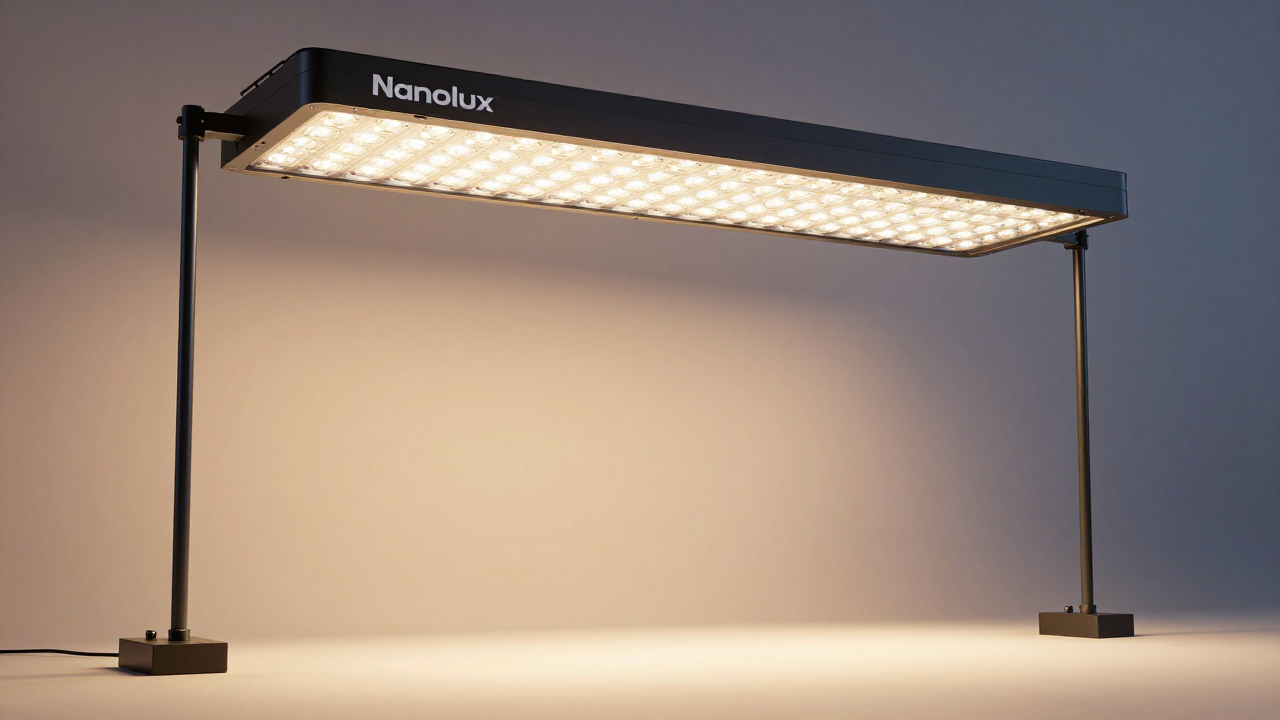
Ask any controlled-environment grower in the United States what changed the economics of their off-season production in the past three years, and you’ll hear the same two words: commercial grow lights. Not the blurple panels that flooded Amazon in 2017, not the repurposed warehouse high-bays. The industrial-grade systems shipping today—the ones that throw 1800 µmol/s of photosynthetic photon flux from a fixture that draws less than 650 watts—have rewritten the rules for what counts as a growing season.
What Actually Happens When You Add Light in Winter
The biology is not complicated, but the numbers are punishing if you get them wrong. A plant’s engine runs on daily light integral, or DLI. The formula sticks to the whiteboard of every head grower I know:
DLI = PPFD × (3600 × photoperiod hours) / 1,000,000
In a New England greenhouse in January, with eight hours of weak sun and an ambient PPFD that might barely kiss 200 µmol/m²/s at noon, your natural DLI sinks to 6 or 7 mol/m²/day. A tomato plant wants 25 to 30 mol/m²/day to set fruit properly. A cannabis canopy in week four of flower can demand 40. That deficit—20 or 30 mols of missing light—is exactly where commercial grow lights earn their keep.
We’ve measured this up close. In a trial we ran alongside a New York vertical farmer in November 2023, supplementing a winter greenhouse with LED fixtures that maintained a canopy-level PPFD of 800 µmol/m²/s for 16 hours pushed the daily DLI from a useless 6.2 mol/m²/day to a productive 29.4. Basil cycles that had been stretching to 35 days in December dropped back to 22 days. The numbers are almost boring, once you trust the sensor.
Frankly, the math isn’t the hard part; making the heat go away is.
The $0.03 per kWh Mistake
Nobody wants to talk about the dead fixtures collecting dust in the back corner of every commercial nursery, but I see them everywhere. The industry burned through a lot of cash between 2018 and 2022 chasing the wrong numbers on spec sheets.
The split between LED and HPS is not a holy war. It’s a heat management problem with a wattage budget. The table below is the one I send to growers who are still on the fence, because it cuts through the marketing noise with the three parameters that actually move their P&L:
*Calculated at $0.12/kWh, 12 hours daily, 365 days. Actual rates vary sharply by state.
There’s a $215 per fixture per year gap hiding in that column. Multiply it by 400 fixtures and you are looking at $86,000 in annual operating savings before you even account for bulb replacements or the reduced HVAC load. In California’s Central Valley, where time-of-use rates can surge past $0.24/kWh, the payback window collapses to under 20 months. In the Pacific Northwest, where industrial rates hover near $0.08/kWh, you need three years. Place matters more than the fixture catalog number.
Does this mean HPS is dead? For high-wire crops like indeterminate tomatoes that need blistering heat and deep canopy penetration, a well-designed double-ended HPS rig still punches above its weight. We tell growers that upfront. The mistake is putting HPS over a low-profile crop like baby kale and wondering why your electric bill looks like a mortgage payment.
A New Jersey Greenhouse’s Electric Bill Told the Real Story
In February 2023, I spent a morning at a two-acre leafy greens operation in Vineland, New Jersey. The owner, a third-generation farmer named Rick DeMarco, had just ripped out 400 double-ended HPS fixtures and replaced them with LED arrays. We stood in his packing shed while he pulled up the utility portal on a dusty laptop.
January 2024: $3,840. January 2022 (the last full month with the old HPS system): $9,220. Same acreage. Same crop mix. The conversation stopped for a solid five seconds while we both stared at the screen. “I had my accountant check it three times,” DeMarco said. “He thought we’d been double-billed the year before.”
That’s the kind of story that rarely makes it into a press release, because it sounds too neat. But I took a photo of the Excel file. I’ve shown it to at least a dozen growers since then, usually on my phone, usually after they’ve just finished telling me that LEDs “can’t possibly pay back that fast.” The math works when you stop treating a grow light as a commodity bulb and start treating it as the primary driver of your winter revenue.
Why Your First Fixture Purchase Could Still Fail
I’m going to take a quick detour here, because this part matters more than the spec sheets. In September 2019, a high-tech vertical farm in Chicago reached out in a panic. Their new LED installation—not ours, I should clarify—was bleaching the tips of their arugula. The plants weren’t growing; they were shrinking, losing weight day over day. The vendor had specced a spectrum heavy in blue wavelengths to keep internodes compact, but without any supplemental far-red in the 730nm range, the stomatal conductance collapsed. The crop was suffocating in a silent, high-tech box.
We ended up retrofitting half the farm with fixtures that included a tunable far-red channel and rewrote the photoperiod schedule. The weekly losses—$3,200 according to their harvest logs—stopped within ten days. That episode taught me something that should be printed on every shipping crate: spectrum isn’t a feature, it’s a steering wheel. You cannot treat a lettuce head the way you treat a flowering vine, and you cannot trust a “full spectrum” label unless you’ve seen the spectral power distribution chart with your own eyes.
Another thing that trips up new adopters: fixture spacing. I walked a hydroponic tomato greenhouse in Arizona in March 2024 where the owner had installed high-output LEDs at a center-to-center spacing of 6 feet, exactly as the manufacturer recommended. But at the canopy edge, PPFD was dropping below 400 µmol/m²/s. The plants on the fringes ripened two weeks later than the center rows. We tightened the grid to 4.5 feet, added under-canopy bars, and the uniformity problem disappeared. An extra $7,000 in up-front hardware saved a $40,000 seasonal yield gap.
These are the quiet failure modes that never make it into a blog post. The fixtures work. The planning doesn’t always.
Smart Lights, Dumber Grids
I was on a call last month with a demand-response program manager from Southern California Edison, and she said something that made me pause the conversation. “Greenhouse loads are too predictable,” she told me. “We can forecast a 40-acre tomato grow’s lighting draw down to the minute, and that scares off the renewable energy investors who want volatility to arbitrage.” The irony is thick: the very stability that makes controlled-environment agriculture attractive to a banker makes it boring to a grid operator running a real-time energy market.
This is where the next iteration of commercial grow lights gets interesting. The protocol isn’t just about turning lights on and off. We’ve been testing a system with a lettuce grower in Yuma, Arizona, where the fixtures auto-dim in response to a rooftop pyranometer. On a cloudless January afternoon, when Arizona’s winter sun pushes the greenhouse DLI to 18 mol/m²/day by 2 p.m., the LED array throttles down to 30% output for the final four hours of the photoperiod. First-quarter data showed an 18% drop in energy consumption against the fixed-schedule control group, with zero statistically significant difference in head weight at harvest.
The hardware exists. The software is maturing. The bottleneck in 2026 is going to be the human layer—the head growers who have spent twenty years trusting a timer clock more than a sensor, and the utility rate structures that still don’t reward a farm for shedding 200 kilowatts at exactly 4:30 p.m. when the grid is sweating.
The Unanswered Question for 2026
A plant physiologist I’ve known for years—we shared a stale coffee at the 2025 Indoor Ag-Con in Las Vegas—summed up the state of the technology in a sentence I haven’t stopped thinking about. “We’ve optimized the photon,” he said. “The next frontier is the signal. Using light not as fuel but as a trigger—dialing in secondary metabolite production, pest resistance, even flavor profile—that’s what moves the needle on margin.”
2026 might be the year a commercial cultivator in Salinas or a greenhouse complex in Ohio proves that concept at scale. Or it might be the year the diode supply chain, still concentrated among a handful of Asian manufacturers, gets squeezed by trade policy and sends fixture prices spiking again. The growers who’ll win are the ones who aren’t waiting for a perfect answer—they’re running their own side-by-side trials, logging their own kWh data, and using the dimmer switches as aggressively as they use fertilizer injectors.
The season, it turns out, doesn’t end when the sunset says it does. Someone just has to pay the electric bill.
