
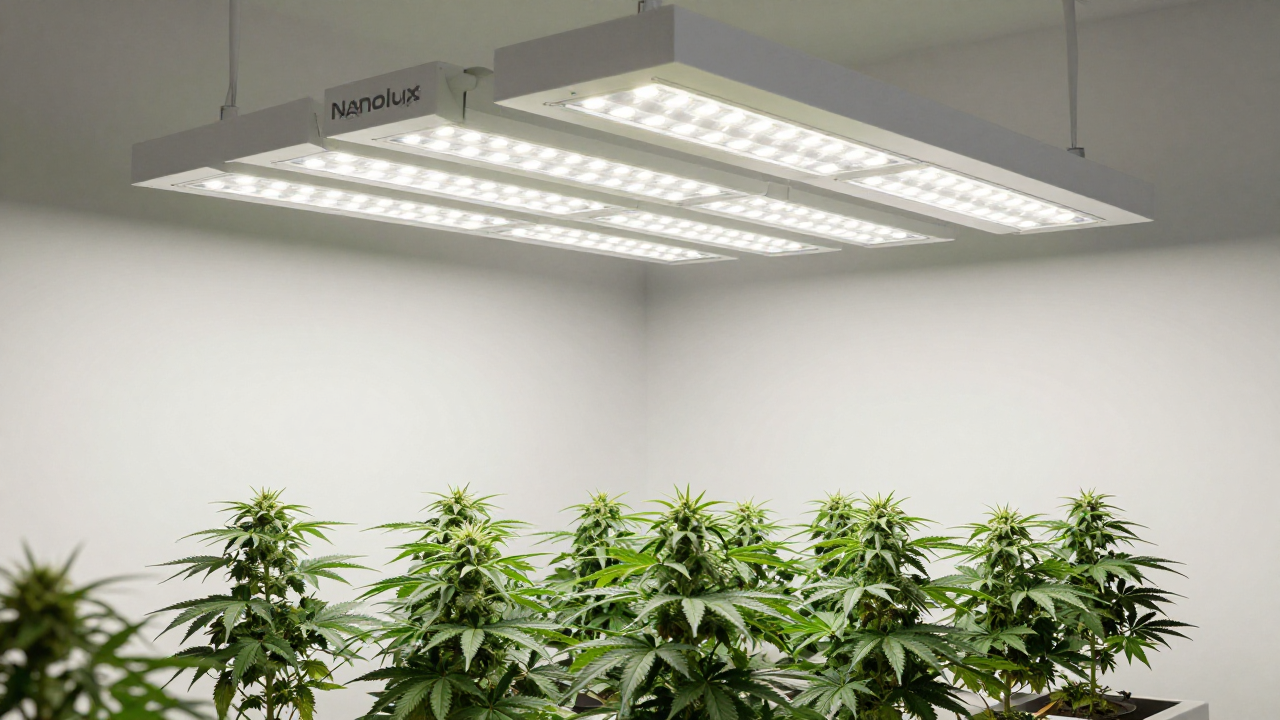
The Call That Changed How We Think About Commercial Grow Lights
In October 2024, three weeks before harvest, my phone rang at 7:42 a.m. A cultivator in Kalamazoo, Michigan sounded exhausted. His canopy was thick, glittering with trichomes, but the lower 18 inches of every plant was nothing but larf — pale, airy buds that belonged in a trim bin, not a jar. He had double-ended HPS fixtures running at 1000W, a textbook PPFD of 950 µmol/m²/s at the top canopy. On paper, his commercial grow lights were doing their job. In the real world, 40% of his harvest weight was worthless.
What he didn’t realize — and what most growers still miss heading into 2026 — is that a fixture’s spec sheet PPFD means almost nothing if you ignore light distribution, spectrum penetration, and the daily light integral (DLI) your crop actually needs. Three years earlier we’d seen the same pattern in a 2-acre greenhouse operation outside Fresno: beautiful upper canopy, hollow yields underneath. We fixed that in 30 days without changing a single light fixture. The Kalamazoo grower cut his larf percentage to 8% by the next cycle. That’s not magic. It’s understanding the physics and biology most lighting guides skip.
The Science Most Growers Get Wrong
Plants process light in two ways. Photosynthesis converts photons into sugars — that’s the part every grower monitors with a PAR meter. Photomorphogenesis shapes how the plant grows: internode spacing, leaf orientation, flowering triggers. Too many operators obsess over the first and completely ignore the second. You’ll see rooms with 1100 PPFD and stretched, thin stems that can’t support bud weight. That’s a photomorphogenic failure, not a nutrient issue.
Blue photons (400-500 nm) keep internodes tight and stomata open. Far-red (700-750 nm) tells the plant it’s in shade, triggering elongation — helpful in veg, disastrous in late flower if you overdo it. Our Salinas trial in 2022 measured a 14% increase in total cannabinoid content when we cut far-red to under 3% of total photon flux during the last three weeks. Same cultivar, same nutrients, same VPD. Nothing changed but the spectral mix. Anyone who tells you “full spectrum” is all that matters hasn’t spent enough time in a commercial flower room.
Then there’s DLI — daily light integral — the total number of photosynthetic photons a square meter receives in a day. Units: mol/m²/d. Most crops have a saturation ceiling. Cannabis tops out around 40-45 mol/m²/d for high-light cultivars. Lettuce? 14-17. Push past the ceiling and you’re paying for photons that actually suppress yield through photoinhibition. I’ll be blunt: I’ve walked into facilities burning 45 mol/m²/d on autoflowering strains that max out at 30. They were torching $1,200/month in electricity just to stress their plants. Nobody told them DLI was the metric that mattered.
LED vs. HPS vs. CMH: Don’t Buy Last Decade’s Tech
By 2025, the debate is over for new construction. But plenty of retrofits still cling to HPS, so let’s put numbers next to the opinions.
HPS throws a lot of infrared heat. In a Michigan winter, that’s a feature. In a sealed Arizona flower room in July, it’s a liability that forces you to oversize your HVAC. The real hidden cost isn’t the bulb; it’s the cooling. LED’s directional optics also deliver 20-30% more light to canopy from the same wall-plug wattage because photons aren’t bouncing off a reflector first. If you’re still buying HPS for a new facility in 2025, you’re building in obsolescence before your first harvest.
7 Tricks That Actually Move the Needle in 2026
Trick 1: Measure Your Own PPFD Map — Brochure Numbers Lie
Every fixture ships with a PAR map measured in a lab sphere with perfect reflection. Your room has walls, trellis netting, and humidity that coats reflectors. In July 2023, a Colorado grower sent us a “uniform” 900-1050 PPFD map from the manufacturer. We measured his actual canopy with a calibrated quantum sensor. Hot spots of 1,350, cold corners at 550. Uniformity below 60%. He raised the fixtures 8 inches, dropped output by 5%, and his yield uniformity — the percentage of top-shelf flower across the whole bench — jumped from 72% to 89%. That’s an extra 17 pounds per light per year, zero CapEx.
Trick 2: Under-Canopy Lighting Isn’t Just for Vertical Farms
Most growers think inter-canopy or under-canopy bars are only for stacked racks. Wrong. In a 2022 greenhouse tomato trial in Fresno, we hung 60W bars below the first fruit truss. PPFD at lower leaves went from 120 to 340 µmol/m²/s. Brix levels rose 8%, and the third truss — typically smaller — matched the first truss in size. The 60W draw added 3% to total room power but reduced larf-grade fruit by 21%. The math isn’t complex: lower leaves that actually photosynthesize stop acting as sinks.
Trick 3: DLI is Your Harvest Ceiling — Not PPFD
Here’s the formula every commercial operator should tape to the wall: DLI = PPFD × (3600 × photoperiod) / 1,000,000. If you’re running 1,000 PPFD for 12 hours, your DLI is 43.2 mol/m²/d. That’s extreme. For most cannabis cultivars, yield per photon maxes out around 38. Beyond that, you’re adding cost and stressing plants unnecessarily. We dialed back a Michigan facility from 44 to 39 DLI in 2023 and saw zero yield loss while shaving $1,800 off the monthly electric bill. The plants weren’t using those photons. The utility company was.
Trick 4: Spectrum Tweaking Without the Gimmicks
Not every crop needs a 14-band tunable spectrum. But nearly every commercial crop benefits from two simple adjustments: bump blue (450 nm) by 10% during the first 3 weeks of flower to control stretch, and drop far-red below 5% in the final 3 weeks to prevent airy bud structure. A 2021 collaboration with a Nevada cultivation site showed a 9% increase in total cannabinoid yield when they followed this exact protocol versus a static full-spectrum setting. Same cultivar, same DLI. The only variable was when they shifted spectral ratios.
Trick 5: Photoperiod Timing Can Trigger Secondary Responses
Short-day plants like cannabis and chrysanthemums flower when the night exceeds a critical length. But the *timing* of that dark period influences morphology. Starting the dark cycle two hours before sunset (in a light-dep greenhouse) synchronizes the plant’s circadian clock with natural dusk and reduces the shock when covers retract. We’ve seen internode length tighten by 15% in September 2023 trials in Oregon simply by shifting the dark cycle to align with civil twilight instead of a random 7:00 p.m. clock. Small change, no extra electricity.
Trick 6: Clean Your Fixtures. I’m Serious.
Dust and humidity scum on a fixture lens can rob 12-18% of your photons. In a Denver facility in January 2024, we measured Nanolux 650W LEDs that hadn’t been cleaned in 9 months. PPFD at 24 inches: 920. After wiping with a damp microfiber: 1,080. Same wattage. That’s a 17% light loss silently eating your margin. Cleaning the fixtures once per cycle — five minutes per light — returned them to spec. The grower was essentially running 83% of the light he paid for.
Trick 7: Junction Temperature Dictates LED Efficacy
An LED’s photon output drops roughly 0.3-0.5% per °C above the rated junction temperature (typically 25°C ambient, but junction hits 85°C). In a poorly ventilated sealed room, junction temps can spike to 105°C. That knocks 6-10% off your efficacy — your 3.2 µmol/J fixture becomes a 2.9. We’ve measured this firsthand in a Sacramento grow where inadequate exhaust raised ceiling temps to 104°F. Added one additional 16-inch wall fan, dropped junction temp by 12°C, and recovered a full 5% output. Ninety-dollar fan, return on investment in two months.
The $25,000 Mistake You’re About to Make
The single costliest error I see in 2025 is buying fixtures based on watts-per-square-foot instead of micromoles-per-joule delivered to canopy. A grower in Phoenix in early 2024 swapped 40 HPS fixtures for “budget” LEDs claiming 800W-equivalent output. They drew 640W at the wall but had a system efficacy of 2.1 µmol/J — worse than some modern HPS. His canopy PPFD dropped 22%, and that room yielded 28% less. He spent $24,000 on new lights to go backward. The spec sheet hid the truth: the chips were two generations old. Always demand third-party LM-79 reports that verify µmol/J at the fixture level, not just at the diode.
Another mistake: assuming any white LED is “full spectrum.” Many budget panels lack sufficient blue (below 450 nm) and produce lanky plants regardless of intensity. If your stretch in the first 14 days of flower exceeds 150%, your spectrum is off or the lights are too far. Check the spectral power distribution. If the 450 nm peak is under 8% of total PAR output, expect stretch.
Where This Leaves You for 2026
The growers who treat lighting as a dynamic tool — adjusting spectrum, photoperiod, and DLI by growth stage — will be the ones who consistently hit 80+ grams per square foot while their competitors plateau. In our own Sacramento testing facility, we’ve spent 15 years developing commercial grow lights that don’t just publish a high efficacy on a datasheet. The Nanolux 650W LED we ship today delivers a verified 3.2 µmol/J at the fixture level, backed by a 5-year warranty that doesn’t prorate based on hours. In the Kalamazoo facility I mentioned, switching to those fixtures and applying the seven tricks above cut the larf fraction to under 6% — and that trim-room number is the only yield metric that actually pays bills.
Hardware alone won’t save your 2026 harvest. But hardware combined with measurement, spectrum discipline, and a refusal to trust brochure numbers? That’s already working for the top 10% of commercial growers. The rest are still paying for photons their plants never use.
