
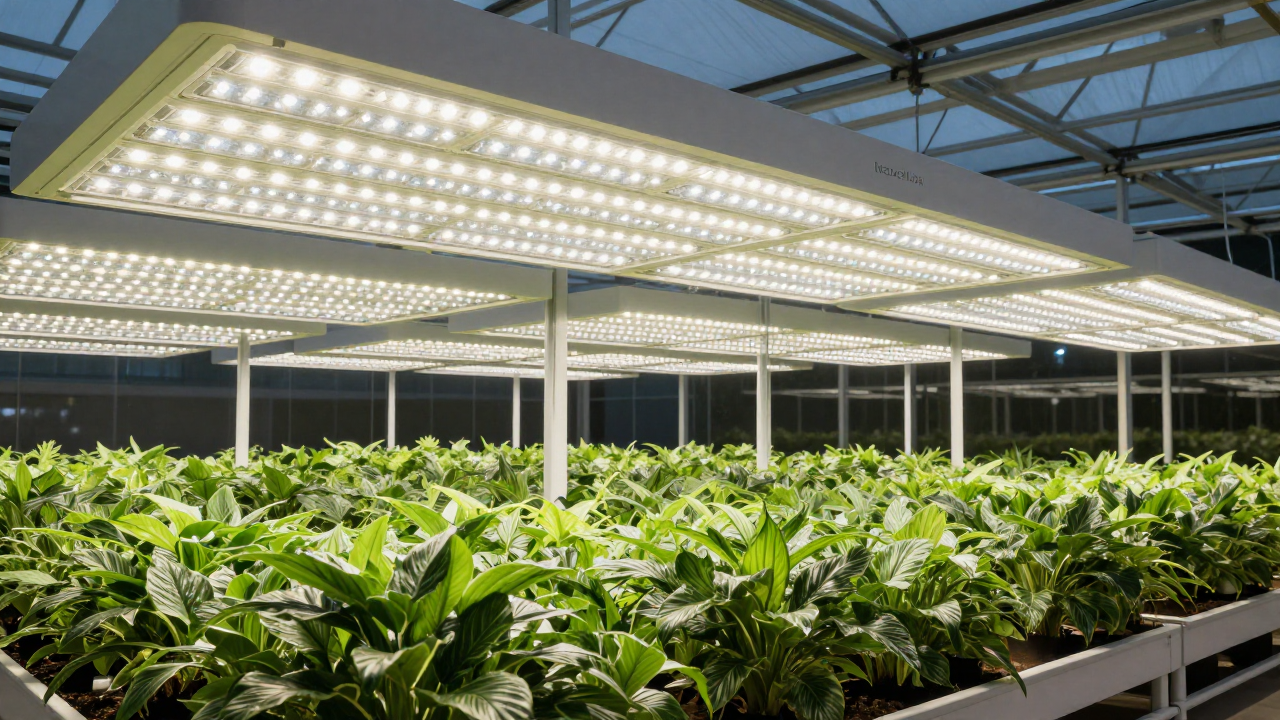
The Efficiency Trap: Why Most Operations Bleed Cash on Lighting
Commercial grow lights are simultaneously the most critical infrastructure decision you’ll make and the one where the industry still operates on folklore. Spend five minutes on cultivation forums and you’ll find growers arguing about spectrum like it’s a religious schism while their power bills quietly destroy their margins. Here’s what twenty-two years of watching this industry evolve has taught us: most facilities aren’t losing money because they bought cheap lights. They’re losing money because they bought expensive lights they don’t know how to use.
Industry data from controlled-environment agriculture facilities shows that lighting typically accounts for 35-45% of total operational energy consumption. In a 50,000-square-foot indoor cultivation facility running on the West Coast grid, that translates to roughly $180,000-$220,000 annually at current California commercial electricity rates of $0.18-$0.22 per kWh. The numbers get uglier in the Northeast, where rates climb past $0.25.
The real problem isn’t the technology. It’s that growers have learned to optimize production, but almost no one has figured out the commercial side. I sat in a meeting in Denver in February 2025 where a facility manager proudly showed me his 3.2-gram-per-watt yield numbers. When I asked his cost per gram, the room went quiet. He’d never calculated it. This isn’t rare—it’s the norm.
Let’s look at what’s actually happening under the canopy. A typical full-cycle indoor facility runs 18-hour veg and 12-hour flower photoperiods. At 800 watts per fixture across 200 fixtures, that’s 160 kW of load during flower. Over a 63-day cycle, you’re looking at roughly 120,960 kWh just for the top lighting layer. At national average commercial rates, that’s about $16,000 per cycle just to keep the lights on. Per room.
—
Not All Photons Are Created Equal
The commercial grow light market has consolidated around three technologies: high-pressure sodium (HPS), ceramic metal halide (CMH), and light-emitting diode (LED). Each has defenders who will argue until they’re hoarse. Here’s what the numbers actually say when you strip away the marketing.
The efficacy gap has widened enough that the economics are now one-directional for new builds. But here’s the mistake I see operators make constantly: they retrofit LED into rooms designed for HPS and expect magic. LED fixtures distribute light differently—narrower beam angles, less infrared radiation, different thermal profiles. Swap the lights without adjusting your environmental controls, and you’ll chase deficiencies that have nothing to do with the fixture and everything to do with the system.
We saw this play out at a facility in Michigan’s Upper Peninsula in January 2023. The grower replaced 150 DE HPS fixtures with LED units rated at identical PPF output. Leaf surface temperature dropped 4-6°F because LEDs emit almost no infrared. The plants slowed their transpiration, nutrient uptake tanked, and the grower blamed the lights. Actual problem: the room temperature needed to run 5-7°F warmer to maintain the same leaf surface temperature. Simple thermodynamics, but it cost them a full cycle to figure out.
—
DLI Is the Only Metric That Pays the Bills
Photosynthetic photon flux density (PPFD) gets all the attention. Manufacturers print it on spec sheets. Growers obsess over it. But PPFD is an instantaneous measurement—it tells you intensity at a single point in time. It doesn’t tell you what the plant actually accumulated over the photoperiod.
Daily Light Integral (DLI) is what matters, and I’ll die on that hill. DLI represents the total number of photosynthetically active photons that land on one square meter over 24 hours. The formula is straightforward:
DLI = PPFD × (3600 × photoperiod hours) ÷ 1,000,000
A canopy receiving 800 µmol/m²/s for 12 hours accumulates a DLI of 34.6 mol/m²/day. Push that to 1,000 µmol/m²/s and you hit 43.2. The difference changes everything about how the plant allocates resources.
Here’s where the commercial math gets sharp. Adding 200 µmol/m²/s typically requires either more fixtures, higher wattage per fixture, or dropping the lights closer to canopy. More fixtures mean more capital expenditure. Higher wattage means higher operational expenditure. Dropping lights closer means more frequent height adjustments or risk of photobleaching.
The third-party testing we’ve commissioned at partner facilities shows that most high-light cultivars plateau in yield response around 40-42 DLI under ambient CO2. Push past that without supplemental CO2 at 1,200-1,400 ppm, and you’re burning electricity for diminishing returns. One facility in Southern Oregon ran a controlled trial across four identical flower rooms at 38, 42, 46, and 50 DLI respectively in Q3 2024. The 50 DLI room produced 3% more dry weight than the 42 DLI room but consumed 23% more lighting energy. Their cost of production actually rose.
That’s the commercial side nobody talks about. More light can mean less profit.
—
What Manufacturers Don’t Want You to Ask About Spectrum
Spectrum is the least understood and most aggressively marketed feature in commercial grow lights. You’ll hear about “full spectrum,” “broad white,” “enhanced red,” and a dozen proprietary ratios. Most of it is noise.
Here’s what twenty-plus years of commercial growing has shown, backed by the published work coming out of institutions like Wageningen University’s greenhouse horticulture group: the fundamental driver of photosynthesis is the ratio of active photons, not the shape of the spectrum curve. Blue photons (400-500 nm) drive stomatal opening and compact morphology. Red photons (600-700 nm) drive photosynthetic efficiency and flowering responses. Green photons (500-600 nm) penetrate deeper into the canopy than either—contrary to the myth that plants “don’t use green light.”
A white-LED-based spectrum with roughly 15-20% blue, 30-35% green, and 45-50% red consistently delivers commercial results within 3-5% of any exotic spectral recipe. For 95% of commercial facilities, chasing the last 5% with premium-priced specialty spectrum fixtures is a losing commercial decision.
The exception is when you’re manipulating morphology for specific operational goals. A facility in Salinas, California switched their propagation room to a spectrum heavy in blue (25% blue fraction) in September 2024. They reduced internode length by roughly 18%, which let them hold transplants an extra 4-5 days without stretching issues. That operational flexibility was worth more than any marginal yield gain.
Write this down somewhere: spectrum fine-tuning is an optimization lever for facilities that have already mastered their environment, genetics, and irrigation. It is not where you start.
—
The Integration Problem Nobody’s Solving
The commercial grow light industry has a dirty secret. Most “smart” lighting systems don’t talk to anything except their own controller. Your lights are on one platform, your irrigation on another, your HVAC on a third, and your environmental sensors on a fourth. The grower becomes the integration layer, and that’s expensive.
A facility manager at a multi-state operation told me in April 2025 that he spends roughly eight hours per week just cross-referencing data from four different control systems. He’s paid $85,000 a year. Do the math on what that integration gap costs across 12 facilities.
The facilities getting this right are the ones treating lighting as part of a unified control strategy. When your LED system dims automatically in response to a spike in greenhouse solar radiation because it’s reading the same PAR sensor as your shade curtain controller, you’re capturing efficiency that isolated systems can’t touch.
We’ve been working on this problem since 2019, and honestly, the industry’s still five years from where it needs to be. The growers innovating fastest are the ones who’ve stopped waiting for manufacturers to solve interoperability and started building their own integration stacks with off-the-shelf industrial automation components.
—
My 2026 Predictions (Some Will Age Poorly)
I’ll stand by these:
LED will own 85%+ of new commercial installations by end of 2026. The economics have tipped past the point of debate. HPS isn’t dead—it’ll hang on in retrofit-averse operations and certain greenhouse supplemental roles—but it’s officially a legacy technology for indoor cultivation.
Under-canopy lighting goes from experimental to standard in high-density indoor facilities within eighteen months. The yield data from multi-layer canopy strategies is too compelling to ignore, especially in facilities paying premium power rates.
The real fight in 2026-2027 won’t be about hardware. It’ll be about software and control integration. The companies that figure out true multi-vendor interoperability will capture disproportionate market share because they’ll solve the actual pain point: labor cost and decision latency.
Spectrum-as-a-service models will emerge. Instead of buying a fixed-spectrum fixture, some operations will lease lighting with programmable spectral output that shifts by growth phase. The economics only work for large facilities today, but the trajectory is clear.
The grower who wins in 2026 isn’t the one with the most expensive lights or the most exotic spectrum. It’s the one who treats lighting as a financial instrument—a cost center to be optimized, not a religion to be defended. Optimize for DLI first, control your environment second, and worry about spectral fine-tuning a distant third.
If your lighting decision starts with a spec sheet instead of a power bill and a yield target, you’re already doing it backward.
