
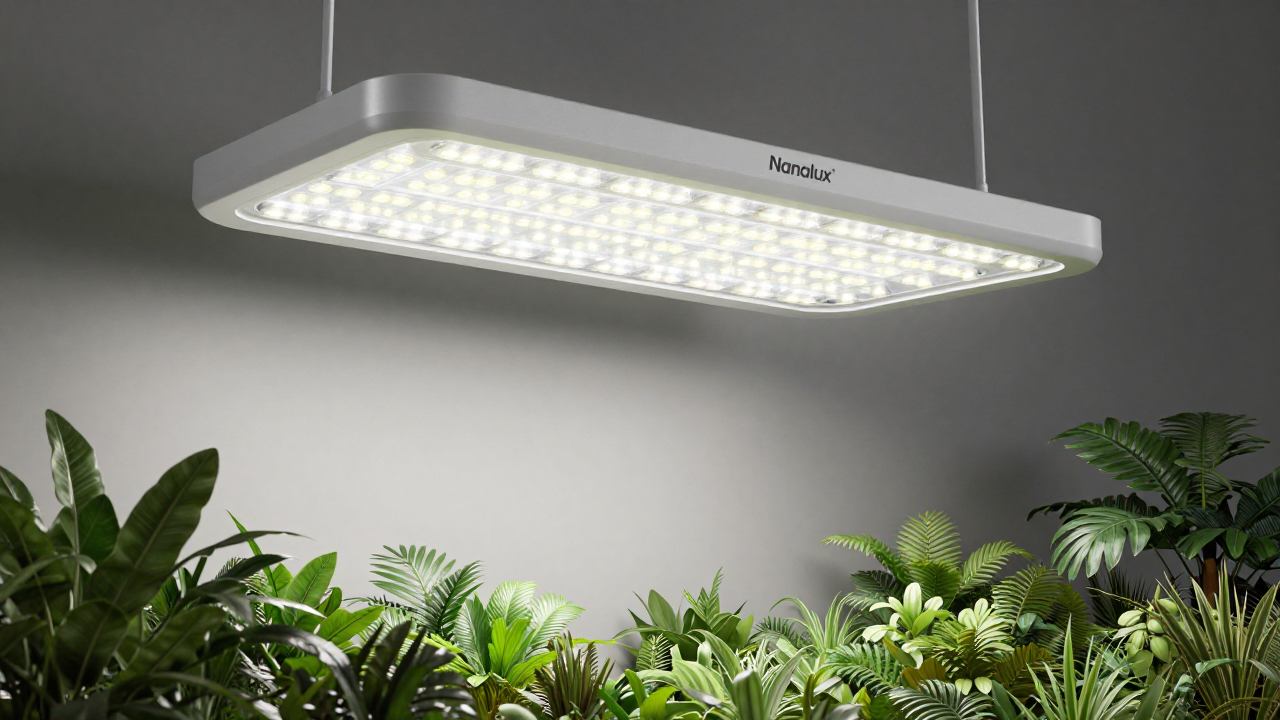
Stop Shopping by Wattage — Start Thinking in Photons
Walk into any grow store in Fresno or Grand Rapids and the first question you’ll get is “how many watts?” That question has been obsolete for five years, yet it’s still the default opener in 2026. Watts tell you what comes out of the wall. They tell you nothing about what hits the leaf.
A commercial grow light is a photon delivery system. Period. How efficiently it converts electrons into photosynthetically active photons — that’s the game. We measure this as photosynthetic photon efficacy (PPE), expressed in µmol/J (micromoles per joule). Back in 2020, a solid white-spectrum LED fixture might deliver 2.6 µmol/J. By late 2025, third-party lab tests across multiple top-tier fixtures were clocking 3.2 to 3.6 µmol/J range — and that delta is where your margin lives. On a 500-fixture greenhouse, 3.6 vs 2.8 µmol/J can swing annual electricity costs by enough to fund a full-time grower salary.
The other spec that gets buried in glossy brochures: PPFD uniformity. You can have a light that hits 1500 µmol/m²/s dead center and drops to 400 in the corners. That’s a canopy nightmare — uneven ripening, staggered harvest windows, labor scheduling chaos. What you actually want is a fixture that maintains ±10% uniformity across your defined footprint. Ask for the PPFD map before you ask for the price. If the manufacturer won’t give you one measured by an independent lab (not their own testing room), walk.
There are also two camps emerging in 2026: broad-spectrum white (think 4000K with supplemented 660nm red) vs narrow-band targeted spectra. Neither is universally superior. For cannabis flower, a white-heavy spectrum with elevated red consistently yields better terpene profiles in blind panel testing. For leafy greens and microgreens, narrow-band red/blue ratios tuned around 4:1 push vegetative biomass faster. The mistake is buying whatever spectrum the sales rep has in stock and retrofitting your crop to match.
Here’s a quick reference table we use with new facility planners to frame the conversation before they spend a dime:
“These LEDs Last Ten Years” — No, They Don’t
The single most expensive lie circulating in 2026 is that commercial LED fixtures are buy-once-cry-once assets. They degrade. The diodes, the drivers, the thermal management — all three have finite lifespans, and they degrade at different rates depending on operating environment.
L90 is the number that matters. It’s the hours until photon output drops to 90% of initial rating. A well-built fixture with quality mid-power diodes and proper thermal design will typically hit L90 around 25,000–36,000 hours under normal greenhouse conditions. That’s roughly 5 to 7 years of 12-hour photoperiods. After that, you’re losing 1–2% output per year, which compounds into yield loss that’s invisible until you benchmark.
We saw this play out in September 2023 at a multi-tier vertical farm in Phoenix, Arizona. Facility manager Santiago noticed his butterhead lettuce was lagging in a specific rack — 14% lower fresh weight at harvest vs the rack next to it. Ambient conditions checked out. Nutrient solution identical. Turned out the LEDs on the underperforming rack had crossed 30,000 operating hours and the thermal paste on the PCB-to-heatsink interface had dried out, causing junction temperatures to spike 15°C above spec. The diodes were still “lit” but photon output had dropped below the crop’s daily light integral threshold. Replacement wasn’t optional — it was overdue by six months.
What does this mean for purchasing? You budget for replacement at year five, not year ten. If a manufacturer advertises L90 at 60,000 hours, ask for the third-party LM-80 test report that proves it. Most can’t produce one because the testing protocol requires 6,000–10,000 hours of actual runtime data, and many brands on the market haven’t existed that long.
Also, driver failures spike after year three in humid environments. A nursery in Homestead, Florida, running supplemental HPS-to-LED retrofits lost 8% of drivers within 36 months — not because the drivers were defective, but because the IP65 rating on the housing wasn’t maintained. Gaskets degrade. Condensation finds a way. If you’re operating above 70% RH ambient, IP66 is floor-level protection.
Scared of the Price Tag? Run the Three-Year Math
The sticker shock is real. A 650W commercial LED fixture from a reputable brand runs $500–$800 per unit in early 2026, vs. a 1000W double-ended HPS fixture kit at roughly $150–$200. Multiply that across a 20,000-square-foot facility and the upfront delta is enough to make any owner-operator flinch.
Before you flinch, pull the utility bills.
A 1000W DE HPS running on a 208V circuit draws roughly 1,050–1,100W including ballast losses. Replace it with a fixture delivering equivalent PPFD at 650W with a PPE of 3.0 µmol/J, and that’s a 400W-per-fixture differential. Across 200 fixtures on a 12-hour photoperiod, that creates a gap of roughly 960 kWh per day — or about $95/day at a blended commercial rate of $0.10/kWh (and plenty of California growers are paying double that). The LED fixtures pay for themselves in electricity savings alone within 18–24 months. After payback, the extra margin is pure operational profit.
But the real savings aren’t just electrical — they’re HVAC. HPS throws massive infrared radiation onto the canopy. You’re dumping heat into the grow space and then paying to remove it. An LED fixture with minimal radiant heat output reduces cooling load by 25–35% depending on facility design. One greenhouse operator in Carpinteria, California, documented a 31% drop in chiller runtime during summer 2024 after replacing one compartment with LED — same tomato varietal, same target DLI.
Cost-effective doesn’t mean cheap. The worst decision I’ve seen small growers make is buying no-name Amazon fixtures at $299 per unit because “the specs look the same.” They’re not the same. The diodes are bin-sorted rejects that major manufacturers sold off. The drivers fail out of phase. Six months in, you’re replacing a third of them and your PPFD maps look like a leopard print. If capital is tight, a better play is leasing — several commercial lighting providers now offer $0-down programs where you pay from operational savings, and the contracts include performance guarantees.
Replacing Bulbs Isn’t a Maintenance Plan
If you came up in the HPS era, you know the rhythm: replace bulbs every 8–12 months when output dips, swap reflectors when the Miro aluminum loses reflectivity, clean glass tubes quarterly. LED doesn’t have glass tubes or consumable lamps, and that lulls people into treating fixtures as infrastructure you bolt up and ignore.
A dirty LED lens is an HID reflector that nobody cleaned. In a commercial cannabis facility with high transpiration rates and foliar feeding, a layer of mineral residue and dust builds up on the lens within 90 days that can cut photon transmission by 8–12%. That loss compounds cycle over cycle until you’re unknowingly running at sub-optimal DLI. We documented a 9.3% yield variance between compartments at a Michigan indoor facility in March 2025 traced entirely to lens fouling — same cultivar, same irrigation, same everything. The only difference was cleaning interval.
Basic maintenance checklist that prevents 80% of long-term degradation:
Controllers deserve their own mention. A grower with 100 fixtures on a simple timer is leaving money on the table. Sunrise/sunset dimming profiles reduce thermal shock on the diodes and extend driver life. Cloudy-day compensation algorithms that adjust supplemental light in real time based on outdoor PAR sensor data let greenhouses cut energy consumption by 10–15% annually without sacrificing DLI. The controller pays for itself in one season, and I’m genuinely surprised how many commercial operations still aren’t using one in 2026.
Your Crop Doesn’t Care About Lumens
Lumens are for humans. They’re weighted to the photopic sensitivity curve of the human eye, which peaks around 555nm — green-yellow, the part of the spectrum plants reflect most. If a spec sheet leads with lumens instead of PPF (total photosynthetic photon flux in µmol/s), put the brochure down. The manufacturer either doesn’t understand plant photobiology or assumes you don’t.
Daily Light Integral is the number that ties it all together. DLI = PPFD × (3600 × photoperiod hours) ÷ 1,000,000, expressed as mol/m²/day. Tomatoes want 22–30. Cannabis in flower wants 35–45, sometimes higher if CO2 is elevated above 1000ppm. Leafy greens and herbs sit around 12–17. Overlighting doesn’t just waste electricity — it creates photoinhibition, where the plant’s photosynthetic machinery literally shuts down to protect itself from excess photon energy. You’ll see it as leaf curling, bleaching, or the classic “taco-ing” that gets misdiagnosed as a calcium deficiency.
Write this down because it’s the most common screw-up I see in new builds: intensity without uniformity is worse than moderate uniform light. A fixture that blasts 1800 µmol/m²/s in a hot spot with poor coverage creates a canopy where 20% of the square footage is light-stressed and 30% is light-starved. The only thing that matters is the DLI your lowest-light zones are receiving, because that’s what determines your overall biomass production ceiling.
When you’re comparing fixtures, calculate the cost per mol of delivered photons instead of cost per watt. Take the fixture price + expected energy cost over 5 years, divide by total moles delivered over that period. Suddenly that $800 fixture stops looking expensive compared to the $500 unit with 20% lower efficacy when you’re running it 4,000+ hours a year.
I’ll close this section with a confession: I’ve bought the wrong lights twice in my career. Once in 2015 betting on a bargain brand that lost 30% output in 18 months. Once in 2019 over-spec’ing narrow-band red spectrum for a mixed crop facility — my lettuce loved it, my basil bolted. Both mistakes cost more than the fixtures themselves. Commercial grow lights are a 5-to-7-year operational marriage. The upfront research pays out every single cycle.
