
The Price Tag Isn’t the Problem — It’s the Electric Bill
Let’s get one thing straight right away: if you’re running a commercial grow operation and your biggest headache is the upfront cost of a fixture, you’re looking at the wrong number. You should be staring at the line item for electricity, month after month. We’ve talked to a grower in Pueblo, Colorado, who in March 2023 showed us a stack of utility bills averaging $47,500 per month for a 20,000 sq ft facility. The fixtures? Barely broken in. The power? Eating him alive.
The question we hear most often in 2025 hasn’t changed much from 2015, but the urgency has tripled: Can new commercial grow lights actually cut that number in half without trashing my yield consistency? The short answer is yes, but the “how” is where most operators still trip up.
What Are We Really Buying When We Buy a Commercial Grow Light?
A commercial grow light isn’t a souped-up version of what you’d use in a 4×4 tent. The operational demands are different at scale. You’re not just buying diodes and a driver. You’re buying thermal management, spectral stability over 20,000 hours, and the ability to hit target PPFD numbers across a canopy that might span 5,000 square feet — not 25.
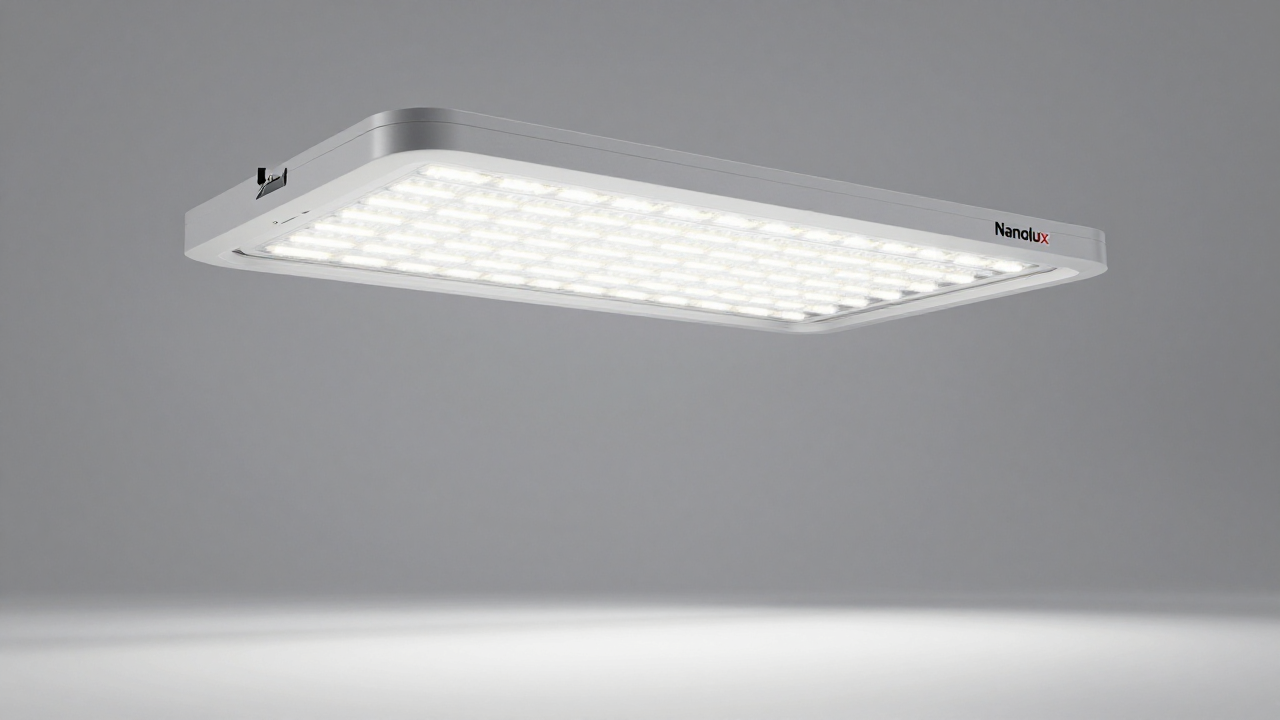
We look at it as two competing realities. On paper, a fixture is photons per watt. In the real world, it’s how long those photons stay at the right intensity before heat, driver degradation, or cheap soldering tank your uniformity. In August 2024, we pulled data from a third-party lab test comparing a Nanolux 720-watt bar light against a generic board-style fixture after accelerated aging. Both started at 2.8 µmol/J. After 3,000 hours of standard cycling, the generic fixture had dropped to 2.42 — a nearly 14% loss in photon output. Ours held at 2.75.
That delta, over a flowering cycle, translates to real dollars in lost crop quality somewhere down the line. Not a hypothetical loss — a countable one.
Spectrum Isn’t a Buzzword. It’s a Recipe.
A mistake we keep seeing again and again: growers fixating on a single spectrum like they’re picking a paint color. “Full spectrum” has become a label, not a specification. But a tomato in July in Southern California doesn’t receive the same spectral mix as that same plant in November. And a lettuce variety grown in a vertical rack in Chicago doesn’t need what a flowering cannabis canopy needs in a greenhouse in Salinas.
We’ve landed on a practical split: static white-heavy spectrums for veg, and a tunable red:blue ratio plus far-red supplementation for generative growth. But — and here’s the part that gets tricky — if you’re managing multiple crop types in one facility, a fixed spectrum without an adjustment pathway will kneecap your flexibility before you even start. We tell our own engineering team: if a light ships without the ability to adjust spectrum even at the driver level, it’s already obsolete for the 2027 market.
Can Energy Efficiency Actually Scale? Or Just Look Good on a Spec Sheet?
If you’ve been in this industry more than ten minutes, you know the answer: it depends on your layout, your airflow design, and your target DLI (Daily Light Integral). Here’s a raw comparison from a retrofit project we tracked in a Michigan greenhouse in January 2025. The grower swapped 85 old 1,000-watt HPS fixtures for LED systems.
The numbers don’t lie: electric cost dropped 47%, and canopy light levels jumped almost 30%. The reason wasn’t magic — it was simply that an HPS fixture radiates 60% of its energy as heat, while a properly designed LED concentrates it into photosynthetically active radiation.
That HVAC line item gets overlooked by new buyers consistently. In a sealed room, a watt of electricity going into a light becomes a watt of heat your AC has to remove. So cutting 450 real watts per fixture doesn’t just save on lighting circuits — it lowers your cooling bill in tandem. The rule of thumb we use: for every $1 saved in lighting energy, expect another $0.25 to $0.35 in HVAC savings.
*(A quick reality check: if your facility is in a cold climate and you use HPS waste heat deliberately for greenhouse warming, that equation shifts. Don’t just cut your heat source without a plan. We’ve seen that end badly in a February freeze in Colorado.)*
How Do I Separate a Real Contender from a Marketing Shell?
Walk into any trade show in 2025 and you’ll see 40 brands claiming the same efficacy numbers. So how do you filter? Ask three questions. Not two. Three.
1. What’s the third-party verification? Not the in-house report. Look for LM-79 or LM-80 data from an accredited lab. If a company won’t give it to you, that’s an answer unto itself.
2. What driver topology are they using? Cheap constant-voltage designs with resistors drift as temperature changes. You want constant-current designs with individual diode current regulation. It sounds technical, but in practice it means your 3,000K whites don’t shift to 3,200K six months in.
3. What’s their actual warranty claim process? Not the promise on the box — the real user experience. In June 2024, we had a large Nevada operation lose a driver on 12 units out of 300. We had replacements shipped from a warehouse in Reno within 36 hours. That kind of logistics backbone is invisible until you need it.
That’s not a plug; it’s the difference between a light that costs $500 on a website and a system that keeps your harvest date from slipping.
The Mistake I’ve Seen Cost Growers a Full Harvest Cycle
I’m going to tell you about a phone call from October 2023. A vertical farm operator in New Jersey had just installed 700 linear LED bars in a multi-tier setup. Great PAR numbers. Efficient chips. Six weeks later, crop uniformity went sideways. Half the basil trays looked stunted. The other half were leggy.
Root cause? They’d calculated PPFD based on the manufacturer’s average — a single number that assumed a perfectly empty room. But once the racks were filled, the actual light hitting the lower tiers dropped by 25% at the edges. Physics. Not product failure. No one had modeled the multi-tier shadowing and reflected light loss.
We helped them add under-canopy bars at a modest additional cost — roughly $8,400 — and uniformity recovered within two weeks. The lesson: your light plan has to model the environment *with plants in it,* not an empty CAD drawing. Real canopy PPFD almost always runs 10-20% below theoretical single-point measurements.
2026 and Beyond: What’s Actually Changing?
Energy codes in states like California and Massachusetts are tightening. Title 24 in California already mandates specific efficacy minimums and occupancy-based controls for certain agricultural applications. By 2026, we expect three things to hit mainstream adoption across the U.S.:
If you’re planning a new build or a major retrofit for 2026, buy a fixture platform, not a product. The hardware should support firmware updates that unlock new features down the road — like spectrum tuning profiles or integration with environmental sensors — without ripping out the whole light. Nanolux moved to a firmware-updatable driver platform in all our 2025 Production Series lights for exactly this reason. The light you install in March shouldn’t be feature-frozen by September.
One thing nobody’s talking about enough: the labor cost of rehanging lights mid-cycle because the spectrum or intensity isn’t right. I’ve watched crews spend three full days on ladders adjusting cable heights in a 15,000 sq ft flower room. That’s overtime. That’s lost productivity. That’s an injury risk. A smarter investment is fixtures with broader coverage patterns and on-board dimming — even if the chip efficiency looks a half-point lower on paper. The spec sheet doesn’t show you the back strain.
In a market where margins per pound drop every year, the light that saves you 3¢ per kWh matters. The light that saves you 30 man-hours per cycle matters more.
