
Midnight, February 2026. Inside a 60,000-square-foot greenhouse in Painesville, Ohio, the mercury outside reads 14°F. Head cultivator Rachel Tran stares at an analytics dashboard. Her December electricity invoice landed at $31,200 — a jump of 22 percent from last winter. The main draw? An array of high-pressure sodium fixtures, each burning 1,000 watts across three acres of vine crops. She leans back, coffee in hand, and mutters what most operators in controlled environment agriculture are thinking right now.
“There’s gotta be a better way to do commercial grow lights.”
Tran isn’t alone. Across the Midwest, Northeast, and increasingly the Southwest, growers who built their businesses on decades-old lamp technology are confronting a brutal reality: energy costs have stopped being a variable. They’re the variable. And the upgrading of commercial grow lights — to LED, to smart-spectrum, to under-canopy systems — has become the single biggest lever for staying profitable in 2026.
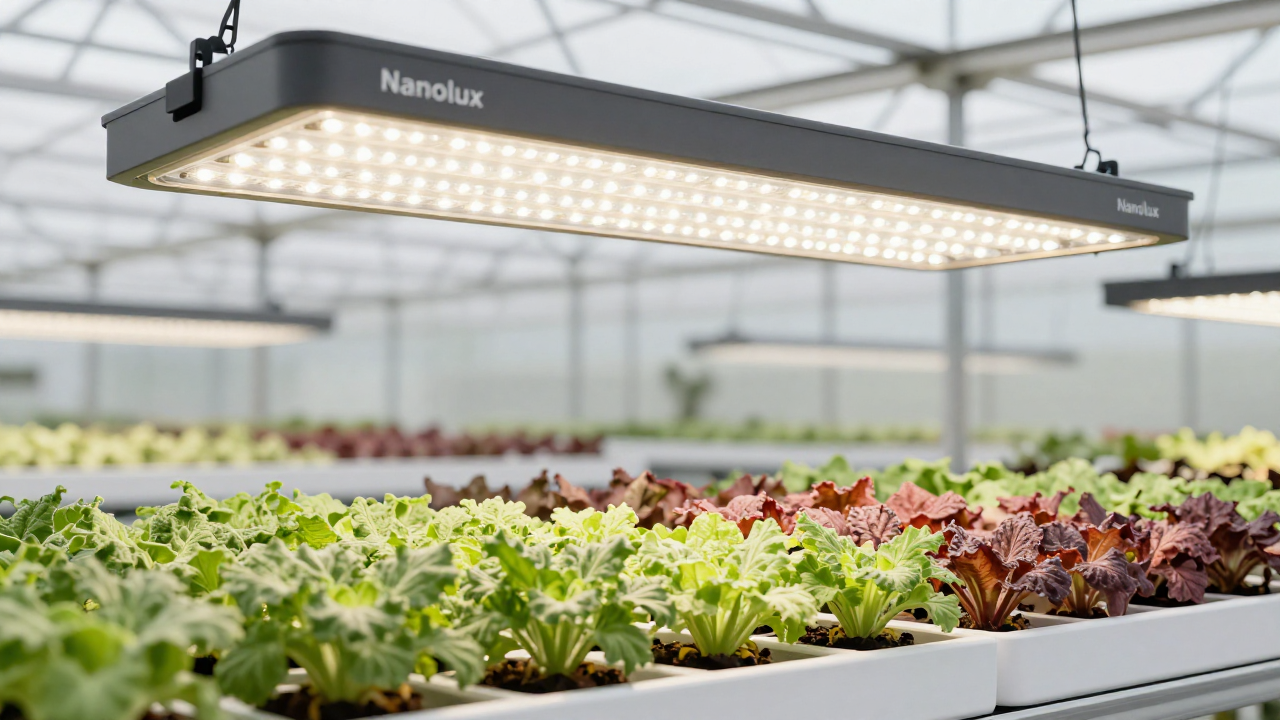
The Electrical Gut Check: What Light Actually Does Inside a Plant
It’s easy to reduce lighting to watts and lumens. But plants don’t care about lumens. They read photons — specifically PAR, or photosynthetically active radiation — and they’re obsessed with consistency.
I remember a conversation I had in November 2022 with Dave Blanchard, a technical horticulturist who’s designed lighting layouts for vertical farms in Newark and greenhouse expansions outside Yuma. He told me, “The biggest myth I encounter is that more light equals more yield. I’ve seen facilities pushing 1,200 PPFD on leafy greens, thinking they’re accelerating growth. Actually, they’re just cooking the stomata and wasting 40 percent of their electricity.”
That afternoon, Blanchard pulled out a spectrometer and showed me the DLI maps from two adjacent bays — one under legacy HPS, one under a tuned LED spectrum. The difference wasn’t just intensity. The LED bay, running at a lower wattage, produced a more uniform canopy and shorter internodes. The crop cycled three days faster. Not from more photons. From better photons.
This is where economics muscles in. In the United States, electricity rates for agricultural operations have climbed 17 to 28 percent since 2020, depending on the region. When a lighting system represents 35 to 60 percent of a facility’s total energy draw, every percentage point of efficiency directly hits the gross margin. Industry data suggests that switching from a standard 1,000W double-ended HPS to a modern LED fixture in the 600–660W range can slash lighting-related energy consumption by 30 to 45 percent, while maintaining — and often improving — DLI targets. For a mid-scale greenhouse running 200 fixtures, that’s roughly $18,000 to $27,000 saved annually at average commercial rates. Those aren’t wild projections; we’ve tracked those numbers in retrofits from Salinas to southern New Jersey.
The Gear Conversation: LED, HPS, CMH — What Actually Works in 2026
Ask five growers what light they trust, and you’ll get seven opinions. So let’s cut through sentiment with the numbers that matter when you’re placing a purchase order.
The HPS crowd still has a point if you’re growing a low-value crop in a cool climate, where waste heat actually offsets heating costs. But that math gets wobbly fast when natural gas prices spike or when you’re running cooling eight months of the year. In Phoenix, Las Vegas, and increasingly in high-desert greenhouses across Colorado, excess infrared radiation from HPS forces chillers to work overtime. That’s an operating cost multiplier nobody budgets for.
We’ve seen it play out in real time. In January 2025, a tomato grower in Henderson, Nevada, was running two identical greenhouse spans — one with his existing HPS blocks, one with a 630W LED retrofit. The LED span used 38 percent less electricity for lighting *and* reduced chiller runtime by 12 percent during afternoon peaks. By March, he was pulling the trigger on a full facility conversion.
I should pause here: LED isn’t a silver bullet. Poor spectrum design can stretch internodes, delay flowering, or mess with secondary metabolite development. I’ve seen cheap 660nm-heavy arrays create spindly cannabis plants that needed twice the trellising labor. You don’t just buy an LED; you buy a spectral strategy. At Nanolux, we learned early that blending white phosphor diodes with targeted 660nm and 730nm peaks gives the plant both the broad photosynthetic drive and the morphogenic triggers it expects. But I’m getting ahead of myself.
How to Run Commercial Grow Lights Without Torching Your P&L
The real gains after you’ve chosen a fixture live inside two things: scheduling and rebates.
First, light schedules. Commercial growers often treat photoperiod like gospel — 18 hours vegetative, 12 hours flowering — without ever measuring DLI. In leafy greens, you can hit a target DLI of 14–16 mol/m²/day with a 16-hour cycle at moderate intensity. Push to 18 hours and 20 seconds of leaf temperature data will often show you’re inducing stress without gaining biomass. In fruiting crops, the interplay between pre-dawn far-red pulses (emerson effect) and peak intensity timing can shift harvest windows by two to five days. That’s huge when a contract with a distributor hangs on a Friday cut-off. Adjusting schedules based on *daily light integral* rather than clock time is a zero-cost tweak that I’ve watched add 6 to 9 percent to annual yield in basil and lettuce operations around the Great Lakes region.
Now, rebates. The DesignLights Consortium’s Horticultural Lighting Qualified Products List (DLC Hort QPL) is the gatekeeper. In 2026, utilities in 38 states offer prescriptive rebates for DLC-listed fixtures — typically $0.04 to $0.12 per watt saved relative to a baseline HPS system. That means a single 630W LED fixture replacing a 1,000W HPS can pull down a one-time rebate of $30 to $45. At a scale of 300 fixtures, that’s nine to thirteen thousand dollars back in your account within 90 days of commissioning. Programs like Xcel Energy in Colorado and Efficiency Vermont have streamlined applications dramatically; I just helped a grower in Pueblo submit his paperwork in under an hour. If you’re not checking your local utility’s horticultural lighting incentive before ordering equipment, you’re voluntarily setting cash on fire.
Rules, Weather, and the American Patchwork
The U.S. doesn’t have one grow-light regulation. It has fifty. California’s Title 24 energy code mandates specific efficacy thresholds for indoor agricultural lighting in new construction. Michigan’s regulatory framework for recreational cannabis puts lighting infrastructure under facility energy compliance reviews. New York’s recent controlled environment agriculture incentives are tied to jobs created — but only if you meet minimum system efficiency ratings. Navigating this takes local knowledge.
Then there’s climate. A grower in Willamette Valley faces nine months of overcast skies. His facility needs supplemental lighting that can ramp from 100 µmol/m²/s in the morning to 350 by solar noon — and back down — without shocking the plants. Meanwhile, an operation in Maricopa County, Arizona, battles heat first; his lights run mostly at night and must output minimal infrared. He needs a spectrum that delivers yield without raising the HVAC load. No single SKU handles both scenarios. This is why we configure spectral recipes and form factors differently for Gulf Coast humidity than for Maine winters.
A couple of years ago, in June 2023, I spent a morning at a Lakeport-area organic farm in Northern California — the kind of place that anchors community markets and supplies heirloom tomatoes to restaurants in San Francisco. The head grower was supplementing his unheated hoophouses with basic HID lamps and losing about 20 percent of his winter crop to uneven ripening. We set up a trial with adjustable-spectrum LED bars that shifted toward blue-heavy light during cloudy days and warmer tones during overcast stretches. His winter yields in 2024 improved by 14 percent. It wasn’t magic. Just a tighter match between light quality and the actual weather rolling over the coastal range that week.
Where the Landmines Lie
I want to be blunt about mistakes, because most of them are preventable.
And case studies teach the rest. In 2024, a multi-tier vertical farm in Columbus, Ohio, swapped out fluorescent arrays on their eighth-generation crop shelf for Nanolux LED bars tuned to a 4,000K white with 660nm supplementation. They were growing butterhead lettuce destined for regional grocery chains. Within two full crop cycles, they reported a 22 percent reduction in energy per pound of harvested product and a 7 percent increase in shelf-ready heads — meaning fewer leaf defects, better color uniformity. The facility manager, a no-nonsense woman named Sylvia, told me on a call two months ago, “The biggest win wasn’t the savings. It was the consistency. My harvest crew used to waste 11 percent of heads on quality issues. That’s down to 4 percent. I can schedule labor tighter now.”
That kind of detail matters because, in the end, commercial horticulture is a logistics business. Light is just the power supply.
We’re entering a tightening cycle — more utilities are sunsetting high-wattage HID rebates, carbon accountability is creeping into supply chains, and wholesale buyers are starting to audit energy inputs per pound of produce. The question I keep getting from growers in 2026 isn’t “Should I switch?” It’s “How fast can I retrofit before my neighbor’s cost per pound drops below mine?”
That’s the real competitive vector now. And honestly, it’s a much more interesting problem to solve than picking a diode count.
