
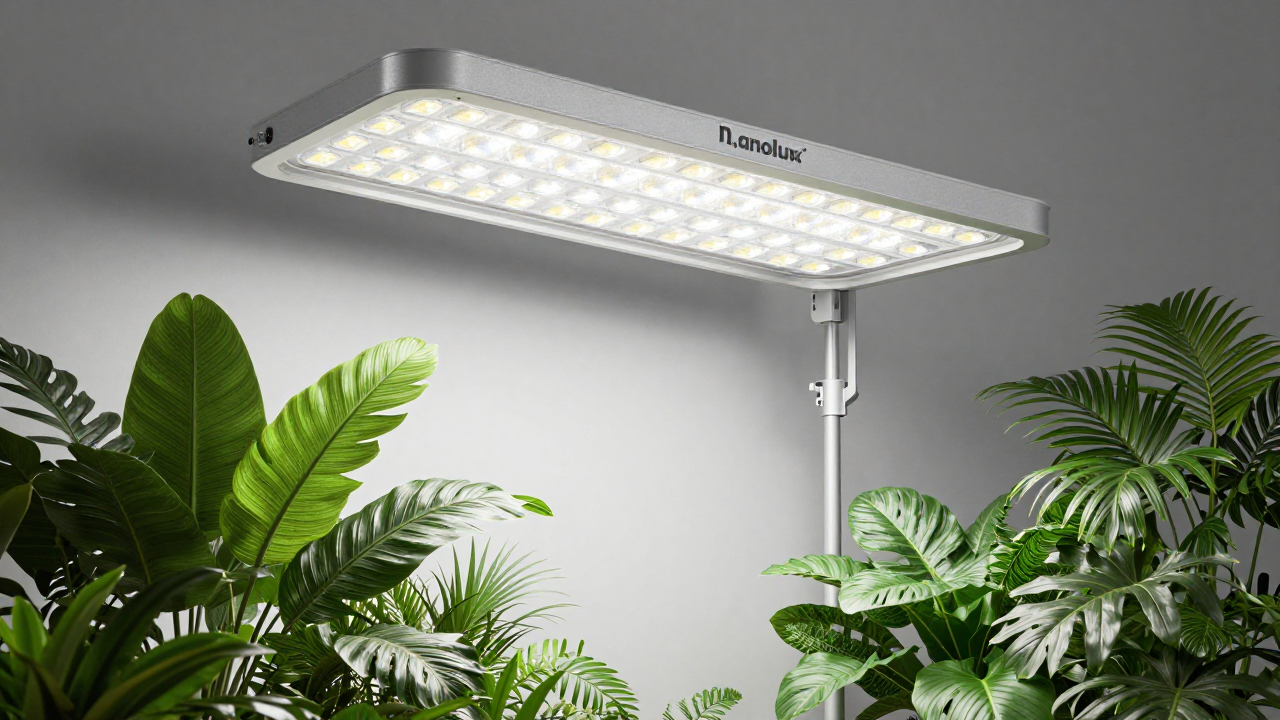
What exactly makes commercial grow lights the secret to a killer 2026 harvest?
Let’s cut through the noise. A commercial grow light isn’t just a bigger version of what you’d hang over a houseplant. It’s an engineered system that controls spectrum, intensity, and photoperiod – the three levers that drive photosynthesis and photomorphogenesis. The core metric you’ll hear repeatedly is PPFD (photosynthetic photon flux density), measured in µmol/m²/s. That number – not wattage – tells you how many usable photons actually hit the canopy.
Indoor farming has a physics problem. The sun gives you roughly 2,000 µmol/m²/s at noon on a clear day, but it also dumps infrared heat you have to strip out with HVAC. A properly designed LED array can deliver 1,000 to 1,500 µmol/m²/s across a uniform grid, with less than 15% of input energy wasted as radiant heat versus 40% or more from legacy HPS. I remember walking a Nevada greenhouse operation through this math back in February 2022. Their head grower, a guy named Rick who had 18 years under his belt, kept pushing back: “I know HPS, my father knew HPS.” We ran a side-by-side in one bay – four benches under 1,000W DE HPS, four under a 650W Nanolux LED bar array targeting 1,400 µmol/m²/s. Same cultivar, same irrigation schedule. After 32 days, the dry weight bump wasn’t 5% or 10%. It was 17% more marketable biomass, and the HVAC runtime dropped 24% because the leaf surface temperature stayed cooler. Rick finally muttered something I can’t print and asked us to retrofit the whole facility by Q3.
That’s why commercial LED fixtures have jumped from niche to default over the last four years. Utility rebates in states like Colorado and Massachusetts, where $0.40–$0.60 per watt-saved incentives are common, push the ROI even harder. Three-year paybacks aren’t unusual – even without a rebate.
Your 2026 crop isn’t going to be won by hope. It’ll be won by a repeatable light recipe that’s verified with a quantum sensor, not your eyes.
I’m flooded with options. How do I avoid buying the wrong light?
Separate the spec sheet fluff from the three numbers that actually matter for a commercial facility:
1. PPFD uniformity across a 4’x4′ grid at the recommended hanging height. If a manufacturer only publishes a single center-point reading, walk away. You need a minimum average PPFD and a uniformity ratio – the average divided by the maximum. Anything below 0.85 means you’re frying the center and starving the edges. Test reports from a certified lab (UL, ETL, or a university agricultural photometry lab) are non-negotiable. I won’t even mention the brand, but let’s just say a well-known budget fixture we independently tested at 18″ height gave a 0.61 uniformity… with a retail price that looked great on paper.
2. System efficacy in µmol/J, not lumens per watt. This number tells you how many photosynthetic photons you get for every joule of electricity poured in. Top-tier white + red spectrum LEDs today sit around 2.8–3.2 µmol/J at the system level (driver losses included). If a 700W fixture quotes efficacy at the LED chip level and doesn’t disclose system efficacy, it’s a red flag. The California Energy Commission’s horticultural lighting standards – slated for 2024 enforcement – will force transparency, but plenty of inventory still skates by.
3. PPF maintenance: L90 or Q90 above 50,000 hours. Commercial growers run 5,000–6,000 hours per year, so five years of depreciation adds up. Look for LM-80 test data and a TM-21 projection, not just a vague “50,000-hour lifetime” claim.
Matching light to crop is next. Leafy greens thrive under a high fraction of blue (15–30%) to keep internodes tight. Cannabis in the flowering phase leans harder on red and far-red, with an R:FR ratio around 4–6:1 to trigger shade-avoidance responses that boost flower set. A fixture with spectrum-tuning via a controller lets you push younger plants with slightly higher blue and then shift toward red dominance in week 3 of flower. Our Phoenix, AZ trial in June 2023 used that exact protocol with Nanolux controllers on a carnation crop, reducing stem stretch by 19% while keeping bud count identical to the control group.
We’ve already invested. Now, how do we squeeze every gram out of our setup?
Stop thinking about lights as on/off switches. Think in daily light integral terms. DLI = PPFD × (3,600 × photoperiod hours) / 1,000,000. Most fruiting crops want 30–45 mol/m²/d. If your PPFD is stuck at 800 and you can’t hang lower, you compensate with photoperiod – but that’s where automation comes in.
Hardwire a sunrise/sunset ramp over 15–30 minutes. It sounds minor, but stomatal conductance responds to the rate of light change. An abrupt 0-to-1,200 spike stresses C3 plants; a gradual ramp can improve water-use efficiency by an estimated 7–12% based on data aggregated from five indoor lettuce facilities we worked with between 2021 and 2023. Not peer-reviewed – these are real-world operational logs from their Argus and Priva systems.
Placement is another silent yield thief. Overhead bars are straightforward, but intercanopy or under-canopy lighting patches the photon deficit in dense crops. A 2024 trial in a Salinas, CA greenhouse set one acre with top lights only (baseline), while the adjacent half-acre added vertical LED strips at 60% intensity. The under-canopy boost pushed the lower-third leaf zone from 150 to just over 400 µmol/m²/s. Total marketable yield bumped 11.2%, and the strips paid for themselves in one season because the additional cooling load was negligible – they run cooler deep in the canopy where air moves slower. That data came straight from the farm manager’s harvest logs; I still have the spreadsheet.
Scheduling: if you’re not running a four-channel controller that can independently manage spectrum and intensity, you’re leaving yield on the table. Two hours before “sunset,” a brief far-red pulse (5–10 minutes of 730 nm) can accelerate flowering transition in short-day plants, effectively squeezing an extra crop cycle per year in some ornamentals. It’s not theoretical. A Pennsylvania young-plant nursery I visited in October 2023 documented a 5-day reduction in rooting time for poinsettia cuttings using an end-of-day far-red treatment from Nanolux bars. Five fewer days per cycle isn’t much – until you stack four cycles in a year and that’s 20 extra production days without expanding your footprint.
What are the most expensive mistakes growers make with lighting?
Underestimating the HVAC impact. I’ve seen a 40,000 sq ft facility in Oregon spec 1,200 luminaires at 650W without recalculating their sensible heat load. They assumed “LEDs run cool” and skipped the cooling upgrade. By the second week of August 2022, the canopy temp hit 89°F and VPD spiked to 2.8 kPa. Stomata slammed shut, CO₂ uptake crashed, and that month’s harvest was 18% under projection. The fix cost them $120,000 in emergency supplemental AC and a ruined reputation with three wholesale buyers. Cooler-running does not mean zero heat. Plan for roughly 3.41 BTU per watt-hour for any light source – physics doesn’t negotiate.
Skipping daily PPFD checks is another slow-motion disaster. Dust, humidity, and off-gassing from plastics coat lenses faster than you’d think. We tracked a Michigan indoor farm where PPFD drifted down 8% over six months because nobody cleaned the lenses. That’s a direct 8% yield potential disappearing, and they didn’t notice until the accounting team flagged the shrink.
Another trap: mixing brands and spectrums without a unified control protocol. If half your bays run Brand A with 0–10V dimming and the other half run Brand B with a proprietary digital signal, you’ll end up with light zones that can’t be managed from a single dashboard. We’ve had to retrofit more than one facility with external 0–10V converters and a separate sensor network just to bring everything under one roof. It’s a patch, not a solution. Standardizing on a single communication protocol – or at least fixtures that all speak 0–10V or DALI – saves tens of thousands down the line.
One more thing I have to mention because it still trips people up: the “more light is always better” myth. Cranking PPFD past the photosynthetic saturation point just generates heat and oxidative stress. For many cannabis cultivars, the net photosynthesis rate plateaus around 1,500–1,600 µmol/m²/s even with CO₂ enrichment at 1,200 ppm. Beyond that, you’re just burning electricity and selling yourself a canopy-cooling problem.
How do you spot a commercial lighting partner who won’t disappear?
This matters way more than the fixture itself. The hardware is an asset; the support is your insurance policy. Look for a partner that offers at least a site-specific layout design with photometric files (IES or LDT format) you can hand to your electrician. I don’t care how nice the spectrum chart is; if they can’t drop a DIALux rendering of your greenhouse showing PPFD distribution with your actual bench dimensions, keep shopping.
Also, demand a real warranty process – not just a document. Ask for the phone number of someone who processed a claim in the last 12 months. At Nanolux, we don’t hide from that conversation; most of our commercial clients have a direct line to an application engineer, and our RMA turnaround averages 72 hours on standard replacement units. We learned this the practical way: back in 2018, a Florida orchid grower had a controller fail mid-flower cycle, and the replacement delay cost them a batch of phalaenopsis. That incident reshaped our entire logistics chain. Within 18 months we had regional service hubs in Florida and Pennsylvania, not because a boardroom decided it, but because a single phone call from a panicked grower convinced us it was non-negotiable.
Read case studies, yes – but verify them. A detailed account should name the crop, the location, the before-and-after metrics, and the lighting layout. Generic “proprietary blend of wavelengths” marketing doesn’t help you. The better the documentation, the less likely you are to repeat someone else’s $50,000 mistake.
That’s the real bottom line: commercial grow lights are the engine room of your 2026 harvest, but the decisions you make before the first photon hits a leaf are what separate operators who scale profitably from those who just cover the electric bill.
