
The first call I took on Tuesday, February 3rd, 2026, came from a raspberry producer in Whatcom County, Washington. His voice had that edge I recognize instantly — part frustration, part fear. The new supplemental LED array he’d installed in December was pushing his mid-winter Brix levels higher than his summer field crop. Impressive, until you realize his packers couldn’t handle fruit that soft. The lights were working too well. He’d optimized for photons per watt, without understanding what those photons were telling the plant to do.
That call, at 6:47 a.m., is why I’m writing this. Not to sell you a fixture — Nanolux has been building those since 2004 in California, so I figure we’ve earned the right to be blunt — but because the 2026 season is forcing a reckoning. A lot of what passed as “best practice” two years ago is now burning capital in plain sight. Here’s what the growers who are winning are doing differently, and where the money is quietly being lost.
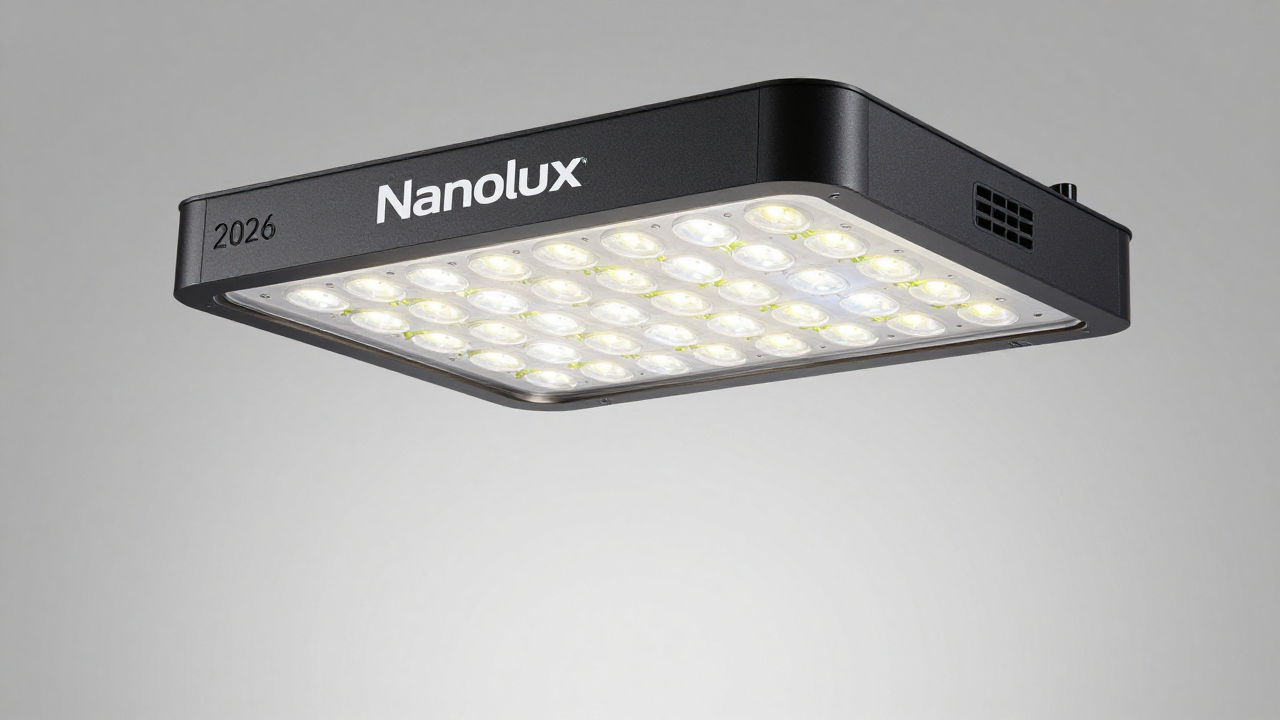
You’re Not Buying Light. You’re Buying a Spectral Recipe
Walk through any trade show floor in 2026 and you’ll hear the term “full spectrum” thrown around like it means something. It doesn’t. A 2018 study from the University of Guelph’s controlled environment lab — still one of the most careful pieces of public research — showed that a 90:10 ratio of red to blue photons produces significantly different leaf expansion rates than 80:20, even when total PPFD remains unchanged. Same DLI, different morphology. Even the top-tier fixture on paper becomes a liability if the grower hasn’t mapped what specific wavebands do to their specific cultivar’s secondary metabolism.
I spent three hours in December at a greenhouse operation outside of Holland, Michigan, staring at a batch of ‘Albion’ strawberries under two different Nanolux spectrum presets. One preset, dialed to 18% blue at 450 nm, triggered anthocyanin accumulation so aggressively that the fruit looked almost bruised. The second preset, shifting to 12% blue and adding a touch of far-red at 730 nm, produced the same dry weight, same yield timing, with marketable appearance. The kicker: the “better” looking fruit came from a setting that delivered *less* total photosynthetic photon flux density. Efficiency metrics lied.
The growers I saw making rapid progress in early 2026 shared a common habit. They treated a spec sheet as a starting point, not a decision tool. They ran small plot trials — 400 square feet minimum — with four to six spectral variants, and measured outcomes against a financial KPI instead of a horticultural one. Not “grams per watt,” but “margin per square foot per week.” If that doesn’t sound intuitive, it’s because most lighting manufacturers still train their sales teams on PAR maps, not payroll math.
5 Things the Smartest Operations Are Doing Right Now
None of these trends are theoretical. I’ve stumbled into enough facility walkthroughs and packing shed whiteboards since October to see the patterns.
1. Dynamic Spectrum Scheduling Is Replacing Fixed Recipes
Static spectrum? That’s 2023 thinking. In January 2026, a controlled-environment lettuce grower in Vineland, New Jersey, showed me their controller’s daily curve: 90% red / 10% blue from 6 a.m. to 10 a.m., then a midday shift to 70% red / 20% green / 10% blue, then back to heavy red for the last three hours. Their harvest crew was cutting 13% more marketable heads per trough than the static-spectrum bays, with no change in fixture count. The logic, as their head grower explained, mimics what outdoor plants experience — spectral quality shifts with solar angle and cloud cover — and the plants respond with predictable morphological changes.
Smart lighting controllers that talk natively to climate systems are the entry point. If your controller can’t dynamically adjust channel output across at least three independently addressable wavebands, you’re locked out of this gain. The hardware cost difference between a dual-channel and a four-channel fixture is real — I get it — but the payback window on those extra channels, based on the New Jersey numbers, was under eight months. And that was lettuce. When you translate dynamic scheduling to high-value floriculture or cannabinoid production, the financial case becomes deafening.
2. Far-Red Isn’t a Nicety Anymore. It’s an Input Cost Hedge
US grid electricity rates for agricultural customers in California’s PG&E territory hit record highs in Q3 2025. I talked to an almond nursery operator near Fresno who was paying $0.28 per kWh during peak demand windows. He’d retrofitted a portion of his propagation benches with far-red (730 nm) diodes that run at just 15% of the total output of his white LED channels, using a concept called the Emerson Enhancement Effect. By triggering a modest photosynthetic efficiency gain during the last two hours of the photoperiod, his infrared-capable bays achieved equivalent growth with a 9% lower overall DLI. That’s 9% fewer kilowatt-hours for the same transplant quality. In a facility burning 22 hours of light per day, that number compounds fast.
Far-red was long treated as a tool for photoperiod-sensitive flowering control. In 2026, its bigger role is as a lever to trade expensive photons for cheap physiological nudges. If your current fixtures don’t have an independently addressable far-red channel, you’re not broken — most facilities built before 2023 don’t. But penciling out a retrofit for the highest-hour rooms will surface some uncomfortable ROI math that probably favors action.
3. Under-Canopy Lighting Is Quietly Doubling Flower Density in Crops That Were Already “Optimized”
Admitting this stings a little, because we at Nanolux spent years hearing from growers that overhead LED arrays were the endpoint. Then in April 2025, a greenhouse tomato operation in Leamington, Ontario — a grower I trust, the kind who documents everything with an obsessive patience — ran a controlled trial with inter-row under-canopy strips at 70 µmol/m²/s, supplementing their standard top-lighting of 220 µmol/m²/s. The result wasn’t subtle. Lower-canopy flower truss count increased 38% on the Beaufort rootstock, and fruit set on the lower clusters held for an extra four weeks into the crop cycle. That’s extra harvestable weight buried deep where conventional overhead light couldn’t reach.
What’s interesting to me is how fast the economics shift. Under-canopy LEDs don’t need the same thermal management as high-bay fixtures. They run cooler, the unit cost is lower, and the barrier to trial is a few dozen lights zip-tied to a crop wire vs. a structural engineering review. Yet I still walk into greenhouses where the lower 40% of the canopy is essentially operating on maintenance respiration. If that’s you, run the numbers. Even a rental trial setup could pay for itself inside one tomato cycle.
4. The ROI Conversation Has Moved From “Efficacy” to “Harvest Window Control”
At some point in 2025, the umol/J wars stopped mattering. Most reputable commercial LED fixtures now sit between 3.0 and 3.4 µmol/J system efficacy, and the difference between 3.0 and 3.4, while real, is dwarfed by a 5-day shift in harvest timing. A leafy greens producer in Yuma, Arizona, I spoke with in December described a contract with a regional distributor that penalized every day his product arrived outside a 72-hour freshness window. He used tunable-spectrum fixtures — not to grow more lettuce, but to slow down or speed up maturation cycles by 2 to 4 days depending on wholesale demand signals. He called it “logistics hedging.”
That framing changed something for me. If you can consistently pull a crop 3 days earlier for a premium slot, the utility value of that spectral tuning far exceeds the efficiency spec on the driver. In 2026, the operations treating lighting as a harvest-date instrument are walking away from the rest of the pack on margin. The hardware is the same. The difference is an operational philosophy that views photoperiod and spectrum as time-shifting tools, not just growth accelerators.
5. Multi-Location Growers Are Forcing Standardization That Defeats the Purpose
This is the trend nobody wants to admit. At a roundtable in Denver last November — growers from Colorado, Michigan, and Massachusetts, multiple facility types — the air got tense when someone asked about lighting standardization across sites. A large multi-state operator had forced all their indoor facilities onto identical fixture models, spectra, and photoperiods. One site in a high-altitude, low-humidity location experienced 22% more tip burn than the others, because the standardized recipe was uniformly tuned for a coastal humidity profile. They spent 11 months troubleshooting nutrition when the issue was vapor pressure deficit interacting with a spectrum that was pushing transpiration too hard.
The ugly truth: standardization reduces procurement complexity, but it erases the agronomic nuance that tunable lighting was supposed to unlock. If you’re a multi-location grower, 2026 is the year to push for spectral autonomy at the site level, even if the purchasing department hates you. The cost of a suboptimal spectrum, repeated across a million square feet, reads like a rounding error on the capital budget but shows up in the yield data after 12 months. It’s slow and silent, and it’s easy to blame on something else. It’s also entirely fixable.
A Quick Field Test to See If Your Setup Is Honest
Before you spend another dollar on light planning, try this during your next crop cycle. Pick a representative bench or bay. Measure actual PPFD at 15 to 20 points across the canopy, not just at center grid. Calculate the uniformity ratio: minimum PPFD divided by average PPFD. If that number drops below 0.75, you’re leaving yield on the table, no matter what the fixture’s rated efficacy says. I’ve walked facilities with “3.2 µmol/J” fixtures that were delivering 0.68 uniformity, effectively burning electricity to light walkways and aisle edges. A cheap quantum sensor and one hour of grunt work will surface this faster than any lighting layout software.
What the Smart Money Is Asking Before a 2026 Purchase
These aren’t theoretical worries. A Colorado cultivator I know lost 14% output on a competitor’s fixture during a July 2025 heatwave — ambient hit 104°F in the facility, and the fixture’s thermal throttling kicked in hard. His Nanolux bays, running a more conservative thermal design, held nominal output within 4%. He’d never have known without that heatwave and a PAR sensor logging every 10 minutes. The lesson: derating curves matter more than CCT ratings.
A question I get a lot, especially from investment groups entering controlled environment agriculture: “What’s the fastest way to recover capital on a lighting retrofit?” The honest answer isn’t a number. It’s “get your environment right first.” I’ve seen $400,000 lighting installs underperforming because the dehumidification system was undersized by 30%. The fixture was fine. The room wasn’t.
And here’s a selfish piece of advice from someone who’s helped build lights for 22 years: if a salesperson spends more than eight minutes talking about lumens, walk away. Horticulture doesn’t care about lumens. Lumens are weighted to human photopic vision, where green light dominates. Plants operate on photosynthetic photon flux, and the conversion between the two requires knowing the exact spectral power distribution. Anyone blurring that line is either careless or hoping you are.
February 2026, Back in Whatcom County
The raspberry grower I mentioned at the start sent me his harvest sheets last week. After we shifted his evening-period spectrum to reduce the red:far-red ratio during the last two hours, his fruit firmness climbed back into spec. Yield didn’t move. But the pack-out rate — the percentage of fruit meeting premium grocer standards — jumped from 71% to 88%. He didn’t need a new fixture. He needed a new schedule. The hardware was already there, waiting for him to ask it a better question.
That’s the thing about 2026. The grow light itself is rarely the limiting factor anymore. The limitation is how we use it. The people who figure that out fastest — who move beyond static recipes, who design around uniformity and derating, who treat far-red as an operating expense lever — are the ones who’ll still be answering my calls in 2027. The rest will be wondering why their “state-of-the-art” room never quite penciled out.
