
It was 3:17 a.m. on a freezing Tuesday in February 2024 when my phone rattled against the nightstand. A grower I know outside Burlington, Vermont—we’ll call him Tom—was staring at a spreadsheet that refused to make sense. His winter utility bill had climbed 34% year-over-year. His lettuce contracts were locked in at $2.87 per pound. He was losing money on every single head that left his greenhouse, and he had 18,000 square feet of crop turning bitter because January light levels tanked his sugar development.
“Tell me straight,” he said. “Are commercial grow lights actually going to save this operation, or am I throwing good money after bad?”
Tom’s question isn’t unique. It’s echoing through indoor farms from Salinas to upstate New York right now. And the answer is messier—and more interesting—than most spec sheets let on.
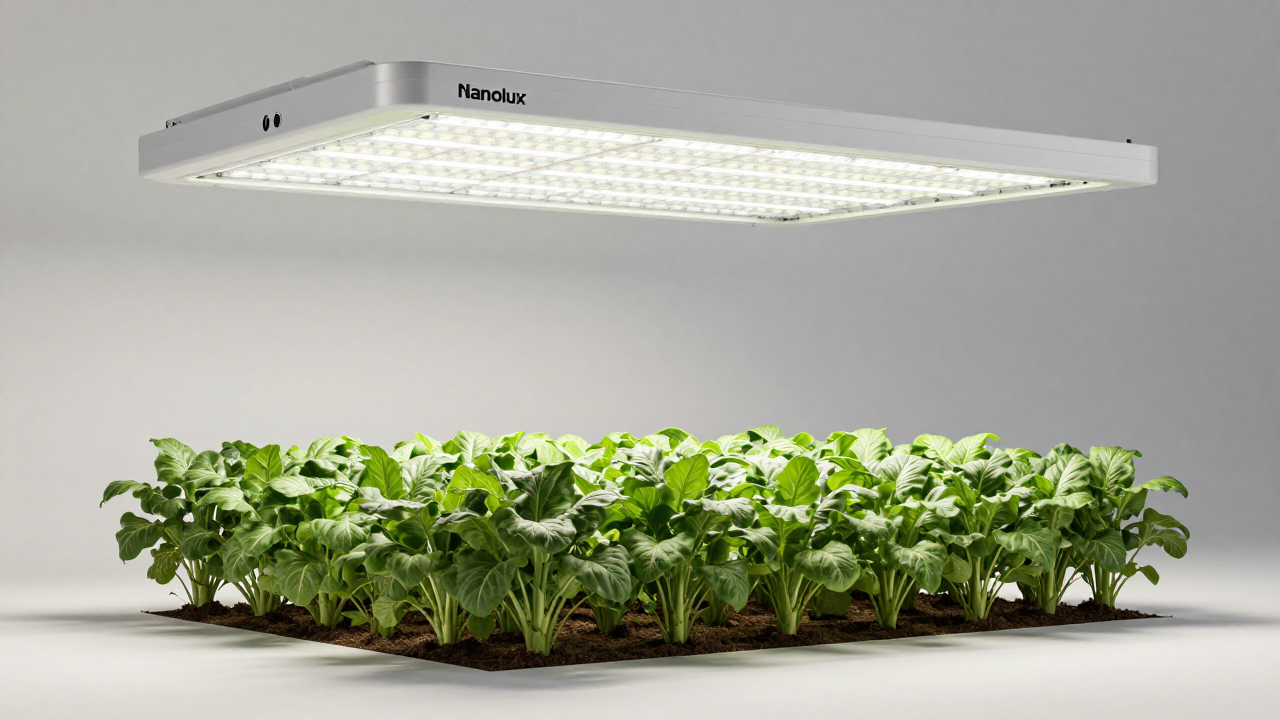
The Physics Nobody Talks About At Trade Shows
Most growers learn the basics: plants need light, electricity costs money, done. That’s like saying a combustion engine needs fuel. True, but useless.
What matters is photosynthetic photon efficacy (PPE) —the micromoles of light your fixture produces per joule of electricity. Five years ago, 2.3 µmol/J was considered solid for an LED commercial fixture. Now? If you’re not pushing past 3.0 µmol/J, you’re bleeding margin every harvest cycle. The physics doesn’t care about your lease terms.
But here’s where it gets non-obvious: spectrum matters more under certain crop prices than others. Blue-heavy spectra (400-500 nm) suppress cell elongation. That’s great if your basil contracts penalize leggy stems. It’s a disaster if you’re chasing biomass weight on leafy greens where a little stretch adds salable grams. I’ve watched growers chase a laboratory-perfect spectrum and lose 12% on harvest weight because nobody asked what their buyer actually valued.
DLI—Daily Light Integral—is the number that separates profitable cycles from expensive compost. The formula is dead simple:
DLI = PPFD × (3600 × photoperiod hours) / 1,000,000
Target numbers vary by crop. Greenhouse tomatoes want 22-30 mol/m²/d during fruiting. Cannabis in flower? More like 38-45. But hitting those numbers isn’t the hard part. Hitting them *evenly* across the canopy is where commercial systems prove their worth or fall apart. A fixture that puts 900 µmol/m²/s dead-center and 400 at the edges isn’t a 650-average light. It’s a lawsuit waiting to happen when your third-party lab results come back patchy.
Why 2026 Changes The Math
Something shifted in late 2024 that most industry outlooks missed. The wholesale price spread between conventionally grown produce and controlled-environment crops narrowed enough that grocers started asking different questions. Not “can you match the field price?” but “can you guarantee Salmonella-negative lots every 72 hours?” and “what’s your days-to-shelf after harvest?”
This is where the economics of supplemental lighting flip from cost center to competitive moat.
Take a mid-scale operation I walked through in Holland, Michigan, in October 2024. They were running a mixed crop under HPS—12 acres under glass, primarily beefsteak tomatoes for regional grocery chains. Their winter production was dipping to 65% of summer peak. The buyer was importing from Mexico to fill the gap, and that imported product was arriving with 9-11 days of shelf life already burned.
They installed a hybrid system: retaining HPS for radiant heat (useful in Michigan winters) and layering LED top-lighting at 250 µmol/m²/s supplemental. Capital outlay: $340,000 after utility rebates. The first full winter cycle post-install, they delivered 88% of summer peak volume with average Brix levels within 1.2 points of June fruit. Their buyer extended the contract by three years at a 7% premium over the commodity rate.
That premium isn’t charity. It’s insurance against a supply chain disruption that grocery chains still haven’t recovered from since 2022.
The Technology You Actually Need
The market has consolidated into three camps, and picking wrong costs more than the fixtures themselves.
The LED column hides a critical detail: spectrum tunability. A fixed-spectrum white LED at 3.0 µmol/J is a commodity now—there are a dozen factories in Shenzhen that’ll ship you one. What separates functional from profitable is the ability to shift red:blue ratios and include far-red (700-750 nm) for the Emerson effect. That far-red bump alone can accelerate flowering by 5-10 days in photoperiod-sensitive crops. In a commercial rotation, 7 fewer days per cycle is an extra harvest every two years.
I’ve spent years at Nanolux tracking how these decisions play out in real facilities. We started in California in 2004, back when “commercial LED grow lights” meant jury-rigging aquarium panels and hoping for the best. The baseline has moved so far since then that comparing a 2026-ready system to a 2019 build is borderline irresponsible—the photon delivery, thermal management, and control integration are different categories of hardware now.
One thing that trips up first-time buyers: they obsess over PPE and ignore light distribution uniformity. A fixture that delivers 3.1 µmol/J but drops 40% intensity between center and edge creates more uneven canopies than a less-efficient fixture with optics designed for your row spacing. I saw this exact problem at a vertical farm in Newark in 2023. Gorgeous lab specs. 22% yield variance across trays. They replaced the fixtures nine months later.
Mistakes That Cost Six Figures
The most expensive error I see repeatedly is overtrusting manufacturer light maps. Any PPFD map printed in marketing materials was measured in a sphere or a perfectly reflective test room. Your greenhouse has trusses. Your vertical rack has support beams. Your warehouse has columns. Each of those casts a shadow that no spec sheet accounts for.
Measure your actual installation. Rent a spectroradiometer if you have to. The $1,200 it costs to map your real canopy is noise compared to a lost cycle.
Another quiet killer: ignoring driver placement. Remote-mounted drivers let you move waste heat outside the grow zone. This matters massively in sealed indoor rooms where every watt of driver heat becomes a watt your HVAC system has to remove. In a 30,000-square-foot indoor facility, driver heat alone can add $4,000-7,000 to annual cooling costs. Nobody talks about this at the purchasing stage because it shows up on a different budget line. It all comes out of the same bank account.
Honestly, the driver thing isn’t the sexiest topic at a trade show luncheon. But neither is a $6,000 surprise on your July electric bill.
Where This Is Heading
Two signals are worth watching as 2026 approaches.
The first is dynamic spectrum control based on real-time crop sensing. Cameras and chlorophyll fluorescence sensors are cheap enough now that mid-tier operations can afford them. The next step—which a few facilities are already testing—is closed-loop systems that adjust spectrum hourly based on plant stress indicators. Not just photoperiod. Actual physiological feedback. This moves lighting from a “set it and forget it” input to an active management variable.
The second is more pragmatic: utility demand response programs. Grid operators in California, Texas, and the Northeast are paying commercial facilities to reduce load during peak hours. A grow room with dimmable LED fixtures can drop 40% of its lighting load for two hours and barely affect DLI if you compensate during off-peak periods. The revenue from these programs can offset 8-15% of a facility’s annual electricity cost. That’s recurring margin improvement without touching your yield.
Tom, back in Vermont, went ahead and made the switch. He didn’t replace everything at once—he retrofitted one bay as a test, ran it against his old HPS bay for a full cycle, and kept the data. His lettuce came in with tighter weight variance per head, and the energy savings on that single bay covered the financing payment with enough left over that he’s now rolling out to the remaining bays on an accelerated schedule.
He called again last month. Not at 3 a.m. this time. Just to say that his spreadsheet finally made sense.
