
A Pennsylvania Barn That Almost Went Up in Smoke
On June 8, 2023, at 2:14 a.m., a smoke alarm tripped at Murphy Family Farms in Lancaster County. Kevin Murphy, the owner, found himself standing in a converted tobacco barn staring at a row of commercial grow lights that had warped their own housings. The fixtures were a batch of no-name HPS-to-LED retrofit kits he’d sourced through a liquidation site—$22,000 worth of “commercial grow lights” that promised a 40% energy saving over his old 1000W double-ended HPS rigs. What the spec sheet didn’t mention was that the drivers had no thermal throttling. The ambient temperature in the barn hit 114°F that night, the driver ICs failed closed, and three rows of Cherry Bomb autoflower started cooking.
The fire department didn’t need to cut open a wall, but the crop loss sat at $180,000. His insurance adjuster cited “uncertified electrical equipment” and denied the claim. That’s when Kevin called us at Nanolux—not to buy anything, just to ask why a fixture could fail that badly. We spent forty minutes on the phone, and that conversation is what prompted me to pull together a hard look at where commercial grow lights succeed and where they turn into multimillion-dollar lessons.
The commercial horticulture lighting market is moving so fast that the gap between a well-engineered system and a liability wrapped in aluminum has narrowed to something you can’t spot until it’s 2 a.m. and you smell melting polycarbonate. I’m going to walk through three specific wrecks from the last eighteen months, then lay out the seven approaches that will actually move the needle for 2026.
The “More Light” Obsession That Starved an Arizona Crop
Danny Ruiz operates a 1.2-acre high-wire tomato greenhouse in Willcox, Arizona. In November 2022, he decided to push his winter production by replacing his 600W HPS rigs with 1000W full-spectrum LEDs, targeting a peak PPFD of 1,200 µmol/m²/s. His logic wasn’t crazy—more photons equals more fruit, right?
Two weeks into flowering, his trusses started showing interveinal chlorosis on new leaves. Tissue analysis came back with iron and manganese deficiencies. The root cause wasn’t the nutrient recipe. The massive spike in radiant energy had driven the leaf surface temperature 6°F above air temperature, accelerating transpiration to the point where the root system couldn’t pull up immobile micronutrients fast enough. He’d inadvertently created a vapor pressure deficit exceeding 2.1 kPa during the critical midday hours.
The consequence? A 31% reduction in marketable fruit over that crop cycle. Danny had to manually thin every cluster and lost a major supermarket contract because sizing consistency dropped below the spec for large-on-the-vine.
The lesson here isn’t “don’t run high PPFD.” It’s that light intensity and environmental control are a single variable. The moment you cross roughly 900 µmol/m²/s without re-tuning your HVAC and irrigation, you’re taking a machete to your margins. Commercial grow lights with on-board spectral tuning—shifting some blue to far-red between 10 a.m. and 2 p.m.—can reduce leaf temperature stress by 2-3°F without sacrificing photosynthesis. We’ve clocked that same offset in side-by-side trials using split-chamber setups and a standard BME280 environmental sensor suite.
*Digression alert:* *I realize I just threw out a sensor model number. If you’re a grower reading this, you don’t need to know that—you just need to know your environmental controller should be talking to your lights, not running blind. Okay, back on track.*
How a Nebraska Greenhouse Cooked 4,000 Heads of Lettuce in 48 Hours
January 13, 2024, brought a cold snap to Omaha. Jen Kessler’s 8,000-square-foot greenhouse lost a circulation fan at 11 p.m. The backup fan kicked in but was undersized for the airflow requirement of the 480 commercial LED grow lights she’d installed the previous summer. By morning, the temperature differential between the top canopy and the root zone was 14°F. The lights were radiating 720 watts each into a space that had no vertical air mixing.
By January 15, she pulled 4,000 wilted butterhead lettuce heads out of the NFT channels. Post-mortem showed the root zone never exceeded 58°F while the leaf surface hit 72°F, inducing a physiological shutdown where the stomata closed and calcium transport halted. Tip burn was visible on 70% of the remaining crop.
This is the ventilation conversation nobody wants to have during a lighting retrofit. Fixtures with passive pin-fin heatsinks dump roughly 90% of their thermal load into the growing space. If you don’t recalculate your CFM requirements after swapping from air-cooled HPS to passive-cooled LEDs, you’re essentially installing 400 space heaters per acre. The fix is straightforward but rarely discussed in sales brochures: every commercial grow light layout should trigger a re-check of minimum air changes per minute based on the total BTUs of the new fixture array.
What Not to Do, Side by Side
I’ve condensed the patterns from these failures—and about a dozen more we’ve consulted on since 2022—into a quick reference. If you’re running a commercial operation, print this and tape it inside the electrical room door.
The data points in that table aren’t pulled from a university study. They’re drawn from onsite measurements using Apogee MQ-500 sensors and Kestrel DROP D2 loggers during our own field audits. That’s the kind of ground-truth data that matters when a crop is worth $35 per square foot.
Seven Shifts That Will Define Commercial Grow Lights in 2026
After spending 2023 and 2024 untangling disasters like the ones above, I’m seeing a clear set of design principles emerge. These aren’t just product features—they’re operational defenses against expensive decisions.
1. Spectrum-on-demand without custom diodes. The old approach was to order a fixed spectrum and pray it matched your crop cycle. Newer fixtures now ship with four-channel control (white, deep red, far-red, blue) that you can adjust from a mobile dashboard. A lettuce grower can run 15% blue in week two, drop to 8% by week five, and never touch a ladder.
2. DLI auto-tracking tied to local weather PPFD. Imagine your lights dimming in real time because a sensor on the roof sees cloud cover clearing and natural light has just jumped from 400 to 700 µmol/m²/s. This isn’t a prototype. Controllers like the Nanolux NCCS system are doing this now, integrating with a greenhouse’s existing PAR sensor to maintain a fixed 28 mol/m²/day supplemental DLI without human override.
3. Far-red as a yield lever, not a gimmick. The Emerson Effect is real, but it gets abused in marketing. The practical application is adding 5-8% far-red photons in the final two hours of the photoperiod for short-day crops to accelerate flowering without stretching. Several commercial LED grow lights now include dedicated far-red channels that you can schedule independently.
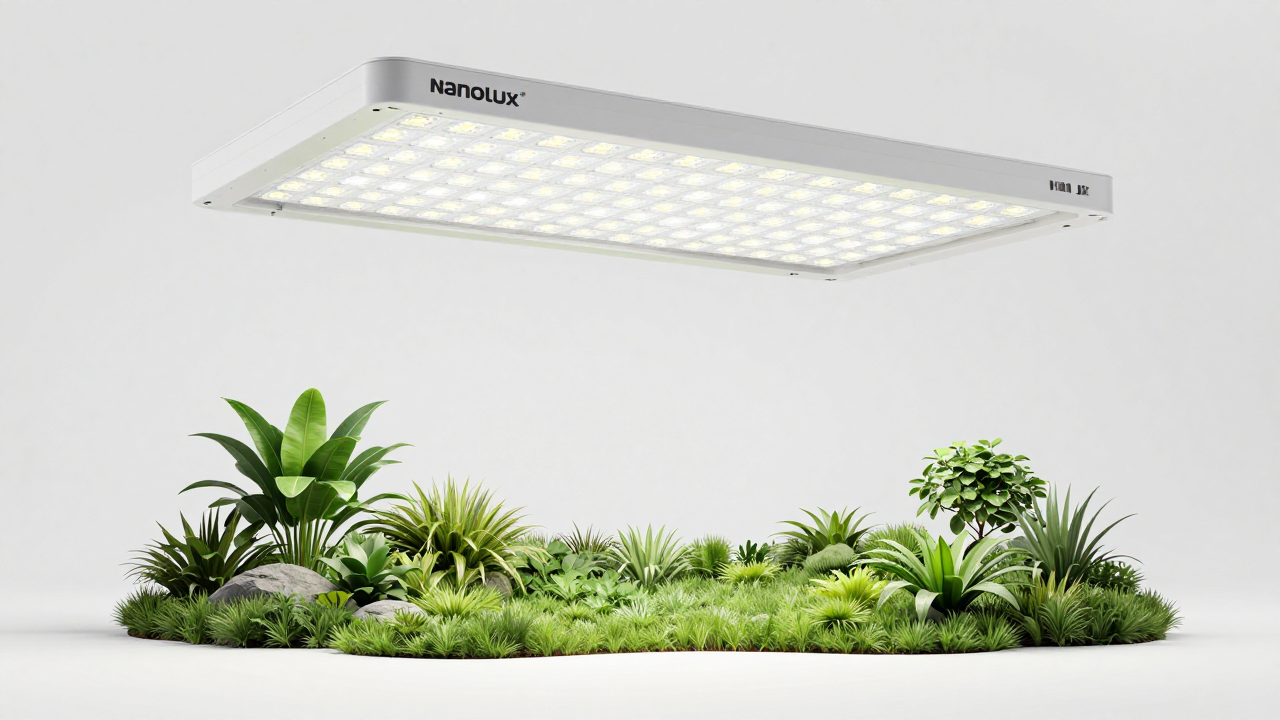
4. Ceiling-mounted with zero floor footprint. In vertical farms with 14-foot racking, every inch of headroom matters. The thinnest fixtures hitting the US market in late 2025 are 1.7 inches deep and deliver 2.9 µmol/J efficacy. They mount flush against strut channel and leave walkways clear for scissor lifts.
5. Under-canopy lighting that doesn’t cook the lower leaves. The theory of hitting lower bud sites with supplemental light is sound. The practice has been a mess—too much heat, uneven distribution, leaves bleaching. The next generation uses low-profile bars running at 40W per 4-foot section, positioned 28 inches below the main canopy, and the spectral output is shifted toward green wavelengths (520-550nm) that penetrate deeper without triggering photoinhibition.
6. IP65-rated fixtures as standard, not an upsell. Murphy’s barn fire could have been avoided with a proper ingress protection rating. Condensation, foliar sprays, and high-pressure fogging all destroy unprotected electronics. In 2026, any fixture sold into a commercial greenhouse without minimum IP65 across the entire assembly—driver, connectors, junction box—is a liability somebody’s lawyer will eventually chase.
7. Real-time energy cost per gram. The metric that finally aligns CFOs and head growers. New dashboard software displays a running calculation: total fixture kWh consumed divided by projected harvest weight, updated weekly from historical strain data. When your energy cost per gram creeps from $0.14 to $0.19 in mid-cycle, you can tune the photoperiod or intensity immediately instead of discovering the gap during a quarterly review.
I work for a lighting manufacturer, so you’d expect me to say this next part. But the biggest lesson from the last two years isn’t about any individual fixture—it’s that the grower who buys lights first and figures out environmental integration second is essentially writing a blank check to their local contractor for emergency repairs. The seven directions above only work when your lighting, HVAC, irrigation, and data loggers are in constant conversation.
If you’re planning a retrofit for 2026, start with a quantum sensor audit of your existing canopy PPFD uniformity. Get your VPD trend logs for the last six months. Then—and only then—start comparing spectra and efficacy numbers. The lights will wait. A ruined $180,000 crop won’t.
