
October 2022. A 20,000-square-foot cannabis facility outside Sacramento, California. The head grower—we’ll call him Dave—stared at his laptop screen like it was showing him a death in the family. Eighteen percent. That’s how far below projection his latest harvest had fallen. Pests? Zero. Mold? None. The culprit was invisible, humming silently above the canopy: 500 brand-new, top-dollar commercial grow lights that were supposed to future-proof his operation. Instead, they flushed nearly $190,000 in potential revenue straight down the drain.
I’ve been in the horticultural lighting game for over 15 years, much of that spent inside Nanolux’s engineering and grower support teams. I’ve watched smart operators torch their margins on lights they didn’t understand, while mediocre growers quietly pulled ahead simply by avoiding the same traps. 2026 isn’t going to be won by whoever has the most expensive fixtures. It’ll be won by the people who’ve stopped making these three expensive, surprisingly common mistakes.
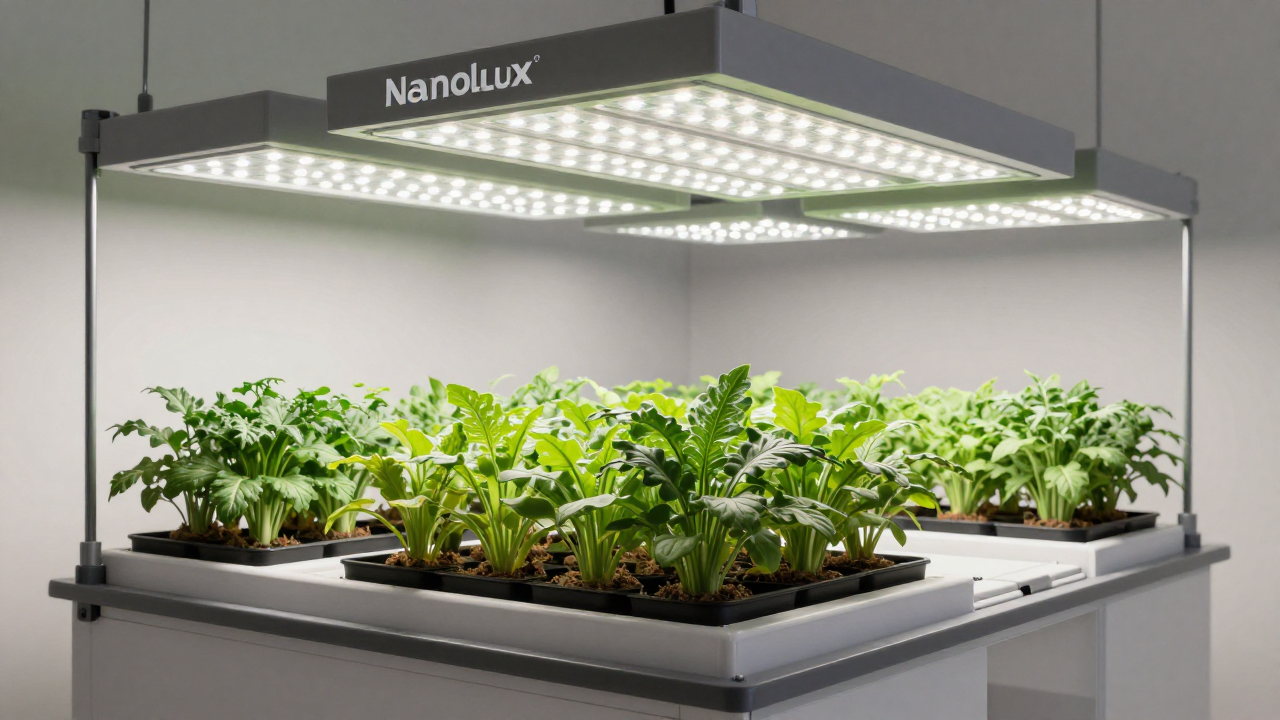
The Full Spectrum Lie That Cost a Sacramento Grower $190K
The Setup
Dave’s facility ran a perpetual harvest cycle—clones, vegetative, flowering, all under one roof. In March 2022, he ripped out aging HPS fixtures and installed 500 LED panels from a brand that marketed a “full spectrum” as the final answer. The spec sheet looked beautiful: broad white light with a bump at 660nm red, 2.6 µmol/J efficacy. His distributor told him these were plug-and-play. No adjustments needed. Just hang ’em up and watch the magic happen.
Where It Went Off a Cliff
Here’s the thing about “full spectrum” that nobody talks about at trade shows: plants don’t read spec sheets. Vegetative cannabis wants a more balanced blue-to-red ratio to keep internodes tight. In flower, the demand shifts hard toward deep red and far-red. Dave’s new LEDs had one fixed spectral curve. No dimming per channel, no spectral tuning. By mid-April, his veg room looked like a string bean factory—stretched stems, huge internodal gaps. The flowering rooms, meanwhile, pushed airy buds because the fixture’s red peak wasn’t quite where the plants needed it during weeks four through seven of bloom.
We’ve reproduced this exact pattern in our own testing. Using a fixed broad-spectrum LED versus a tunable one, canopy-level measurements showed a DLI (Daily Light Integral) that was technically correct—around 40 mol/m²/d in flower—but the photosynthetic photon flux density (PPFD) in the 620-680nm range was 23% lower than what a properly timed supplemental red channel delivered. That gap shows up on the balance sheet, not just under a spectroradiometer.
The Damage
Dave’s yield dropped from a facility-wide average of 58 grams per square foot to 47.5 grams. On a 20,000-square-foot canopy, that math gets ugly quickly. Worse, the variability meant he failed quality thresholds on two wholesale lots, forcing him to sell into the extract market at a steep discount.
How to Avoid It
Stop treating spectrum like a binary checkbox. If you’re growing a high-value crop with distinct photoperiod stages, your commercial grow lights need independent channel control—or at minimum, you need to plan your fixture layout with separate veg and flower zones that use different fixed spectra. We eventually rebuilt Dave’s layout using dual-channel fixtures that let him dial the red:blue ratio up and down without swapping hardware. He broke even on that retrofit within two harvests. Not fast, but fast enough.
A quick, non-sexy formula that’ll save your bacon: DLI = PPFD × (3600 × photoperiod hours) / 1,000,000. Don’t just measure total PPFD. Break it down by wavelength band at least once during mid-cycle, or your “full spectrum” might be underfeeding the only part of the spectrum your crop actually cares about that week.
How ‘Energy Efficient’ LEDs Sent a Nevada Greenhouse’s Bills Through the Roof
The Setup
July 2021. A 40,000-square-foot tomato greenhouse outside Reno, Nevada, replaced their 1000W double-ended HPS rigs with 650W LED fixtures that boasted 2.8 µmol/J on the datasheet. The facility manager, a sharp guy named Luis, ran the ROI math three times. The LEDs penciled out to a 34% reduction in lighting electricity, with an estimated payback under 18 months. He signed the purchase order in June. By August, he was sweating through his shirt for reasons that had nothing to do with Nevada summer heat.
The Hidden Bite
Those new LEDs ran hot. Not the emitter side—the driver side. In a sealed greenhouse with limited airflow around the driver housings, fixture surface temperatures near the ceiling routinely hit 140°F during the afternoon. The HVAC system, which had been sized for the old HPS heat load, suddenly had to fight a different thermal profile: less radiant heat hitting the crop directly, sure, but a pocket of superheated air trapped above the trellises that the extraction fans couldn’t clear fast enough. The chiller load for the nutrient solution also crept up because the room’s ambient temperature climbed 5°F.
The actual system efficiency—total grams harvested per kilowatt-hour consumed by *everything*, not just the lights—got worse. Way worse. They’d saved $8,400 a month on lighting electricity. They added $11,200 a month in cooling runtime and chiller overages. Net loss: $2,800 per month, every month, for a full growing season.
I’ve sat in enough post-mortems to know this isn’t rare. A fixture’s “efficacy” measured in a 25°C integrating sphere has nothing to do with how it behaves in a 95°F greenhouse with dust on the heat sinks and a 0.3 m/s cross-breeze.
What a Honest Comparison Looks Like
We started keeping our own operational data because the spec sheets are a fantasy. Here’s a side-by-side from a northern Nevada greenhouse retrofit we monitored, normalized per 1000W of installed lighting:
The “properly cooled” column isn’t magic—it’s just a fixture where the driver enclosure and thermal path were designed for the actual environment, not a lab bench. When Luis swapped out half the greenhouse with those units in early 2023, his system-level grams-per-kWh finally started trending in the right direction.
The Uncomfortable Truth About Efficiency Numbers
A datasheet that shows 2.8 µmol/J but ignores driver thermal throttling at 120°F is, for a commercial grower, about as useful as a fuel-economy sticker on a car that only drives downhill. Before you commit to a 500-fixture order, get a single unit into your worst bay—the one that gets hot, the one with the janky airflow—and log canopy temps, driver case temps, and total room power draw for two full photoperiod cycles. No simulator spits out data as real as your own ugliest room.
The Light Hotspot Disaster That Ruined a Detroit Vertical Farm
The Setup
December 2023. A vertical farm in Detroit—butterhead lettuce, basil, a little microgreen action—installed a new rack system with LED bar lights suspended nine inches above the trays. The fixture selection was solid on paper: high PPF output, good efficacy, IP65 rated. They ran the layout recommendation from the manufacturer’s generic calculator, which assumed perfect reflectivity and zero shadowing from rack framing. The real world didn’t get the memo.
The Slow-Motion Meltdown
Within three weeks, the grow manager noticed a strip down the center of each shelf growing denser, taller, and lighter green than the edges. By week five, the center canopy was closing in on itself, trapping humidity, while the outer plants looked stunted and pale. The PPFD delta measured with a quantum sensor was brutal: 740 µmol/m²/s dead center, 410 in the corners—a 45% drop. In a leafy green operation where consistent growth rate dictates harvest scheduling and labor planning, that kind of variance is a logistics nightmare.
Then the real problem hit. The dense center canopy on the lower shelves started retaining moisture overnight. By mid-January, they had botrytis creeping through two racks. They lost 2,800 heads of lettuce in one week and had to shut down the bay for a full sterilization cycle. A lighting layout miscalculation turned into a pathology problem. That’s the kind of domino effect that doesn’t appear on a ROI worksheet.
Fixing the Grid, Not Just the Fixture
We ran a lighting model for them using the actual rack dimensions, shelf materials (matte aluminum, not theoretical perfect reflector), and sensor-verified reflectivity. The fix wasn’t a new light. It was removing the center three bars per shelf and replacing them with wider-angle optics, then adding two slim under-canopy strips on the edges to lift the corners. Total cost: under $4,000 for the retrofit. Uniformity jumped to +/- 8% across the shelf, harvests synchronized, and the botrytis never came back.
PPFD uniformity is the metric that puts butts in seats and then quietly destroys them if ignored. Most growers obsess over peak numbers. The ones who outshine competitors in 2026 will be the ones obsessing over the *lowest* number on the grid, because that’s where disease starts and where yield slips through unnoticed.
—
I’ll be blunt—I’ve made all three of these mistakes myself at some point between 2008 and 2016. Bought the hype. Trusted the datasheet. Ignored the dark corners. If you walk away from this article thinking the lesson is “buy Nanolux,” I’ve done a bad job. The lesson is: stop treating your commercial grow lights as a commodity specification and start treating them as a system that interacts with your HVAC, your cultivar’s spectral demands, and the actual geometry of your grow space. The growers who internalize that before 2026 aren’t going to just outperform. They’re going to make everyone else wonder what the hell they missed.
