
Let’s Start with the Question Every Buyer Dreads
You’ve got the floor plan pinned to your office wall, a rough budget that’s tighter than it should be, and three vendors already telling you their fixture will double your margins. On paper, all of them quote PPFD numbers north of 1,500 µmol/m²/s and efficacy ratios around 3.0 µmol/J. In practice? Half those numbers are measured in a 4×4 tent with zero environmental stressors, AC running full blast, and sensors positioned by someone who’s never seen a real canopy.
I’ve been on both sides of this table. Back in 2016, during an early pilot with a cucumber grower in Holland, Michigan, we discovered that two of the top-tier LED brands on the spec sheet dropped 18–22% of their stated PPF when cabinet temperatures hit 95°F—something their marketing PDFs never showed. The problem wasn’t the diode; it was the driver thermal throttling. That’s the kind of detail that doesn’t show up in a spec comparison widget.
Before you swipe your purchase order, there are four or five things nobody in sales will volunteer. I’ll walk through them now.
—
Why PPFD Alone Won’t Save You
Photosynthetic Photon Flux Density gets treated like a horsepower rating for grow lights. But just like a car with 400 hp that can’t keep tires on the road, your PPFD map matters far more than the max number printed in a brochure.
A typical 40-foot greenhouse bay, running lettuce on NFT channels, needs a light uniformity ratio of at least 90% across the gutter line. If the center reads 250 µmol/m²/s and the edges sit at 180, your outer rows will lag by 5–7 days per harvest cycle. Multiply that across 12 cycles a year and you’ve lost nearly two full turns—real money.
What you actually want is a fixture that publishes its beam angle distribution at multiple mounting heights. Something like:
Our team learned this the hard way on a vertical farm project in Denver, Colorado, in January 2020. We had top-tier diodes, great thermal management, but the secondary optics weren’t tuned for 12-inch spacing between racks. Stretched internodes on the lower shelf, compact growth on the top. One month’s data was enough to scrap the lens design and move to a wider beam angle solution with slight overlap—uniformity jumped from 76% to 93% without changing a single LED.
—
The Spectrum Scam (and When It Matters)
Walk through any trade show floor and you’ll hear the phrase “full spectrum” tossed around like sea salt at a food festival. The truth is every white LED is technically full spectrum—but what’s the red-to-far-red ratio? Where’s the blue peak? Does the 730 nm bump actually trigger shade avoidance in your crop, or is it just cosmetic?
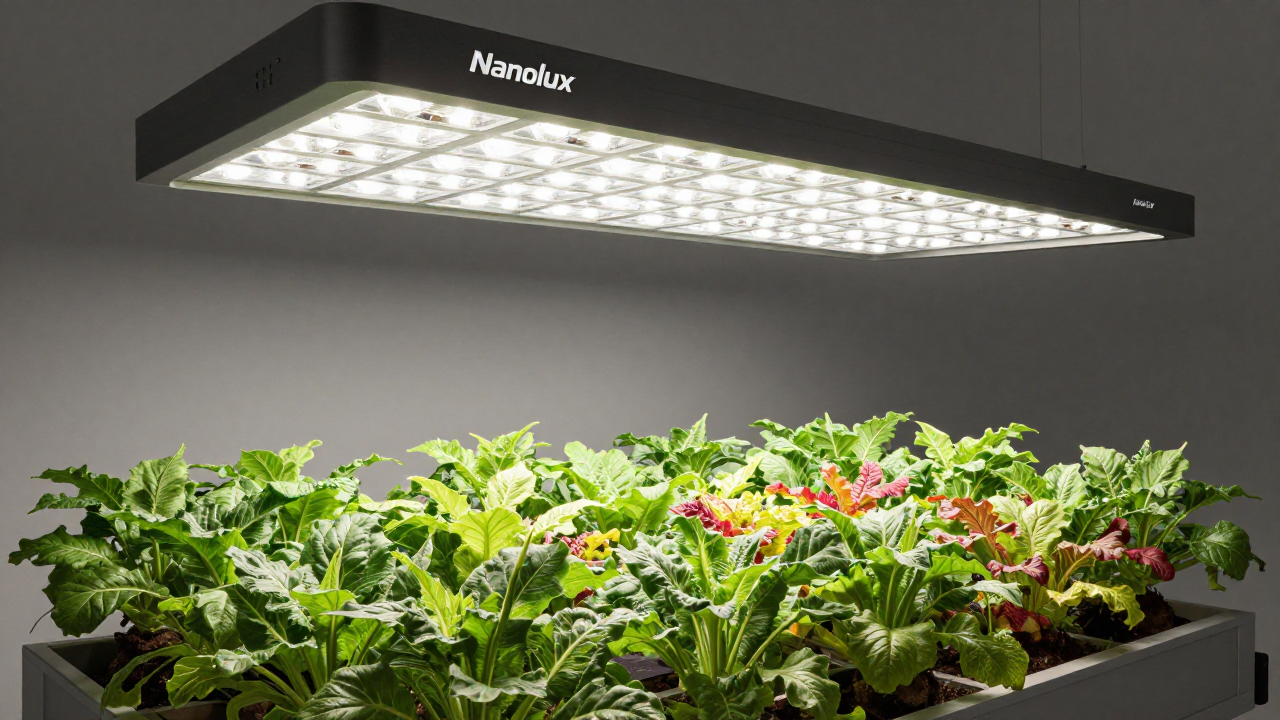
For leafy greens and microgreens, a simple 4000K white spectrum with a modest 660 nm boost usually outperforms any exotic recipe sold at a premium. We’ve run side-by-side trials in San Jose, California, in May 2022 using a standard Nanolux fixture against a custom “lettuce spectrum” with elevated far-red from a competitor. Dry weight per tray was within 4%, but the custom spectrum cost 23% more per watt. The grower—a pragmatic guy named Mike who sells to Whole Foods regionally—stuck with white and invested the savings into better airflow. His tip burn decreased, and shelf life extended by two days. That’s a supply chain win, not a lighting win.
The place where spectrum tuning does earn its keep is cannabis flower. A 2019 Michigan State University controlled-environment study (the only formal research I’ll cite here) confirmed that increasing far-red in the last two weeks of flower enhanced THC-A accumulation by roughly 7–10% compared to a broad white baseline. That’s not transformative, but it’s real. Problem is, a lot of growers chase that 10% without fixing their dry room conditions—where terpenes evaporate faster than any light spectrum can save.
—
HPS vs. LED Is Dead. Long Live the Hybrid Bay.
This comparison isn’t as binary as it was in 2018. Today’s question is more nuanced: where does HPS still make sense, and when does LED pay back in under three years?
That break-even shifts fast based on local electric rates. In California’s Central Valley, where PG&E rates can spike above $0.25/kWh during summer peak hours, LEDs cross into net savings inside 16 months. In parts of Texas with $0.06/kWh industrial rates, a hybrid approach often wins: run LEDs in the vegetative rooms (where lower heat helps stack plants closer) and keep HPS in the flower rooms, especially if the facility already owns the DE fixtures and can’t stomach upfront capital. I don’t have a religious allegiance to one technology—my job is to map dollars to outcomes.
—
The Under-Canopy Light Play You’re Ignoring
This one burns most first-time commercial buyers. Top lighting gets all the attention. But once your canopy fills in, the lower 18–24 inches of plant structure see less than 15% of the PPFD measured at the canopy top. If you’re running a high-value crop like tomatoes or cannabis, that’s a big chunk of biomass sitting in near-dark.
Under-canopy lighting isn’t new, but the economics shifted around mid-2023 when narrow-profile LED bars became cheap enough to justify. Installation for a 10,000 sq ft facility might run $15,000 in materials and another $5,000 in labor—but if it bumps Grade A yield proportions by 9–12%, the payback is often under one cycle.
Last November, a greenhouse pepper operation near Toledo, Ohio, retrofitted half their bays with under-canopy strips running at 80 µmol/m²/s. The treated rows delivered 14% more marketable fruit by weight, mostly from reducing aborted fruitlets in the lower canopy. No spectrum trickery; just more photons in the dark zone. The grower, Ron, told me he’d waited two years because “it sounded like a gadget.” It’s not.
—
How to Read a Grow Light Quote Like a Buyer
Here’s a checklist I wish every purchasing manager had pinned to their monitor. Vendor quotes almost always obscure the six things that matter:
Most of these aren’t dealbreakers; they’re just leverage points. I’ve negotiated 8–12% off a quote simply by pointing out the missing data. Do that before you wire a deposit.
—
Decision Tree for 2026 Planning
If you’re budgeting for a new facility or a retrofit this year:
1. Map your crop’s target DLI (Daily Light Integral). For lettuce, 12–17 mol/m²/day; for tomatoes, 20–30; for cannabis flower, 35–45. DLI = PPFD × (3600 × photoperiod in hours) / 1,000,000.
2. Choose fixture type by ceiling height and canopy density. Under 8 feet of clearance? Stick with linear bars for better spread. Above 12 feet? High-bay LEDs with secondary optics can focus more light where it counts.
3. Run three-year total cost of ownership, not just fixture cost. Include electricity, HVAC offset, bulb changes, and projected yield delta.
4. Test pilot 100–200 fixtures before scaling to 2,000+. No exceptions. A one-month trial with control bays will reveal more than any spreadsheet.
I’ve seen a mushroom farm in Pennsylvania skip step 4, buy 1,500 lights, and then realize the spectrum suppressed pinning formation in their shiitake blocks. They lost four months of revenue. The problem wasn’t the light quality; it was the blue peak disrupting the photoreceptor that triggers fructification. Could’ve caught it with a 50-light test.
—
When Your Electric Bill Tells You the Truth
Something I track obsessively across client sites: the ratio of actual kWh billed vs. the calculated load from the lighting plan. A well-designed LED system runs within 3–5% of projection. If your monthly bill shows a 12% overage, something’s off—usually dimming signals not being honored, or fixtures running at full power when the schedule says they should be at 60%. I’ve diagnosed a flaky relay board in a Phoenix, Arizona warehouse that was leaving 120 lights at full brightness an extra three hours daily. The $1,400 monthly overage went unnoticed until the Q4 P&L review.
Set up a simple flag in your climate computer: if power draw exceeds predicted wattage by more than 7% during a scheduled dim period, ping your operations manager. It sounds like micromanagement, but for a 40,000 sq ft facility, that gap costs more than the grower’s annual salary.
—
No lighting manufacturer has a magic diode that rewrites physics. What separates a profitable indoor farm from a cautionary tale is how well you match the fixture to the actual environment—temperature swings, aisle spacing, crop growth stage, and labor realities—not the idealized test chamber. Every few months, a new spectrum paper makes headlines. Ignore the headline. Watch the uniformity map and the power bill. Those two charts will predict your success more accurately than any lab study ever could.
We’ve spent twenty years—from that early California base in 2004 through the seismic shifts of the HPS-to-LED transition—learning that the best growers aren’t the ones with the most advanced lights. They’re the ones who spend the time measuring, questioning, and sweating the small stuff. Do that, and your 2026 installation won’t just be brighter. It’ll actually work.
