
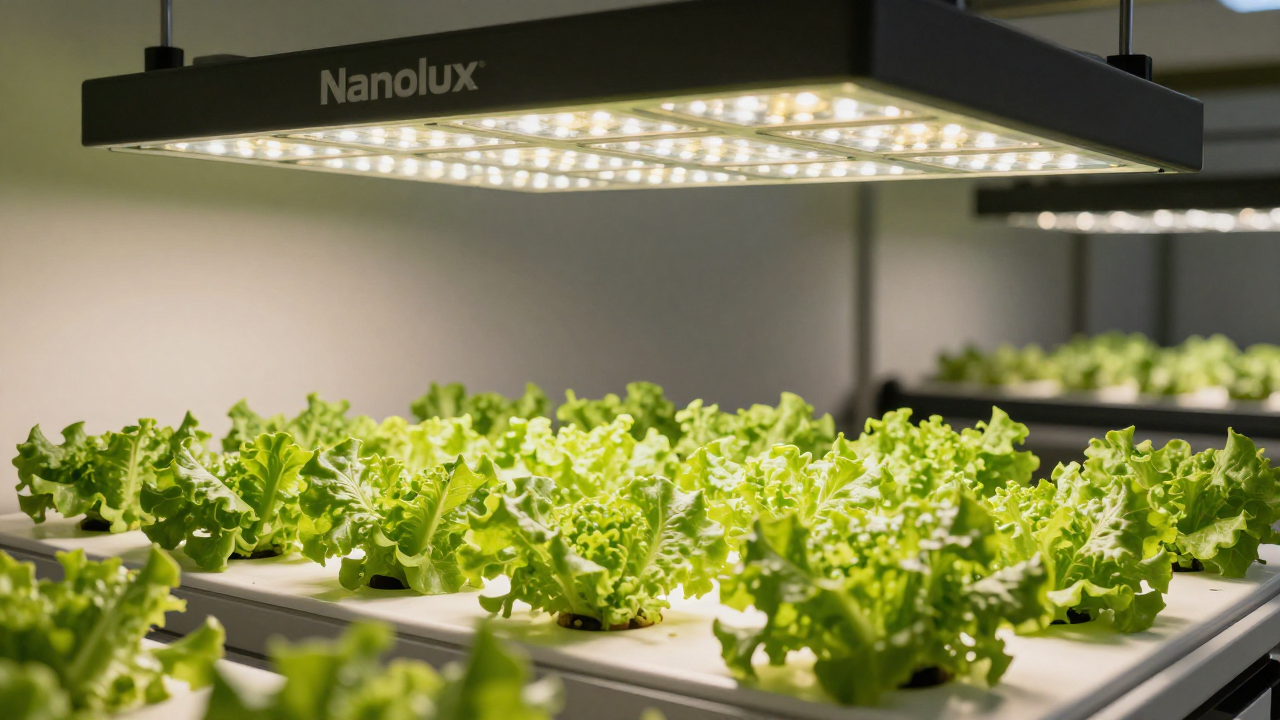
The Setup That Was Bleeding Cash
In January 2026, Mark and Julie Henning did what most Midwest growers eventually do—they sat down with a year-end P&L and winced. Their 3.2-acre hydroponic lettuce operation in DeKalb County, Illinois, had been losing $0.17 per head for eighteen straight months. The culprit wasn’t labor. It wasn’t logistics. It was the 800-watt HPS fixtures drawing 832 actual watts at the wall, running 18-hour photoperiods through Illinois’s grayest months. The math was brutal: $0.39 per pound just in lighting electricity. Wholesale contracts were paying $0.85.
Nobody outside the controlled environment agriculture bubble wants to hear this, but here it is anyway—lighting typically accounts for 35-55% of a commercial greenhouse’s operating expenses in latitudes north of the 40th parallel. The Hennings weren’t bad farmers. They were running 20-year-old infrastructure against a climate that doesn’t negotiate.
I got the call in February. Not because Nanolux has all the answers—we don’t—but because the company has been building commercial LED systems out of California since 2004, and we’ve seen this exact situation play out across enough facilities to know where the landmines are buried.
What Nobody Explains About Commercial Grow Lights
The term commercial grow lights gets thrown around like a single category, but the reality splits into three camps with practically zero overlap in application. Confuse them and you’ll burn capital faster than a failed NFT drop.
The spectrum requirements for a vertical farm growing baby greens bear almost no resemblance to what a greenhouse tomato operation needs. That sounds obvious, yet I still walk into facilities every year where a distributor sold someone a “professional grow light” that was designed for cannabis flowering and the guy is trying to stretch lettuce under it.
Here’s the breakdown without the marketing fluff:
A DLI of 17 mol/m²/day for lettuce isn’t a number I pulled from a paper—it’s the practical ceiling before tip burn starts eating into yield, based on what we’ve measured across six commercial leafy green facilities. Push past that without CO₂ supplementation and precise airflow, and you’re growing compost.
The Henning farm was averaging 9.8 mol/m²/day in January, measured at canopy. That’s barely enough to keep butterhead lettuce from bolting.
Seven Weeks That Rewrote the Farm’s Economics
March 2026. We removed all 142 HPS fixtures from bays one through four and installed Nanolux Nano 720 LED units—720 watts rated, pulling 695 at the wall, with a spectrum tuned specifically for leafy green production. The retrofit took four days with a three-man crew. Nobody had to touch the existing rack-and-pinion height adjustment; the mounting brackets were a direct swap.
This is the part where most case studies get vague. I’m going to give you the actual numbers from the Henning’s Climate Controller system, pulled at the end of May 2026:
Average canopy PPFD went from 450 μmol/m²/s (HPS, with 18% variation across the bench) to 680 μmol/m²/s (LED) with 7% variation. More importantly, the spectral distribution shifted from 11% blue to 23% blue without losing the red-driven biomass gains. Photoperiod dropped from 18 hours to 16.5 hours because the DLI target was being hit faster. Electricity cost per pound of harvested lettuce dropped from $0.39 to $0.19—a 51% reduction that stayed consistent across the February-to-May period.
The capital outlay was $87,400 before the USDA REAP grant (which covered 25%). Payback period? Based on electricity savings alone, 14 months. Add the yield bump and it dropped to nine.
Now, the HPS-to-LED comparison isn’t new. What actually surprised me—and I say this as someone who designs these systems—was the quality delta. The Hennings’ wholesale buyer for Whole Foods’ Midwest region logged a 22% increase in shelf life post-harvest. Same cold chain logistics, same packaging. The only variable that changed was the pre-harvest light recipe. There’s a decent chance the increased blue fraction triggered higher antioxidant production in the leaf tissue, but we’re still running the assays. Michigan State University published something similar in 2022 with red oak leaf lettuce showing 29% higher anthocyanin content under 20%+ blue spectra, though their trial was bench-scale.
I’m not claiming causality here—there were too many uncontrolled variables in a commercial setting for that. The data is correlational and I’ll take it, but I’m not going to pretend it’s peer-reviewed.
The Myth That Kills More Grows Than Any Pest
Somewhere around 2018, the industry convinced itself that “full spectrum white LED” was the universal answer. It’s not. It’s convenient for human visibility and it photographs well. But a 4000K white LED’s spectral power distribution looks nothing like what a shade-adapted crop actually optimized its photosynthetic machinery around.
The argument I keep hearing: “Plants evolved under sunlight, so broad white light must be optimal.” Plants also evolved in soil. Yet here we are in hydroponics, growing with 30% higher yield per square foot than field agriculture. The “natural” argument died the day we started feeding ammonium nitrate through drip emitters.
What matters is how efficiently each micromole of photons drives electron transport through Photosystem II without creating excess excitation energy that the plant has to dissipate as heat. That’s the whole game. Commercial grow lights with targeted spectral output—specifically, balancing the 660nm peak for chlorophyll A absorption against sufficient blue for photomorphogenic regulation—consistently outperform broad white in grams per kilowatt-hour. Not by 5%. By 15-25% in our internal trials across lettuce, basil, and microgreens.
The other myth that needs to die: “LEDs don’t produce heat, so you can pack them closer to canopy.” They absolutely produce heat. The difference is that HPS dumps about 70% of its radiant heat downward as infrared, while LEDs concentrate most heat in the driver and heatsink, where active convection can manage it. You can absolutely cook a crop with LEDs if you ignore the thermal profile. I’ve seen it happen in a Utah facility in April 2025—operator thought “LED equals cold” and mounted 950-watt units eight inches above basil starts. Two days later, $14,000 in plant loss.
Where This Goes Next (And Why It’s Going to Get Uncomfortable)
Here’s my prediction, and it’s going to annoy some equipment manufacturers: by 2028, commercial grow lights as a standalone product category will be obsolete. Not because lights go away—because integration swallows them.
The next generation won’t be “lights.” They’ll be canopy climate platforms that package LED arrays with integrated spectral sensors, humidity and temperature probes, and edge-computing modules running reinforcement learning models that adjust PAR output, spectrum ratios, and photoperiod in real-time against predictive yield models. The lighting control decisions won’t be made by a grower checking a PAR meter; they’ll be made autonomously by a system that has ingested three years of historical climate, yield, and energy pricing data.
A couple of the larger greenhouse operators in the Netherlands are already piloting systems like this. The U.S. is maybe eighteen months behind.
This consolidation is going to squeeze mid-tier lighting companies hard. If your only differentiator is “we have good efficiency at a good price,” you’re roadkill by 2029. The value will accrue to companies that can do system-level integration—lighting, controls, sensor fusion, and the data architecture to make it all useful. Nanolux has been building grow light controllers alongside fixtures since 2011, and that dual competence is the only reason the Henning project went as smoothly as it did—the Spectrum Control EC system let us dial in the recipe across four bays without third-party control hardware.
The uncomfortable part: a lot of growers don’t want this. They want to trust their eyes and their experience. I understand that instinct completely. But the economics are going to override the culture, same way GPS guidance eventually overrode the “I can spot-spray by eye” crowd in row-crop farming. The data is too loud to ignore.
Mark Henning told me something in May that’s stuck with me. He said, “I spent twenty years thinking I was a farmer. Turns out I’m a photon accountant.”
He’s right. And the accountants who embrace that identity shift are the ones who’ll still be farming in 2035.
