
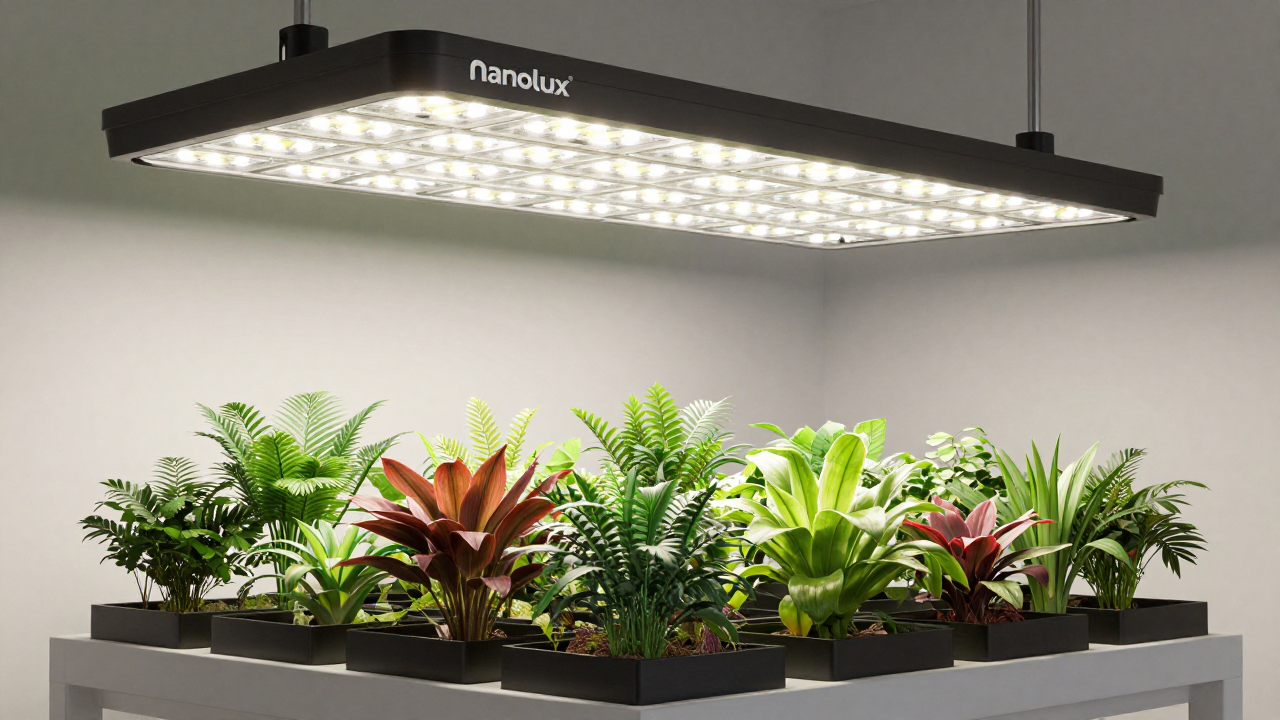
Why Cranking Up Your Lamps Is Usually a Money Pit
Most commercial growers we talk to start with the same assumption: more watts equals more yield. That logic works for a tractor engine, not for a plant canopy. Light is not just fuel — it’s information. Toss a 1000W HPS fixture into a 4’x4′ tent and you’ll generate heat, not better plant morphology.
Photosynthesis captures photons between 400 and 700 nm (what plant scientists call PAR). Photomorphogenesis — how a plant builds stems, stretches, and sets flowers — uses specific wavelengths outside that range, especially far-red and UV. A standard HPS bulb dumps 40% of its electrical input into infrared radiation you can’t see, and that the plant can’t use for carbon fixation. Run the numbers: a single-ended 1000W HPS might deliver 1.7 µmol/J of photosynthetically active photons. A modern commercial LED bar designed for a greenhouse hits 3.0 to 3.4 µmol/J without the radiant heat load. You’re literally paying to heat the ceiling.
Back in February 2022, a cut-flower greenhouse in Carpinteria, California swapped 90 HPS fixtures for an equivalent PPF layout from LED. Their canopy-level PPFD reading stayed at 600 µmol/m²/s, but the electric bill dropped 38% and — this is the part that surprised the owner — stem length uniformity improved by 21% across the bench. Not because of extra light, but because the spectrum eliminated the far-red spike that was triggering stretch. The owner, a guy named Martin who’s been growing gerberas since ‘98, told us, “I was trying to fix my climate. Turns out my lights were the problem.”
One more thing worth flagging: fixture wattage ratings are almost useless until you map them to a light plan. A 630W LED can outperform a 1000W SE HPS if the photon distribution is uniform. Think in terms of µmol/s per fixture, and then look at the coefficient of variation across the grid. If your uniformity is garbage, you’ll push intensity to compensate for dark spots, which fries the centers and leaves the edges lean. That’s where yield leaks away without anyone noticing.
—
LED vs. HPS — What the Spec Sheets Don’t Tell Ya
Comparison charts look clean on a website. On the ground, the decision gets messy. Let’s cut through it with a table that reflects what we’ve measured on actual farms, not just marketing slicks.
HPS still has one advantage: brute-force capital cost. If a startup grow operation needs to light an acre of greenhouse this month and cash is tight, a used HPS fleet makes sense. We’ve seen exactly this play out in southern Colorado’s hemp boom of 2019. That’s not a knock on HPS — it’s a cash-flow reality. But by year 3, the cooling bill, lamp replacements, and lost spectrum control usually flip the math in LED’s favor.
Actually, I’m getting ahead of myself. The choice between LED and HPS isn’t a binary — plenty of growers blend overhead HPS with under-canopy LED bars to salvage an older install without tearing out infrastructure. That hybrid approach bought a perennial nursery in Homestead, Florida an extra two years before they fully transitioned. The real question is whether you’re willing to look beyond $ per fixture and model $ per pound of dried flower or per head of lettuce over five years. If you aren’t, the cheapest light today becomes the most expensive one you own.
—
What Nobody Tells You About Light Schedules and DLI
Photoperiod manipulation is more than turning lights off at 6 PM. Plants integrate light over a 24-hour window — the Daily Light Integral, measured in mol/m²/d. A tomato crop in a glasshouse needs 22 – 30 mol/m²/d to hit full yield potential; lettuce sits around 14 – 17. Push DLI too high without bumping CO₂ or nutrients, and you’ll see leaf edge burn, nothing extra hitting the scale.
Here’s a typical miscalculation: a grower in Eugene, Oregon, running a year-round indoor basil operation set his LEDs to 18 hours at 450 µmol/m²/s. That yields DLI = 450 × (3600 × 18) / 1,000,000 = 29.2 mol/m²/d. Basil can take it, but they also jacked up nitrogen thinking the plants “needed more energy.” The result was leggy, low-oil herb with weak flavor. Pulling back to 15 hours and 350 µmol/m²/s, then gradually ramping up over two weeks, gave a DLI of 18.9 mol/m²/d during propagation and 25.5 mol/m²/d for finishing. Oil content recovered to 0.7% fresh weight.
With commercial grow lights, you can now schedule per-second spectrum shifts using 0-10V control signals. For short-day plants like certain Cannabis cultivars, a 10-minute far-red pulse at lights-out can shorten flowering cycle by 5-7 days without sacrificing cannabinoid content. That’s not lab theory; a facility outside Sacramento tested it in November 2023 across three rooms — same clones, same nutrient line — and the far-red pulse rooms finished a full week earlier. One week less of electricity per cycle, six cycles a year. Do that math.
The gear matters, but the schedule matters more. Most PAR maps from light manufacturers assume 100% output. Real operations dim new fixtures to 85% for three weeks to burn in the LEDs, then slowly step up. Record your actual PPFD at canopy height weekly — not once, not when the sensor guy visits.
—
The Hidden Cost of Cooking Your Canopy
Thermal regulation isn’t just an HVAC problem. Leaf surface temperature (LST) governs stomatal opening and transpiration rate. Chase ambient room temperature while ignoring radiant heat from the lights, and your crop is effectively growing 4-6°F hotter than the thermostat claims. That slashes CO₂ assimilation.
In July 2024, a consultant we work with got a panicked call from a vertical farm in Phoenix, Arizona — 108°F outside, and bok choy tips were necrotic despite ambient at 78°F. The culprit: they’d hung 800W LED fixtures 16 inches off the trays. LST measured 92°F. They raised fixtures to 24 inches, dialed intensity back to 70%, and added horizontal airflow fans. Within five days, new leaves emerged clean. No lamp change, just placement and awareness.
Heat also degrades LED drivers prematurely. Some budget fixtures mount the driver directly above the heatsink with zero ventilation, chasing a compact look for marketing photos. Inside a sealed grow room, that driver case hits 140°F and longevity slides from 50,000 hours to maybe 20,000. Commercial grow lights designed for covered production almost always separate the driver or use remote mounting — for a reason.
Don’t confuse “my room feels cool” with “the canopy is cool.” Buy a $50 infrared thermometer and scan leaf temps across the bench three times a day for a week. You’ll find hotspots you didn’t know existed, and those hotspots are costing you grams per square foot right now.
—
Why Your Maintenance Routine (or Lack of One) Is Slashing Your Harvest
Dust, fog, and sulfur vapor from crop protection sprays settle on every horizontal surface — lens covers included. Independent measurements from a third-party lab in the Netherlands (Wageningen University, a 2019 controlled-environment study) showed that a 1 mm dust layer on a glass greenhouse roof reduced PAR transmission by 4.2%. On a fixture lens closer to the canopy, a film of residue can cut output 8-12% over eight weeks.
Now multiply that across 300 fixtures in a one-acre bay. That’s an invisible 10% yield drag that nobody budgets for.
Maintenance isn’t just cleaning. LED diodes shift ever so slightly in spectral output over thousands of hours. A fixture that was perfectly 3000K + 660nm red at installation may drift 2-3% toward blue by year 3. For a mixed salad green operation, that drift changes leaf shape and color — your retail pack looks different, and a buyer notices. Map your light spectrum annually with a handheld spectrometer, not just a quantum sensor, and replace any bar or lamp that falls outside spec before it skews an entire harvest cycle.
Reflector surfaces inside HPS fixtures tarnish. In a Texas greenhouse running high humidity, we’ve seen reflectors go from 95% reflectivity to below 80% in 18 months. That’s not a lamp replacement issue; it’s a housing replacement. Write it into your capital expense forecast.
—
From 40 Grams to 92 per Square Foot — A Salinas Lettuce Op That Actually Did It
In August 2021, a controlled-environment baby lettuce operation in Salinas, California — we’ll call them Coastline Greens — was fighting a yield ceiling of 40 g/ft² per harvest, despite premium seeds and a dialed-in nutrient film technique. Their existing HPS system rendered the room uncomfortably warm, limiting them to lower light intensity to avoid tipburn.
We worked with their head grower to map the canopy with a spectroradiometer and found a 35% uniformity variance — some pockets hitting 500 µmol/m²/s, others barely 180. HPS fixtures were spaced based on a metal building column layout, not a photometric plan. We proposed removing every other HPS and installing an array of Nanolux LED bars, using our 650W full-spectrum fixtures paired with side-lit under-canopy strips. The under-canopy lights raised PPFD at the lower leaves from 90 to 210 µmol/m²/s without increasing heat load.
By January 2022, after two full crop cycles, their harvest weight climbed to 71 g/ft². They pulled back on leaf texture complaints — previously a big issue for their buyer at Whole Foods — and shelf-life improved due to thicker cell walls from UV-A we included in the spectrum. Through incremental tuning — changing photoperiod to 17 hours, bumping CO₂ to 1000 ppm, and adjusting nutrient EC — Coastline Greens hit 92 g/ft² by May 2023. Their electricity cost per pound dropped from $0.48 to $0.31.
The kicker: payback on the lighting retrofit came in at 17 months, not the projected 28. Did every variable line up perfectly? No. Their chiller failed once and they lost a week of data. But the direction was unmissable. Real operations are messy. What matters is that the lighting infrastructure stopped being the bottleneck.
—
2026 Is Coming: Are You Ready for Adaptive Lighting and AI?
We’re already seeing commercial grow lights with embedded cameras and environmental sensors hitting the pilot stage. These systems don’t just dim on a timer; they read real-time chlorophyll fluorescence and adjust spectrum in 5-nanometer steps to nudge photosynthetic efficiency upward. It’s not science fiction — a beta test ran in a West Virginia tomato greenhouse from March to June 2025, cutting energy use by 14% while keeping production weight flat compared to a static spectrum control group.
Smart controllers and cloud platforms that let you map a whole facility from an iPad are becoming table stakes. But — and here’s the catch — sensor drift and data overload are already tripping up early adopters. If your irrigation system and your lighting AI aren’t speaking the same language, you end up with conflicts: lights ramping up while nutrient dosing drops because a different algorithm thinks VPD is rising. The solution, for now, is choosing a controller ecosystem that handles lighting, HVAC, and irrigation with a single deterministic logic layer, not three separate clouds.
LED fixture efficiency is asymptotically approaching 4 µmol/J in lab settings, but commercial products are settling in the 3.2 – 3.6 range; beyond that, electrical gains risk diminishing returns on spectrum quality. The 2026 leap won’t be in raw efficacy. It’ll be in spectral agility — the ability to load a “seedling recipe” at midnight and a “finisher recipe” at noon without swapping a single lamp. Facilities that invest today in addressable, per-fixture control will retrofit in a day what others will spend a season rebuilding.
Look at your lighting infrastructure as a data platform, not a utility. The growers who treat their light plan like a static asset will get left behind. The ones who treat it as a living, sensor-driven system will be the ones harvesting 100+ g/ft² and wondering why anyone ever thought that was hard.
