
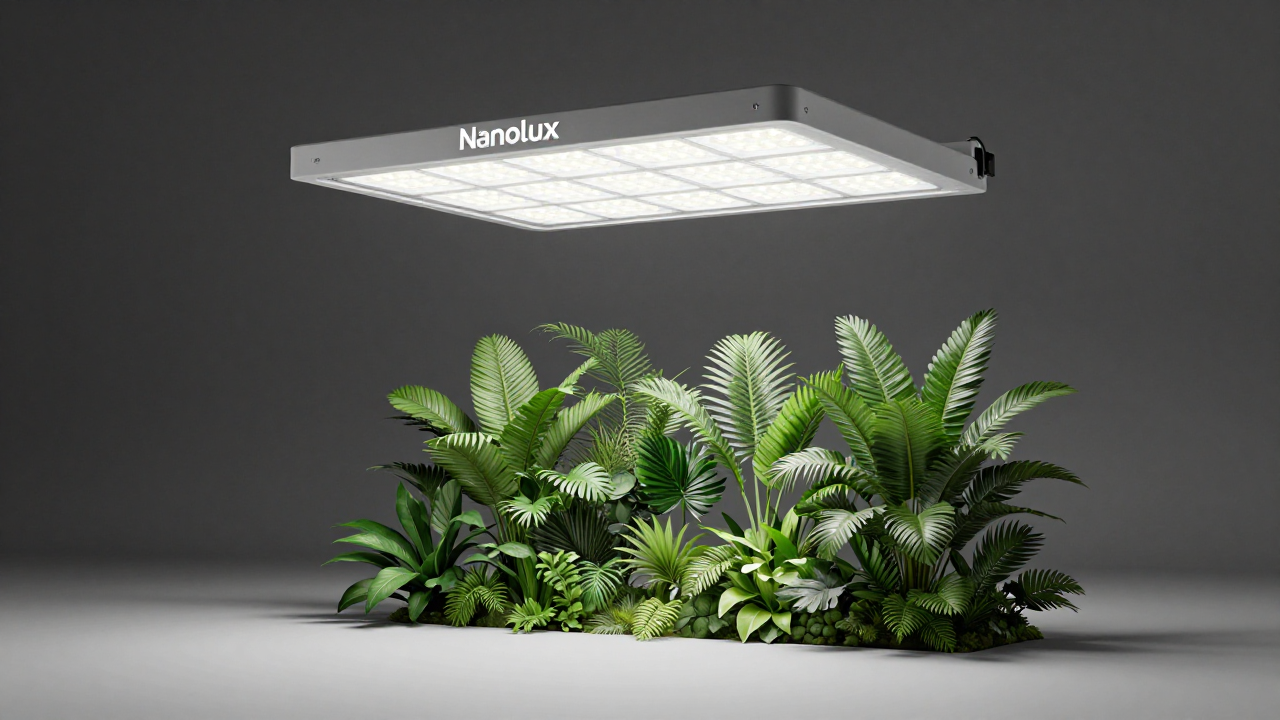
The Light That Separates Profit from Loss in 2026
I’ll be blunt — most of what circulates online about commercial grow lights is recycled garbage. It’s a game of telephone played by content marketers who have never stepped inside a 40,000-square-foot greenhouse in Salinas, California. If you’re running a commercial operation, the difference between buying a fixture because a spec sheet looks good and buying one because you understand the physics behind photon delivery is what separates a harvest that clears your debt from one that sinks you. And that’s exactly why we need to rip apart the five most persistent myths about commercial grow lights before they wreck your 2026 planning cycle.
Stop Believing That Wattage Tells You Anything Useful
The obsession with how many watts a fixture pulls from the wall is a holdover from the HPS era, and it needs to die. I’ve sat through meetings where a purchasing manager waves a quote for a 1000W LED and declares it “twice as powerful” as a 500W option. That logic is bankrupt.
What matters is how many photons land on the canopy, not how much heat you’re paying the utility company to generate. When we evaluate fixtures internally at Nanolux, we look at the photosynthetic photon flux (PPF) — the total number of photosynthetically active photons a fixture emits per second — and the photosynthetic photon efficacy (PPE), measured in micromoles per joule. A fixture that promises 2.7 µmol/J and delivers 2.4 µmol/J under real thermal conditions is a liability, not a bargain.
Industry benchmarks have shifted dramatically. Top-tier LED fixtures today routinely hit 3.0 to 3.5 µmol/J in controlled testing. A mere three years ago, anything above 2.5 µmol/J was considered premium. That evolution means an old design with a low efficacy rating doesn’t just spike your electricity bill; it forces you to run additional HVAC capacity to remove the wasted heat. I’ve seen a facility in Phoenix, Arizona get absolutely crushed by that oversight in August 2023 — their cooling load spiked 18% because they trusted a “cheap” fixture’s printed specs. Don’t be that operator.
High-quality drivers, robust thermal management, and verifiable LM-80 test data aren’t luxury add-ons. They’re the bare minimum. If a manufacturer can’t give you an IES file that matches what a third-party lab measured, walk away.
Your Crop Doesn’t Care About the Brochure — Light Recipes Are Real
I’ve lost count of how many cannabis growers assume a blanket 1:1 red-to-blue ratio works for everything from propagation to flower. Then they wonder why their leafy greens are stretching into pale, bitter messes. We got a panicked call in February 2022 from a vertical farm in Newark, New Jersey trying to dial in butterhead lettuce. They were blasting a generic full-cycle spectrum and applying a DLI of 28 mol/m²/d. Lettuce doesn’t want that much light — 14 to 17 mol/m²/d is the sweet spot for most varieties. They were torching the calcium transport in young tissue, and tip burn was rampant.
Different crops, and even different growth stages of the same crop, demand specific light intensity, spectral distribution, and photoperiod. A tomato transplant in a Michigan greenhouse during a dark February week needs a very different configuration than a flowering cannabis canopy in a sealed indoor room in Oklahoma. Short-day plants trigger reproductive cycles based on uninterrupted darkness, not light. If you don’t have a controller that manages sunset and sunrise dimming — and doesn’t leak a faint purple glow during the dark cycle — you’re inviting hermaphroditic responses and uneven ripening.
We’ve built our RFX series around this principle: spectral tuning isn’t a marketing gimmick. The ability to shift far-red intensity in the last two hours of the photoperiod can accelerate flowering, but only if your DLI and VPD are already dialed in. Throwing a “bloom booster” spectrum at a stressed plant just cooks it faster. Match the light recipe to the crop physiology, not the brochure photo.
The “LEDs Are Too Expensive” Argument Collapsed Three Years Ago
Let’s settle this with a table because I’m tired of hearing it.
The HPS numbers aren’t theoretical. I pulled them from a retrofit project we tracked in Denver, Colorado between 2021 and 2023. The facility swapped 85 double-ended HPS fixtures for an equivalent LED layout, saw a 37% drop in their electrical draw, and canceled their annual bulb-replacement contract worth $4,800. Payback on the LED capital expenditure hit month 14. After that, it’s pure margin improvement.
If you’re still calculating payback on LED conversions based solely on wattage savings, you’re leaving money on the table. Factor in the avoided HVAC load, the labor for bulb swaps, and the yield consistency from a fixture that doesn’t decay 8% in photon output every six months. That’s the real TCO story.
Installation Is a Subtractive Puzzle, Not a Rocket Launch
Honestly, this is the myth that frustrates me most. A well-engineered commercial lighting rack uses plug-and-play waterproof interconnects and a standardized mounting grid. If your facility already has a 10-foot ceiling clearance and a level trellis structure, a team of two can hang 50 fixtures in a morning — we’ve timed it multiple times during Nanolux commissioning trips.
The disaster scenarios I see almost always trace back to one mistake: ignoring the lighting layout map. A facility manager in Portland, Oregon tried to “eye it” in a new 12,000-square-foot flower room in May 2023, centering fixtures based on ceiling tiles instead of canopy footprint. Three weeks into the cycle, the perimeter rows were receiving 400 µmol/m²/s while the center hit 950 µmol/m²/s. Uneven growth, fight after fight with the head grower, and a mid-cycle re-hang that cost them two days of labor.
Map your uniformity in software before you drill a single bracket. Target a light uniformity ratio (min/average) of 0.85 or higher. Verify with a calibrated quantum sensor at canopy height — don’t trust a phone app. And for the love of God, don’t hang fixtures at the same height for a multi-tier vertical rack as you would for a single-level greenhouse; beam angle and overlap calculations change completely.
We’ve simplified this extensively with our grid-mount system, but the real win is documentation. A 20-minute walkthrough with a tablet beats a roomful of guesswork every time.
Maintenance That Doesn’t Feel Like a Root Canal
The image of a grower in a hazmat suit wiping down 1,000 reflectors is pure HPS trauma. Modern LED fixtures with sealed housings and IP66 ratings don’t need that ritual. That said, neglect will still bite you.
I walked a cultivation site in Salinas in late 2024 where the CO₂ enrichment system had been running aggressively, and a fine mist of potassium bicarbonate deposits had coated the LED lenses. Nobody noticed for six months because the fixtures “looked clean” from a distance. Light output had dropped 11%, directly translating to a measurable yield drag in the third consecutive flowering cycle. The fix was a simple wipe-down with a 1% citric acid solution and a microfiber cloth, done quarterly.
Preventive maintenance on commercial grow lights boils down to three non-negotiable actions: quarterly lens cleaning, bi-annual inspection of all cable strain reliefs and connectors (screw terminals loosen with thermal cycling), and a random spot-check of PPFD with a handheld sensor every 60 days to catch driver drift early. That’s it. If a fixture’s driver fails prematurely, you’ll usually see it in the first 90 days, and any reputable company — including us — will cross-ship a replacement immediately.
What Nobody Says About the 2026 Supply Chain
Here’s where I’m going off-script. The greatest risk to your lighting strategy next year isn’t a poor spectral recipe — it’s logistics. Commercial LED drivers rely on integrated circuits manufactured largely in Taiwan and Malaysia. A spike in container rates or a trade-policy shift can stretch lead times from 4 weeks to 14 weeks in a heartbeat. We saw it happen in the second quarter of 2024, and it caught several mid-sized cultivators completely unprepared. They had to limp through an entire summer cycle with aging HPS rigs because their new LED shipment was stuck in customs.
My unvarnished advice: lock in your procurement by February 2026, even if you don’t plan to install until June. The growers who treat lighting as a just-in-time inventory item are the ones who end up posting in industry forums begging for a pallet loan. Build a buffer. Warehouse the fixtures on-site if you have to. The capital you spend on early delivery is an insurance policy against a lost crop cycle — and that’s a trade I’ll make every single time.
Ditch the brochure myths. Match the physics to your plant’s needs, run the real cost numbers, and control what you can control. The 2026 market won’t be kind to anyone still making decisions based on 2010-era conventional wisdom.
