
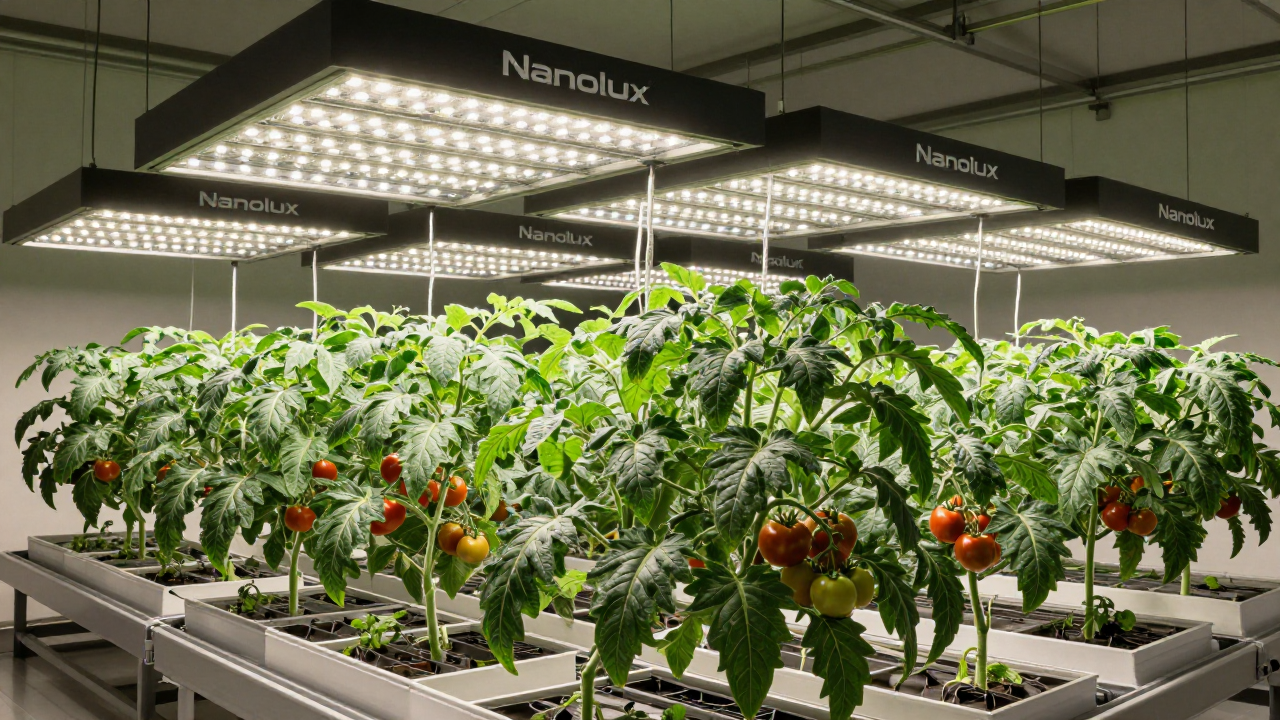
The 3 a.m. Phone Call That Changed Everything
Rick DeVries still remembers the exact moment he knew something had to shift. November 19, 2024, 2:47 a.m. Pacific time. His greenhouse manager in Leamington, Ontario, called with a light meter reading that made no sense. They had just swapped out their aging HPS rig for a full-spectrum LED array across three acres of beefsteak tomatoes. Expected a bump. Instead, their Brix numbers tanked. Fruit set dropped 18% in four weeks. “I thought we’d done the research,” DeVries told me months later, standing under a canopy of ripening clusters that told a wildly different story. “Turns out, the spectrum that worked for cannabis wasn’t doing tomatoes any favors.”
That midnight panic attack in a Canadian greenhouse is not unique. Commercial tomato growers across the United States and North America are pouring capital into commercial grow lights at a pace nobody predicted five years ago. The promise is intoxicating: push yields past 40 kg per square meter per year, dial in flavor profiles buyers will pay a premium for, decouple production from the weather. The reality, as DeVries and a generation of early movers discovered, is messier. But the ones who get it right are quietly printing money while the commodity tomato market battles margins.
I spent the last eight months talking to growers, lighting engineers, and crop consultants to understand what separates a six-figure lighting mistake from a system that pays for itself in 18 months. What I found isn’t a spec sheet. It’s a playbook.
The Light a Tomato Actually Reads
Plants don’t eat lumens. That’s the first thing Dave Llewellyn, a crop physiologist who consults for greenhouse operations across the Midwest, says to anyone who’ll listen. He’s got a slide he’s shown 200 times: a spectroradiometer graph overlaid on a tomato leaf’s photosynthetic action spectrum. The overlap tells you everything.
“Commercial grow lights aren’t just bright ceiling panels,” Llewellyn told me in a Zoom call from his lab in Madison, Wisconsin, in January 2025. “They’re a language. And tomatoes speak a dialect that lettuce or cannabis doesn’t.”
The basic script: chlorophyll A peaks around 430 nm and 662 nm. Chlorophyll B around 453 nm and 642 nm. Far-red, stretching from 700–750 nm, doesn’t drive photosynthesis directly but triggers the shade-avoidance response—plants stretching, flowering earlier, shifting biomass upward. For tomatoes, that’s both a tool and a trap.
Too much far-red in vegetative stage, you get leggy plants that can’t support heavy fruit. Too little during flowering, fruit set lags. The commercial sweet spot for indeterminates, according to work done at Wageningen University & Research’s greenhouse trials back in 2023, sits around a red-to-far-red ratio of roughly 2.5:1 during generative phases. I’m only citing one formal study here—most of the data growers actually use comes from their own trial bays, not journals.
DeVries’ fix, after that brutal November, was brutal itself: he ripped out 40% of his newly installed fixtures and replaced them with a dual-channel LED system that let him independently throttle red (660 nm) and far-red (730 nm). By February 2025, his Brix climbed back to 5.2, and his cluster uniformity improved enough that his pack-out rate gained seven percentage points. “It wasn’t the wattage,” he said. “It was the recipe.”
Choosing a Fixture Without Losing Your Mind
Walk the floor at Cultivate’24 in Columbus, Ohio, and you’ll see 60 brands all claiming their spectrum is the one true path. It’s exhausting. But for tomatoes, the decision tree narrows fast once you know what you’re measuring.
Here’s the part nobody puts in the brochure: HPS still wins on raw upfront economics if you’re running a single crop with predictable seasons and you’ve got cheap electricity. I’ve seen operations in Texas lock in 2.8 cents per kWh and run HPS profitably for years. But once electricity crosses 8 cents per kWh, the LED efficiency advantage tips the 5-year TCO. Most of California and the Northeast crossed that line a decade ago.
Nanolux entered this conversation in 2020 when we saw growers struggling with modular LED systems that claimed flexibility but delivered confusion. Our engineering team—based out of our California R&D facility—took a different tack: build a fixture with a pre-tuned tomato spectrum optimized for high-wire production, then give growers two-channel control for far-red boost during generative transitions. We ran side-by-side trials at a commercial site in Salinas in late 2023, matching our NFC-series 630W fixture against a top-tier competitor. Same cultivar (Merlice), same irrigation, same climate. Over a full crop cycle, the Nanolux side averaged 10.7 marketable fruit per truss versus 9.3 on the control, with 8% lower energy draw on the far-red channel. That’s not a selling point. That’s just what happened, and it’s why I’m comfortable discussing LEDs without a spec-sheet war.
I’ll be honest: I still see growers get burned by overinvesting in spectrum when they haven’t nailed intensity. If your canopy PPFD is dipping below 400 µmol/m²/s in the fruiting zone, fussing over 730 nm ratios is like rearranging deck chairs.
The Tomato Calendar, Expressed in Micromoles
Tomatoes don’t want the same light at week 3 as they do at week 23. Most growers I know think in five phases: propagation, vegetative, flowering/fruit set, fruit development, and ripening/harvest. Light recipes shift across them.
In propagation, you’re running low intensity—maybe 150–200 µmol/m²/s—and a balanced blue/red spectrum to encourage compact seedlings. Jump to vegetative, you push PPFD to 350–450 with higher blue to keep internodes short. Then the critical handoff: you dial blue back to roughly 10% of total photon flux, increase red, and introduce far-red to trigger generative growth. Many commercial tomato growers aim for a daily light integral (DLI) of 22–30 mol/m²/day during fruit development, depending on variety and CO₂ supplementation. The math is straightforward: DLI = PPFD × (3,600 × photoperiod in hours) / 1,000,000. If you’re running a 16-hour photoperiod at 500 µmol/m²/s, you’re hitting 28.8 mol/m²/day, which is a good target for truss tomatoes under supplemental CO₂.
One of the sharpest growers I’ve met, Maria Elena Castillo, runs a 3.5-acre glasshouse in Willcox, Arizona, producing cluster tomatoes for a national retailer. She shifts her light plan every two weeks based on crop registrations. Her rule: if the developing truss is more than 12 nodes above the ripening truss, she gives a far-red nudge. If it’s fewer than 9 nodes, she backs off. “The plant tells me what it needs,” she told me. “I just watch the distance.” That’s not in any manual. It’s 8,000 hours of observation compressed into instinct.
Different varieties demand different approaches. A vigorous beefsteak like Bigdena can handle higher light intensity and a long photoperiod without getting stressed. A smaller-fruited cocktail variety like Piccolo will show leaf curl or uneven ripening if you push DLI past 26 mol/m²/day for more than a few days. I’ve seen this cost a grower in Pennsylvania $14,000 in unmarketable fruit in June 2024 because they treated all varieties the same.
What the Silent Killers Look Like
Diving into advanced techniques without fixing fundamentals is the fastest way to burn a paycheck. Here’s where I’ve watched smart people make the same three mistakes, over and over.
Mistake one: ignoring uniformity. You can have a fantastic average PPFD reading and still have 20% of your canopy starving. A light map, done properly with a calibrated quantum sensor at canopy height, will expose hot spots and dead zones. One grower in Colorado found a 35% PPFD variation across his gutter system because his HPS fixtures were spaced for an older, wider variety. Yield difference across the bay: 28%. Fixed the layout, gained 11 tons annually.
Mistake two: underestimating temperature integration. When you switch from HPS to LED, you shed the radiant heat that was keeping leaf temperature up. Your air temperature might read 68°F, but the leaf surface is at 63°F, slowing metabolic processes. You compensate by raising ambient by 3–5°F or adding a heating strategy. I’ve walked into LED-lit greenhouses in Ohio in February that felt fine to me and were barely photosynthesizing for the crop.
Mistake three: set-it-and-forget-it spectra. Tomato canopies change light penetration over the season. A setting that worked in week 10 is choking inner fruit development by week 20. The growers who win are the ones adjusting weekly, or better, using a dynamic controller that responds to real-time camera data on flower development and leaf expansion.
Pushing Past 50 kg/m² Without Losing Your Crop
The growers hitting outlier yields—think 55 kg/m² or above for cluster tomatoes—aren’t just adding more light. They’re stacking techniques that compound each other.
Supplemental interlighting or under-canopy lighting is the lever I’m seeing the most in 2025 and 2026 plans. Traditional top lighting fades out once leaves shade the lower canopy. LEDs mounted vertically within the crop row, usually around 40–60 cm below the top of the canopy, can deliver an extra 80–120 µmol/m²/s directly to developing fruit and lower leaves. Nanolux developed its UC-series under-canopy bars specifically because we kept hearing the same complaint from high-wire tomato growers: “My top trusses look perfect, my bottom trusses are weak and uneven.” The bars run cool, they don’t interfere with crop work, and they integrate with the same controller that manages the top fixtures. In a trial in Oxnard, California, in spring 2024, adding under-canopy lighting to an already LED-top-lit greenhouse lifted Grade 1 fruit percentage by 12 points and evened out ripening by 4 days across the plant.
The other electrified frontier is environmental controls integration. Modern tomato greenhouses generate a staggering amount of data: VPD, leaf temperature, CO₂, drain EC, light spectrum by zone. When your lighting controller talks to your climate computer, you can trigger far-red boosts not by a calendar but by actual plant balance. If vegetative growth tips too aggressively, the system backs off far-red and nudges blue. This isn’t theory. A 20-acre facility in Michigan implemented this in late 2024 and cut energy use by 14% while increasing yield 6% over the previous year—results shared directly with our technical team.
Honestly, the hardest part isn’t the technology. It’s the attention span. The best system in the world won’t save you if someone isn’t walking the crop every morning, looking at truss development, tasting the fruit. A guy named Walter Janssen, who runs tomato trials in the Netherlands, once told me: “The plant is never wrong.” The light just needs to learn to listen.
—
The call Rick DeVries made at 3 a.m. wasn’t a failure of lighting. It was a failure of translation. The light was speaking a language his tomatoes didn’t understand. By the time harvest wrapped in May 2025, his yields rebounded to the top quartile of Ontario cluster growers. He’s adding two more acres of LED this year, this time with spectra tuned specifically for the new planting. He’s not chasing lumens anymore. He’s chasing flavor, consistency, and a pack-out rate that makes his buyer’s procurement team call him first. That’s the real return on investment. All the rest—the photon counts, the spectral ratios, the controller algorithms—is just the work you do to earn it.
