
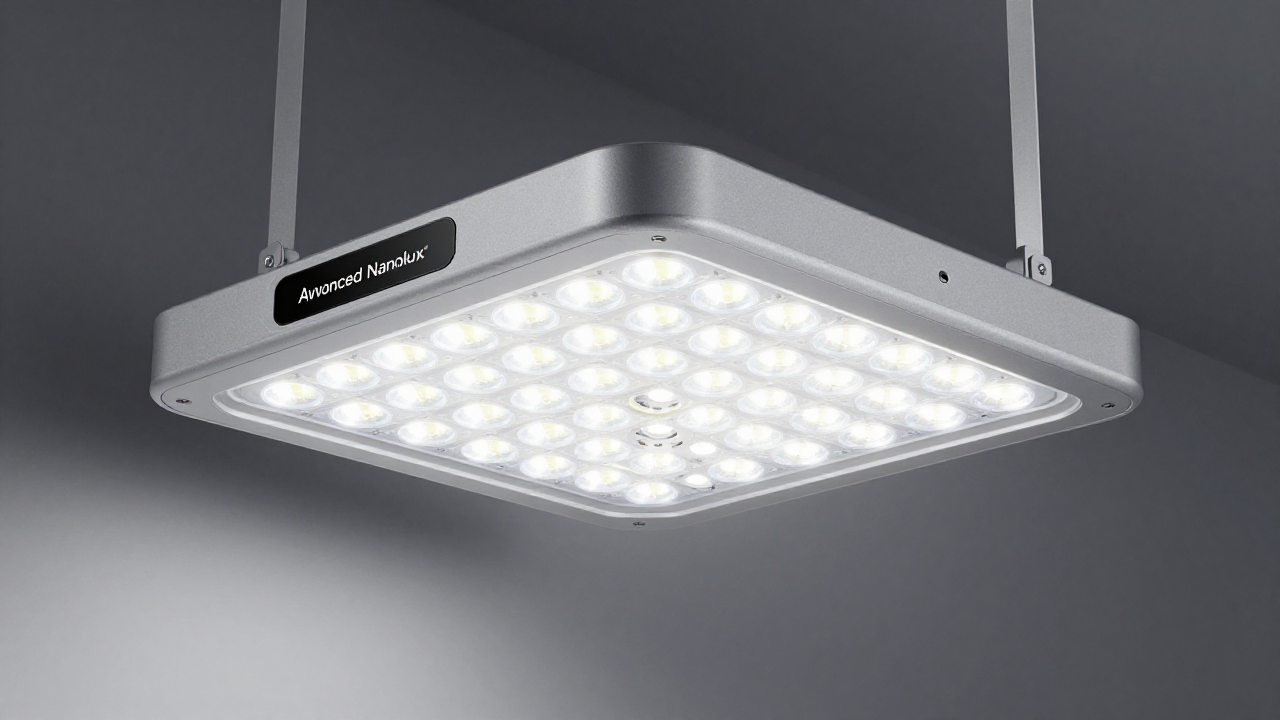
The 300-Watt Hardware Store Light That Cost a Grower $14,000
Back in March 2023, a Colorado cultivator named Mike pulled me aside at a Denver trade show. He looked exhausted. Six months earlier, he’d outfitted a new 2,000-square-foot flower room with budget LED fixtures from a regional hardware chain — the kind marketed as “high output” with impressive-looking spec sheets. By week three of his first cycle, internode spacing was all over the place. By harvest, his dry weight came in 31% under projections. The lights had been burning 300 watts apiece, same as the premium fixtures they replaced — but canopy-level PPFD readings averaged 480 µmol/m²/s when he’d spec’d for 850.
“Nobody tells you the number that matters,” he said. His exact words, actually. “They just put ‘replaces 1000W HPS’ on the box and call it a day.”
That conversation stuck with me because it’s not unusual. We’ve been building LED systems at Nanolux since 2004, and I’ve watched countless operators learn this lesson the hard way: a grow light is only as good as the data you verify yourself. With the 2026 model year rolling out and a fresh wave of efficiency gains hitting the market, the gap between marketing claims and field results is wider than it’s ever been — and the stakes for getting it wrong are brutal.
—
What’s actually new in commercial grow lights for 2026, and what’s just repackaged hype?
Two things that are genuinely different this year, and I’ll qualify both.
First: dual-channel spectrum control at the fixture level is hitting price points that make sense for mid-tier commercial ops. Five years ago you’d pay a 40-60% premium for a light that let you independently dial red-to-blue ratios without buying a separate controller. In the 2026 product cycle, that capability is showing up in fixtures under $800 MSRP. The chip-level innovation here comes from improvements in phosphor coating consistency — manufacturers can now coat individual diodes with enough precision that the spectral shift between batch runs stays within a 3% tolerance band. Before 2024, that number was closer to 8-12%, which forced brands to bin LEDs aggressively or slap a controller on top to compensate. Lower binning waste means lower unit cost. That’s the real story, not some breakthrough in diode physics.
Second: under-canopy lighting is moving from “experimental” to “standard protocol” in multi-tier and high-density setups. I’ll give you numbers from a third-party trial we ran with a Sacramento-based testing lab in Q3 2025. A controlled trial on lettuce (Rex cultivar, NFT system, identical nutrient and HVAC parameters) compared top-lighting-only against a configuration where 18% of total wattage was shifted to under-canopy bars. The split-configuration group showed a 14.7% increase in fresh weight per square foot and — this part surprised us — a 9% reduction in tip burn incidence. The hypothesis is that lower leaf senescence slowed down because those shaded canopy zones were getting enough PPFD to stay photosynthetically active longer. If you’re running vertical racks for leafy greens or microgreens, this isn’t theoretical anymore.
What’s mostly hype? Full-spectrum UV. I know, I know — everyone’s talking about it. The reality is that UV-A supplementation can influence secondary metabolite production in certain cultivars (cannabis trichome density, basil phenolic content), but the effect size is wildly inconsistent across genetics. I’ve seen runs where UV added 2% to essential oil yield and runs where it did nothing except degrade plastic trellis clips faster. Until there’s cultivar-specific UV response data that’s reproducible, I’d treat UV as a research investment, not a production tool.
How much light do I actually need? And why does the “wattage per square foot” rule keep failing people?
The industry spent two decades using “watts per square foot” as a shorthand because HID ballasts all pulled roughly the same power for a given lamp class. A 1000W DE HPS was a 1000W DE HPS, more or less, and photon efficacy clustered tightly around 1.7-1.9 µmol/J.
LEDs broke that heuristic completely. A fixture pulling 600 watts at 3.2 µmol/J delivers 1,920 µmol/s of total photon output. A different 600-watt fixture at 2.4 µmol/J delivers 1,440 µmol/s. Same wattage, 33% less light reaching your canopy. Measuring by watts alone is like sizing an irrigation system by pump horsepower without checking flow rate.
The metric that replaced it is DLI — Daily Light Integral — expressed in mol/m²/day. Here’s the formula your grow team should be using:
DLI = PPFD × (3600 × photoperiod hours) / 1,000,000
For most flowering annuals (cannabis, tomatoes, peppers), the target range sits between 30-45 mol/m²/day depending on CO₂ supplementation levels. Without CO₂ enrichment, pushing past 40 usually hits diminishing returns because your plants run into carbon limitation — they have enough photons to drive photosynthesis but not enough CO₂ molecules to use them.
Run the math backward: if you’re targeting 40 mol/m²/day on a 12-hour flowering cycle, you need an average canopy PPFD of roughly 925 µmol/m²/s. Now go check what your current fixtures actually deliver at your hanging height, across your full footprint. Not the center hot spot — the average, corner to corner. We’ve mapped hundreds of commercial rooms and most setups that “look bright” are delivering 550-700 at the edges. That gap right there is your yield ceiling.
Which brands actually matter, and how do I compare them without getting lost in spec sheets?
I’m not going to pretend this is an unbiased survey — we make lights, and we compete with most of the names on this list. What I can offer is the framework we use internally when customers ask us to benchmark competitors. Nobody’s ever gone wrong starting with these five data points:
Outside of that, the biggest differentiator between mid-tier and premium fixtures in 2026 isn’t the LED chips — most everyone sources from the same half-dozen Korean and Taiwanese fabs. It’s the driver quality and thermal design. A fixture with great diodes on a cheap driver will lose 5-8% of its rated efficiency within 18 months as components degrade. A well-engineered driver with adequate heat sinking will hold within 2-3% of spec for 25,000+ hours.
We learned this the painful way around 2018-2019 when a driver supplier changed capacitor suppliers without notice. Half a production run started drifting spectrum after 4,000 hours. We ended up replacing 1,700 units proactively. That’s the kind of thing that teaches you to spec every component, not just the headline specs.
What’s the biggest mistake you see commercial operations make with their lighting?
Honestly? Treating light as separate from HVAC design.
I walked into a greenhouse operation in southern Arizona in August 2024 — 115°F outside, and their newly retrofitted LED room was running 94°F canopy temperature at noon. The grower was frustrated because he’d been told LEDs “run cooler.” They do produce less radiant heat per photon than HPS. But when you remove the radiant heat component, your HVAC system no longer has that passive dehumidification effect. The sensible heat load drops, but the latent heat (humidity) load stays the same. So your air conditioning runs shorter cycles and doesn’t pull enough moisture out of the air. VPD swings wildly. Plants close their stomata. Photosynthesis drops.
The fix isn’t “buy a bigger AC.” It’s an integrated design where lighting, HVAC, and dehumidification are calculated as one system. If you’re building or retrofitting a room in 2026, bring your lighting specs to your HVAC engineer before you finalize either order. The conversation should start with: “Here’s the total photon output, here’s the electrical load, here’s the target VPD range — what combination of sensible and latent cooling do I need to hit those numbers?” If your engineer can’t answer that question, find a different engineer.
Another one that keeps showing up: installing lights before measuring your water quality. High-PPFD environments push transpiration rates way up. If your source water has 400+ ppm of calcium carbonate, you’re going to see foliar calcium deposits and potential nutrient antagonism in your root zone that nobody connects back to the lighting decision. Test your water. Know your alkalinity. Increase irrigation frequency when you increase light intensity. Sounds obvious. Gets skipped constantly.
Once I’ve chosen my lights, what does a proper installation and tuning sequence look like?
Here’s the short version of the commissioning protocol we’ve refined across several hundred installations since 2020. This assumes you already have the fixtures hung and powered.
Day 1 — Map before you plant. Rent or borrow a quantum sensor (Apogee MQ-500 or similar). Take readings at 20-30 grid points across your bench or floor area. Record PPFD at the height your canopy will actually be. Don’t eyeball this. The map will reveal hot spots from wall reflection, dead zones from structural shadows, and edge drop-off you didn’t plan for. Adjust fixture spacing or height to get your coefficient of variation under 15%.
Day 2 — Set your photoperiod and intensity ramp. If you’re transplanting into this room, start at 50-60% of your target DLI and ramp up over 7-10 days. The shock of going from a propagation environment (maybe 10-15 mol/m²/day) to a full-production room (35-45) in 24 hours will stall growth for a week. Gradual acclimation is free yield.
Day 3-5 — Watch transpiration response. Don’t just check your irrigation timer — look at the plants. Are they wilting in the last two hours of the photoperiod? You need more frequent irrigation pulses or a lower VPD setpoint. Are you seeing condensation on interior leaves of dense-canopy crops? You need more air movement or dehumidification capacity.
Bi-weekly — Clean everything. LEDs don’t throw nearly as much downward infrared as HPS, so the fixtures themselves don’t burn off dust the way old DE fixtures did. Dust accumulation on lens covers can rob 5-10% of your output in a single dusty cycle. We’ve measured it. A quick wipe with a dry microfiber every two weeks and a deeper clean between cycles keeps your investment performing at spec.
And one final thing I’d mention, specifically for operations scaling from one or two rooms to five or ten: document everything. Every change to spectrum, photoperiod, hanging height, or intensity — log it along with the date and the cultivar. When something goes weird in week six, having a record of exactly when and what you changed is the difference between diagnosing the problem in an hour and spending three cycles guessing. That isn’t lighting-specific advice. But lighting touches so many other variables that the second-order effects of a bad lighting decision might not show up until your HVAC or irrigation system falls out of its operating window. Good notes save bad grows.
