
Baking Under HPS: The Expensive Education of Early Indoor Farms
Anybody who’s been in the commercial grow light game longer than a decade remembers the exact moment they realized HPS was a dead end. For me, it was August 2017—standing inside a 40-foot container farm in Newark, sweat dripping onto a PAR meter, watching a 1000-watt high-pressure sodium fixture pull 1100 watts from the wall and deliver less than 600 µmol/s of usable light to the canopy. The electric bill for that single rack was $340 a month. The lettuce barely held its color.
We started Nanolux in California back in 2004, building HID ballasts when ceramic metal halide was the “next big thing.” Nobody wanted to hear about LEDs then. The early diodes were fragile, the spectra were blue-heavy, and the initial cost made growers laugh. Fast forward to 2023, and I’m unboxing a 600-watt LED that delivers 1800 µmol/s with a PPE of 3.0 µmol/J, runs 50,000 hours before any meaningful depreciation, and lets you dial in spectrum ratios from a smartphone. The tech shifted that fast. Problem is, most urban farmers still buy lights like it’s 2012—chasing wattage, ignoring uniformity, and treating spectrum charts like horoscopes.
If You Can’t Read a Spec Sheet, You’re Already Losing Money
Walk into a trade show and ten vendors will shove a “full spectrum” graphic in your face. Here’s what they won’t tell you: PAR output isn’t yield. Uniformity is. A fixture that pumps out 2000 µmol/s but dumps 70% of it in a hot spot under the emitter will give you leggy outer plants and burnt centers. I’ve seen it happen in a Cleveland vertical farm in March 2022—gorgeous red butter lettuce in a 12-inch circle, bitter trash everywhere else. The owner had paid $18,000 for those lights.
Learn to ask for three numbers before you shake hands on a deal:
A quick cheat sheet for the major fixture types you’ll encounter:
I’ll say it plain: the tunable LED market is full of overpriced gadgets that promise to mimic sunrise and sunset. Unless you’re running university-level photobiology trials, save the cash. A fixed 4000K white with 660nm red supplement gets you 95% of the performance at 60% of the cost.
The 3-Minute Decision Logic That Prevents Expensive Mistakes
I get calls from growers agonizing between six different fixtures. My answer usually boils down to two questions. What’s your crop? and What’s your vertical clearance? That’s it. The rest is engineering, not art.
Here’s how the decision tree works in practice:
1. Leafy greens, microgreens, or herbs with limited plant height (under 12 inches)
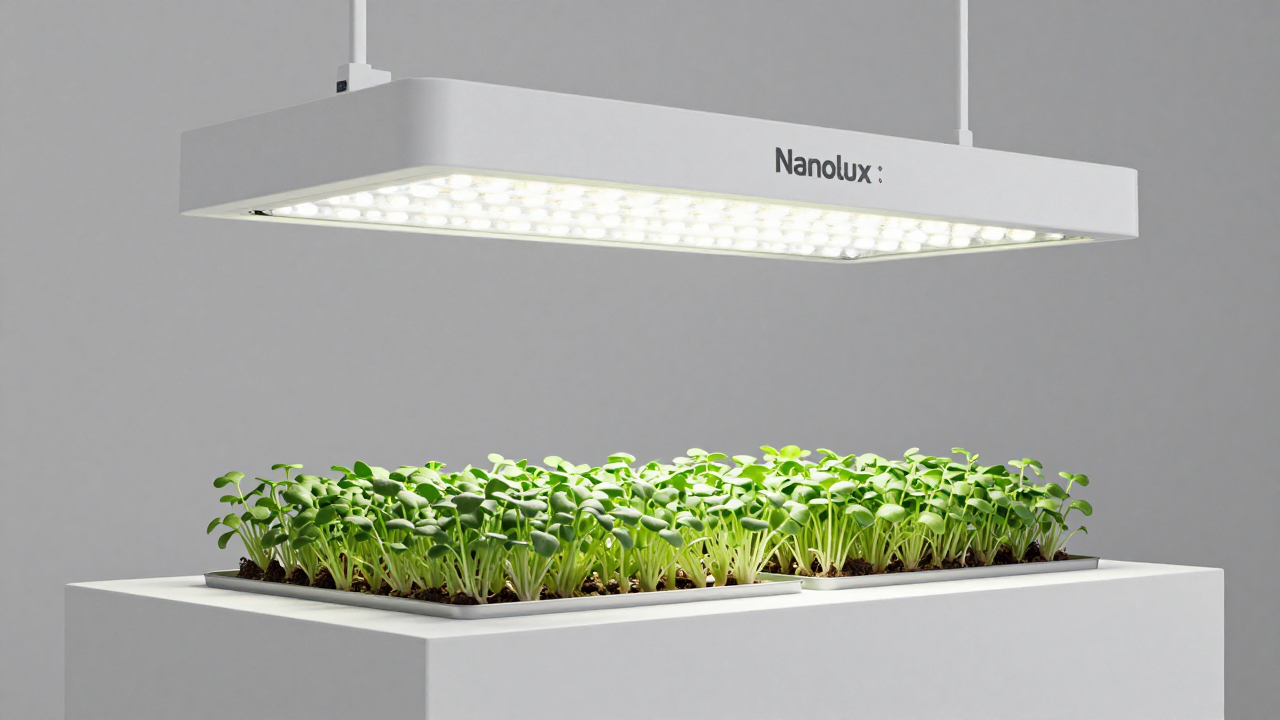
→ Go with low-profile LED bars, 50–150 watts per 4×4 ft, hung 6–12 inches from the canopy. Uniformity matters more than raw intensity. PPE above 2.8 is fine. No need for far-red.
2. Vining crops (tomatoes, cucumbers, peppers) with trellising
→ You need inter-canopy lighting, not just top light. This is where under-canopy LEDs shine. In a greenhouse in Madison, Wisconsin, September 2024, a grower paired Nanolux 600W toplights with our 40W under-canopy strips and got 23% more fruit set on lower trusses compared to top light alone. The key is penetration, not just output.
3. High-value compact crops (cannabis, specialty flowers)
→ Broad spectrum with tunable red/far-red ratios can steer morphology. But even here, most commercial ops run a fixed “flowering” recipe and never touch the dial. You’re better off spending the budget on more fixtures and better canopy coverage than on a spectrum controller you’ll use twice.
A pitfall I see repeatedly: buying a light based on the “flowering footprint” advertised, then putting it on a light mover because the canopy is too big. A light mover doesn’t fix poor coverage—it just averages the hot spots. Fix the layout first. Always map your PPFD with a quantum sensor (rent one if you have to) before you commit to a purchase order.
ROI Doesn’t Live in the Fixture—It Lives in the Canopy
Here’s a number most manufacturers won’t give you: the cost per pound of usable yield over the fixture’s lifespan. Electricity cost per kWh, fixture price, and lifespan all matter, but only in relation to what you harvest. In a Detroit container farm we worked with in November 2023, switching from 315W CMH to 400W LED (PPE 3.1) brought the electricity for lighting down from $0.41 per pound of basil to $0.19. The lights paid for themselves in 14 months—not because the LEDs were cheap, but because the canopy finally got even coverage and the harvest weight jumped 17%.
The math formula you need to tattoo on your forearm:
DLI = PPFD × (3600 × photoperiod hours) / 1,000,000
For butter lettuce, target a DLI of 14–17 mol/m²/d. If your PPFD averages 300 µmol/m²/s and you run lights 16 hours, you’re at 17.28 mol/m²/d—right in the sweet spot. Drop below 12, and yields tank without any obvious visual cue. Over 20, and you’re wasting electricity for marginal gains, plus risking tip burn.
Maintenance that actually moves the needle:
Honestly, the biggest mistake I’ve made in my own projects was ignoring the HVAC interaction. LEDs run cooler than HPS, which is great—except in winter, when you lose the “free” radiant heat that was keeping your ambient temps stable. In a Boston indoor farm, January 2025, the grower cut his gas bill by half after we added supplemental heat, but he didn’t realize the HPS was doing that work all along. Now we always model the full thermal balance before we quote a light plan.
Sell the Story of Your Light (It’s Weirder Than You Think)
Urban farms that win at farmers’ markets and DTC sales have one thing in common: they turn their lighting setup into a brand asset rather than a utility cost. Walk through a grow room, shoot 60 seconds of footage of the plants under a clean, white spectrum, and post it with a caption like “Our arugula sees exactly 16 hours of custom-tuned light every day—no sunlight needed.” That lands harder than any certification logo.
A Brooklyn microgreen company we’ve supplied since 2022 does exactly this. They film side-by-side time-lapses—same seed lot, one under a generic blurple panel, one under a proper commercial grow light with a natural color rendition. The visual difference sells subscriptions faster than any blog post. They don’t mention the fixture brand in the video; they let the even growth and deep color speak. That honesty earns trust.
Optimize your website’s “How We Grow” page for long-tail searches like “indoor basil farm lighting setup” or “commercial LED lettuce rack layout.” Include photos with captions that have real numbers: “This rack runs 12 hours at 350 µmol/m²/s, harvested every 21 days.” Google’s getting better at surfacing that kind of specificity when a chef or grocery buyer searches for local hydroponic suppliers.
And if you ever decide to license your growing method to a franchisee or a partner farm, having a completely documented light map—fixture models, hanging heights, PPFD overlays, and harvest data by month—turns your operation from a passion project into a replicable business. That’s when the lighting investment shifts from a cost line to an asset line on your balance sheet. Few growers make that switch. The ones who do, scale.
I’ve been in the commercial grow light trenches since the days when we had to explain what a diode even was. The technology has never been better, and the marketing has never been louder. Separate the two, and you’ll build a farm that runs on data, not hope.
