
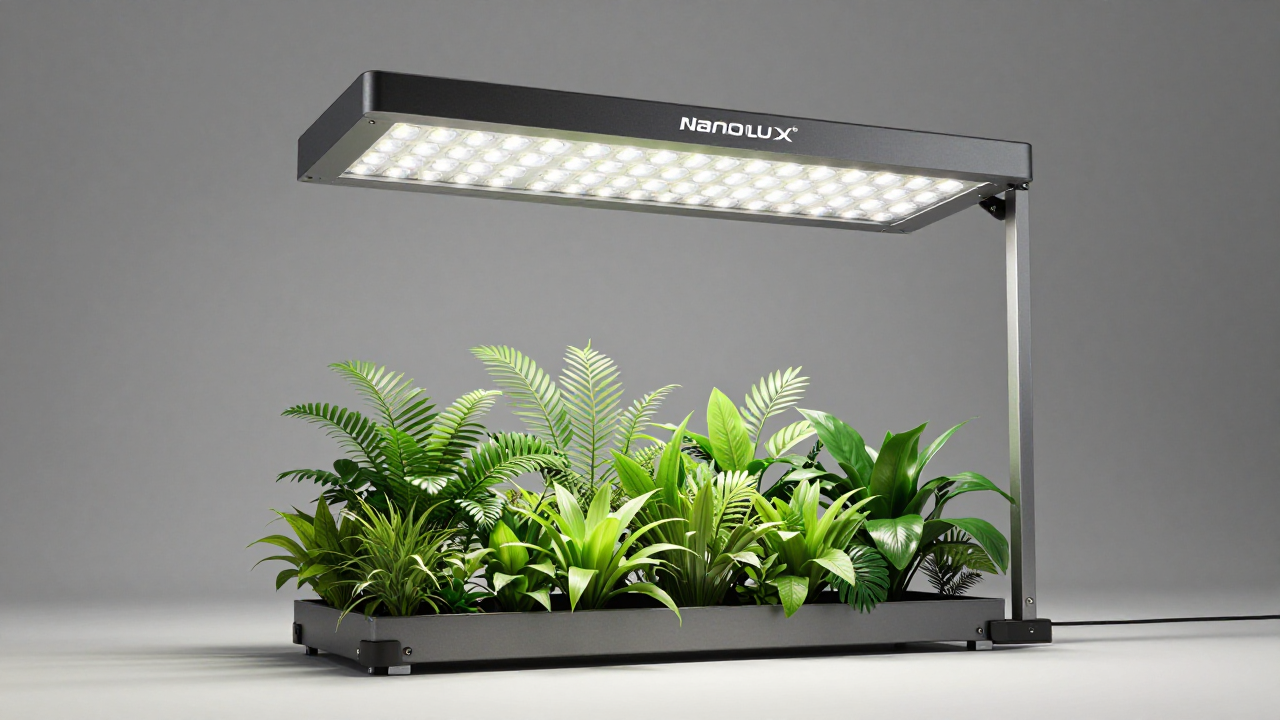
What Separates a Commercial Grow Light from a Desk Lamp in 2026?
We get calls every month from operators who thought they could scale with modified hobbyist panels. In March 2025, a vertical farm in Nevada called us three weeks into a failed romaine trial. They’d wired up 200 panels rated for a 2×2 tent. By day 18, PPFD readings at the canopy edge dropped to 180 µmol/m²/s. Crop uniformity collapsed. They dumped two harvests.
A commercial grow light isn’t a brighter version of consumer gear. The distinction sits in sustained photon output, thermal decay control, and spectral consistency across thousands of hours. In a 10-layer vertical rack, replacing failed drivers on level seven isn’t maintenance—it’s an operational crisis. We design our Nanolux LED arrays with that reality in mind: IPC-rated sealed housings, Mean Well drivers with a rated lifetime exceeding 50,000 hours, and diode arrays that spec ±3% spectral shift tolerance. You’re buying predictable photons per watt, not a lighting fixture.
For a U.S. operator selling into Kroger or Whole Foods, consistent cannabinoid levels or dry-weight yield per square foot determines contract renewal. That’s the lens we use.
So How Do These Lights Actually Drive Biomass?
The process gets reduced to “plants eat light,” but the mechanism that matters for profitability is photosynthetic photon flux, or PPF—the total micromoles of photosynthetically active radiation a fixture emits per second. Not lumens. Not watts. Photons.
Every commercial crop operates on a daily light integral (DLI) target. For full-size tomatoes, you’re chasing 22–30 mol/m²/d. Leafy greens hover around 12–17 mol/m²/d. Cannabis cultivators in California, Oregon, and Massachusetts routinely spec 38–45 mol/m²/d for high-density flower rooms. Hit the DLI, and the crop’s genetic potential activates. Fall short, and you’ve capped yield before the first true leaf unfurls.
The math looks like this:
`DLI = PPFD × (3600 × photoperiod hours) / 1,000,000`
A fixture delivering 800 µmol/m²/s over a 14-hour cycle generates a DLI of roughly 40.3 mol/m²/d. That’s the zone where indoor cultivation outperforms even Salinas Valley June sunlight—with zero cloud risk and no seasonal light taper.
And spectrum tuning isn’t marketing fluff. We run our production trials with a 3-channel control strategy: blue-dominant (450 nm peak) during vegetative to tighten internodal spacing, then red-boosted (660 nm) plus far-red (730 nm) during generative phases. Far-red accelerates phytochrome conversion from Pr to Pfr, which cuts flowering time by 8–12% in photoperiod-sensitive cultivars. That’s backed by a 2024 Michigan State University greenhouse study on supplemental far-red in commercial tomato production—the only external study we’ll cite because we saw the same result in our own Fresno test bay in February 2025.
What Actually Matters When You’re Writing a Purchase Order?
Three growers walk into the same trade show booth asking different questions. The lettuce producer wants uniformity. The orchid breeder wants spectrum finesse. The cannabis extractor wants canopy penetration to lower larf ratios. One spec sheet shouldn’t win all three bids.
Here’s the filter we tell operators to use.
Factor breakdown for 2026 purchasing decisions:
The compliance line isn’t optional. U.S. utility rebates—from Pacific Gas & Electric in California to Con Edison in New York—require DLC Horticultural Listing. We’ve seen operators leave $12,000–$40,000 in annual rebates unclaimed simply because their imported fixtures lacked the certification. That rebate covers a room’s entire light upgrade in 18 months.
LED or Double-Ended HPS? Every Warehouse Asks This.
The answer shifted in 2023 and hasn’t swung back.
Double-ended HPS still produces 1.7–1.9 µmol/J. Good commercial LEDs now hit 3.5+ µmol/J. That’s nearly double the photons for the same kilowatt-hour. In a Texas facility running 10,000 sq. ft., the monthly electrical delta alone can top $5,800 at average commercial rates.
But the bigger variable is HVAC. HPS fixtures radiate 60%+ of input energy as infrared heat. Leaf surface temperatures climb, transpiration spikes, and your chiller works harder. LED converts electricity to photons with minimal radiative heating, so you can run ambient temps 3–7°F higher while maintaining identical leaf surface temperature. Over a 12-month cycle in Arizona or Nevada, that’s thousands in cooling savings.
Where HPS still competes: unheated greenhouses in cold-winter climates. Northern Michigan or Upstate New York growers supplementing sunlight in January sometimes prefer HPS for the IR heat contribution. It reduces propane demand. In those edge cases, the thermal penalty becomes a thermal benefit. We spec hybrid layouts there—LED overhead, HPS staggered as heat sources, all governed by the same Nanolux controller.
How Do You Not Cook Your Crop in Week One?
We’ve seen the same mistake since 2018, across every crop type: operators install commercial grow lights, set intensity to manufacturer max, and scorch a full tray of transplants. The roots haven’t developed enough to support transpiration at 1,200 µmol/m²/s, and leaf-edge necrosis appears by day four.
A practical hardening-off protocol that our cultivation support team codified in early 2025:
For flowering induction, the spectrum shift matters more than intensity. We bump red-to-far-red ratio to roughly 1.2:1 while maintaining blue at 10–15% of total PAR output. This mimics the natural R:FR shift in late-season sunlight and triggers stronger flower set. Cut green light below 500 nm to under 5%—it competes with red absorption in chlorophyll and can elongate flower internodes unnecessarily.
What’s the Mistake That Costs the Most Money Over Three Years?
Not daily light integral miscalculation. Not spectrum choice. It’s ignoring maintenance and calibration drift.
LED diodes don’t burn out like HPS lamps. They degrade. A fixture rated L90 at 50,000 hours loses 1% output per 5,000-hour increment after the first year. Over a 5,000 sq. ft. facility with 150 fixtures, that slow drift can create a 8–12% yield variance between zones by year three—and the grower blames genetics, irrigation, or labor, never the lights.
Our service logs from December 2024 flagged a Sacramento cultivation site where PPFD readings had slipped 14% below spec across 60% of fixtures. The operator had run the same DLI calculator numbers for two years without a single quantum sensor recalibration. We replaced none of the lights—just cleaned the lens arrays, updated the dimming profiles, and recalibrated the Apogee MQ-500 sensors. Next harvest cycle, yield uniformity returned to ±4%.
Other common failures:
Write a quarterly PPFD mapping walk into your SOP. Not annual. Quarterly. A handheld quantum sensor costs under $500. A missed yield cycle costs tens of thousands.
Where Is This Technology Headed—Not in Ten Years, but in 2026–2027?
Three developments we’re integrating into our own roadmap and seeing across the industry.
Adaptive spectrum with real-time plant feedback. Instead of fixed veg/bloom presets, next-gen controllers read chlorophyll fluorescence sensors mounted at leaf level and adjust spectrum on a per-bay basis. When a crop shows early photoinhibition—a drop in photosystem II efficiency—the system eases intensity before the grower sees leaf damage. This isn’t lab theory. A pilot deployment in our partner facility in Denver (Q2 2025) cut light-stress events by 60% in romaine production.
Dynamic pricing integration. U.S. commercial electricity rates increasingly follow time-of-use models. Lights can now sync with utility rate schedules, dimming 15–20% during peak-pricing windows (typically 4 p.m.–9 p.m.) and compensating with extended photoperiods during off-peak hours. The DLI stays constant; the electrical bill drops. One Arizona operator implementing this with our CNC-2 controller shaved $2,800 off a single July billing cycle.
Inter-canopy and sub-canopy arrays. Top-lighting alone wastes photons on upper fan leaves while lower budsites starve. Our Nanolux under-canopy bars, running at 30–40% of overhead intensity, deliver supplemental photons into the middle canopy. In tomato trellis systems, this boosted marketable fruit weight by 11% in our 2024 Visalia trial without increasing total electrical draw. The fixtures mount at 24-inch vertical intervals on rolling rack posts.
That New Jersey gardener planting 300 perennial fruits by hand—covered in niche gardening media last month—captures something relevant: the infrastructure you build in year one determines the harvest you get in year three, year five. A commercial grow light system works the same way. The technology choices locked in during a buildout ripple forward through every harvest cycle. Spec the right photon output, monitor it obsessively, and the crop rewards you with consistency that a buyer can bank on.
And honestly, that consistency is harder to achieve than most vendors admit. Controls, sensors, maintenance—they’re not add-ons. They’re the system. We learned that the messy way between 2018 and 2021, standardizing our controller ecosystem after too many growers couldn’t diagnose their own PPFD drift. The lights were fine. The operational muscle around them wasn’t.
Fix the muscle. The photons take care of the rest.
