
In 2021, I sat across a folding table in a dusty greenhouse in Salinas, California, with a grower named Frank. He’d just ripped out $40,000 worth of “commercial-grade” LED bars that fried his butterhead lettuce crop. His electric bill barely budged. His harvest window stretched an extra week. That afternoon, over gas-station coffee, I scribbled a checklist on a napkin — the same brutal checklist I still use when I’m evaluating commercial grow lights for a new facility. Frank’s disaster taught me more than any spec sheet ever could.
Most lighting guides spoon-feed you the same tired bullet points about spectrum and efficiency. That stuff matters, sure. But if you’re the person signing the PO for 800 fixtures, you need to think like a buyer — not a lab technician. You’re not just buying photons, you’re buying predictable labor costs, insurance against crop loss, and a warranty that doesn’t evaporate the moment a driver buzzes out. I’ve been on both sides of this table since 2008, and later inside Nanolux when we shifted from building HID ballasts in a Sacramento warehouse to full LED systems. I’ve seen what holds up over 18-hour flowering cycles in a Colorado winter, and what ends up in a dumpster behind a vertical farm in Newark.
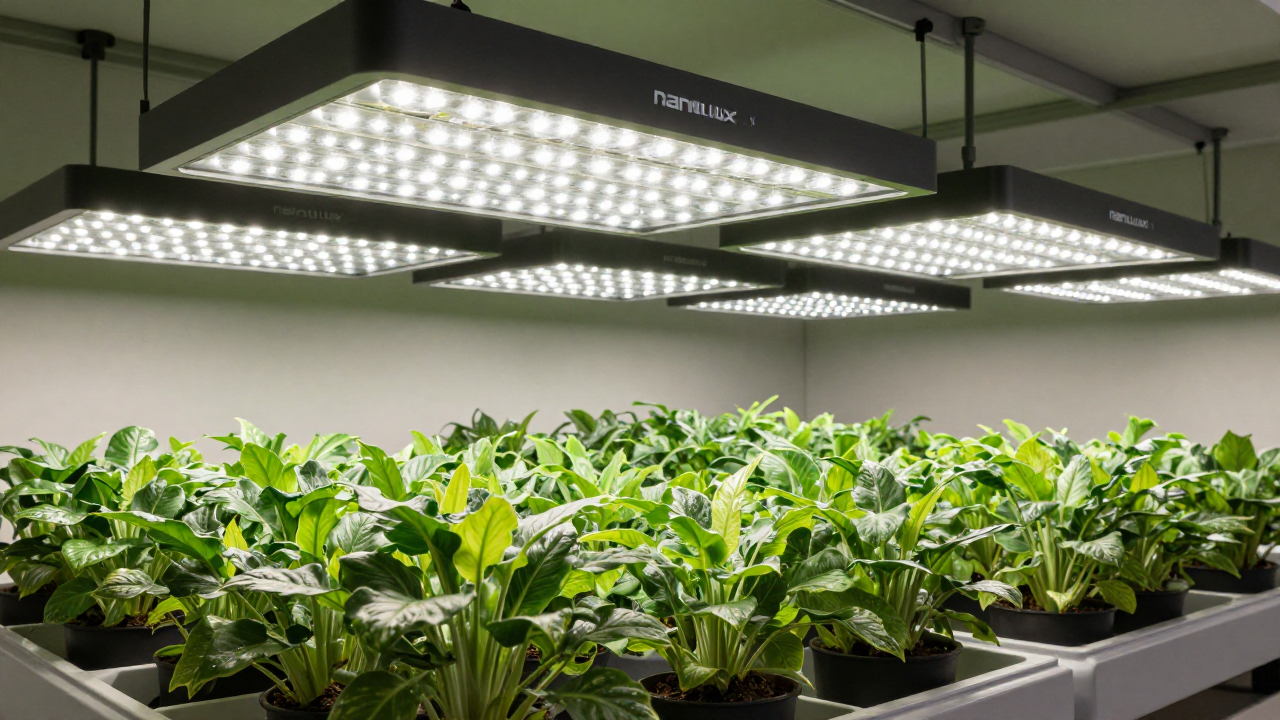
Quit Treating Watts Like a Tractor Pull
The first question a rep wants you to ask is “How many watts?” That’s because it’s the easiest number to inflate. You’re not buying watts. You’re buying harvestable photons that actually land on the canopy — not on the aisle floor, not baked into the driver housing, not scattered onto the wall six feet above the trellis.
Here’s the framework I run every fixture through when I crack open a datasheet. It weeds out 80% of contenders in five minutes flat.
The Five-Minute Knockout Test
Grab the fixture’s PPF value (photosynthetic photon flux, in µmol/s) and its actual wall-plug wattage at full tilt — not the “rated” wattage, the one you’d measure with a Kill-A-Watt after 60 minutes of runtime. Divide PPF by watts. If that number lands below 2.5 µmol/J for a bar-style LED in 2026, stop right there. Technology has moved. In 2019, 2.3 µmol/J was respectable. Today, anything commercial should be pushing past 2.7 unless you’re buying a specialty spectrum for cannabis finishing and you’re willing to eat the efficiency loss for UV-A content.
Next, ignore the PPFD map the manufacturer printed at 12 inches hanging height. Flip it. You need the map at the mounting height your rack or greenhouse ceiling actually demands — typically 18–36 inches for high-wire crops. Look at the edge-to-center uniformity ratio. A fixture that drops 40% from center to corner turns your crop schedule into a guessing game. I’ve walked rooms where the outside row of basil was three days behind the middle, all because the buyer trusted an averaged number on page two of a brochure.
I’ll be honest, I got burned on this exact thing in 2015 — bought a batch of “high efficiency” panels, hung them 24 inches above tomatoes, ended up with a beautiful high-PPFD bullseye in the center and chlorotic plants on the fringes. Lesson learned. If the manufacturer won’t send you an IES file or a point-by-point simulation at your real canopy height, walk away.
The Math Your CFO Actually Cares About
Let’s strip the romance out of it. If you’re running 50,000 square feet of greenhouse or a vertical rack with 12 tiers, the purchasing decision is an exercise in cost per mole of photons delivered over six years. Not upfront fixture price. Not lumens per dollar (unless you grow humans, not plants).
Here’s a real-world comparison I put together for a mixed-veg operation in Pennsylvania in 2023. We modeled a 100-fixture zone, 18-hour photoperiod, $0.11/kWh blended rate. This table makes the CPAs stop asking questions.
The LED racks up a higher upfront check, yeah. Nobody’s pretending $480 per fixture feels good on a PO. But by month 28, the cumulative cost flips in most real-world use cases — earlier if a utility rebate through DLC qualification kicks in. And the hidden cost savior? No crew swapping HPS bulbs every nine months, no reflector haze cutting PPF by 15% before anyone notices.
If you’re in a market where labor for maintenance is $22/hour, do the math on ten hours of bulb swaps across three cycles. It gets ugly.
What 2026 Farmers Are Actually Saying — Not What Reddit Thinks
I keep in touch with growers who run everything from one-acre cannabis canopies in Humboldt County to stacked lettuce farms in Brooklyn warehouses. Their feedback isn’t filtered through a marketing team. Here are two situations that stuck.
August 2023, a greenhouse tomato operation in Delta, Colorado, swapped out 200 aging HPS fixtures for a mix of broad-spectrum white LEDs plus our dedicated far-red bars in the Nanolux line (disclosure: yes, that’s our gear, and yes, I made them share power data before and after). Their daily light integral (DLI) bumped from 26 to 31 mol/m²/day during short December days, while the peak power draw dropped 22%. That’s the kind of shift that moves harvest timing by seven to ten days. The grower texted me one screenshot of their Con Edison portal with six exclamation points. Didn’t need words.
But there’s a flip side.
February 2024, an indoor basil farm in New Jersey called me, frustrated. They’d sourced a bargain LED from an online platform, specs looked decent, 2.8 µmol/J on paper. Six months in, 8% of drivers had failed. The warranty process required shipping the entire 8-foot bar back to a depot in another state, with a four-week turnaround. No loaners. No field-replaceable driver. Their crop cycle doesn’t pause for RMA tickets. That’s when a $12,000 “saving” becomes a $34,000 mistake in lost yield and emergency rentals.
This is where I get blunt: a spec sheet is a promissory note, not a contract. The only warranty worth anything states plainly that on-site parts replacement is covered within a stated business-day window, and it’s backed by a US-based stock of components. Check the fine print. Does it cover the driver for five years? OK. Does it cover the bars? The connectors? The dimming module? Because I’ve seen warranties that protect the chassis and nothing else.
The Specs Nobody Puts in the Catalog (But You’ll Pay for Later)
I don’t care what the total fixture lumens are. I care about photon distribution at canopy level. And I care about heat. Not the “it feels warm” kind — the kind that changes the VPD in your grow room, forcing your HVAC to work harder and your dehumidifier to cycle five times an hour.
When we test a fixture, we run it for 72 hours and measure driver case temperature ten inches away from the board. Sustained temps above 75°C (167°F) on the driver housing shave years off component life. A well-designed system dumps heat away from the canopy while keeping the diodes themselves below critical junction temperature. If a rep can’t tell you what the Tj (junction temperature) targets are for their board layout, you’re talking to a reseller, not a manufacturer.
To be fair, even high-end fixtures run warm in sealed rooms. The difference is whether the heat becomes your enemy or just a factor you account for in the HVAC design. We’ve seen facilities where switching to a cooler-running LED shaved 18% off the cooling tonnage required — real capital expenditure avoided before a single seed went in.
A Practical Way to Stop Overthinking the “Which Technology” Question
It’s easy to drown in acronyms: MH, HPS, CMH, LED with quantum boards, COB, strip lights. At this point, for any new commercial installation in the US, the debate is mostly between double-ended HPS (if your capital budget is near zero and you’re in a cold climate that uses lamp heat) and LED. The middle ground — CMH — can make sense for propagation and mothers where hanging height is low and footprint is small, but it’s become a niche.
If you’re still on HPS and want to ease in, don’t rip out everything at once. Run a side-by-side bay. Swap one zone to LED, leave the rest HPS. Compare yield density, plant morphology, and HVAC runtime over a full season. The data you collect in your own packing shed outweighs any white paper.
When I’m asked by a buyer “What’s the single most important number?” I always point to PPF per watt at the canopy, multiplied by uniformity percentage. That’s your real productivity factor. Above 2.7 µmol/J with 90%+ uniformity across a 4×4 foot area? You’ve got a workhorse. Below 2.4 µmol/J with 70% uniformity? That’s a fixture designed by someone who’s never harvested anything on a deadline.
The One Mistake I Keep Seeing, Over and Over Again
In 2022, a vertical farm in Chicago bought 3,000 strip lights tuned entirely for high blue ratio — chasing compact basil. Six months later, their Romaine trials stretched horribly because the team forgot that different crops need different red-to-far-red (R:FR) ratios. A fixture that rocks for microgreens might leave your fruiting peppers leggy and unproductive. The fix isn’t a different product line; it’s using controllers to dial in spectrum per crop phase, or choosing a broad-white spectrum with adjustable far-red supplementation.
Another classic: ignoring UL/ETL certification because “these imported lights are the same thing.” They’re not. An uncertified fixture that starts an electrical fire in a wood-framed greenhouse might void your property insurance entirely. I’ve had growers tell me their inspector flagged uncertified lights and shut the room down mid-cycle. Don’t gamble on this.
At this point I’ve probably overloaded you with checklist items. So here’s the stripped-down version I send to colleagues when they’re about to cut a purchase order:
If a fixture clears those six hurdles, it’s probably going to earn its keep.
I wrote this because I’m tired of watching operations lose a season to lights that looked good on a YouTube review. The technology is solid now. The difference between a profitable year and a “what happened?” postmortem usually comes down to the boring stuff — thermal design, honest photometric data, and a warranty phone number that doesn’t ring into a virtual assistant. Stick to that, and you’ll be fine.
