
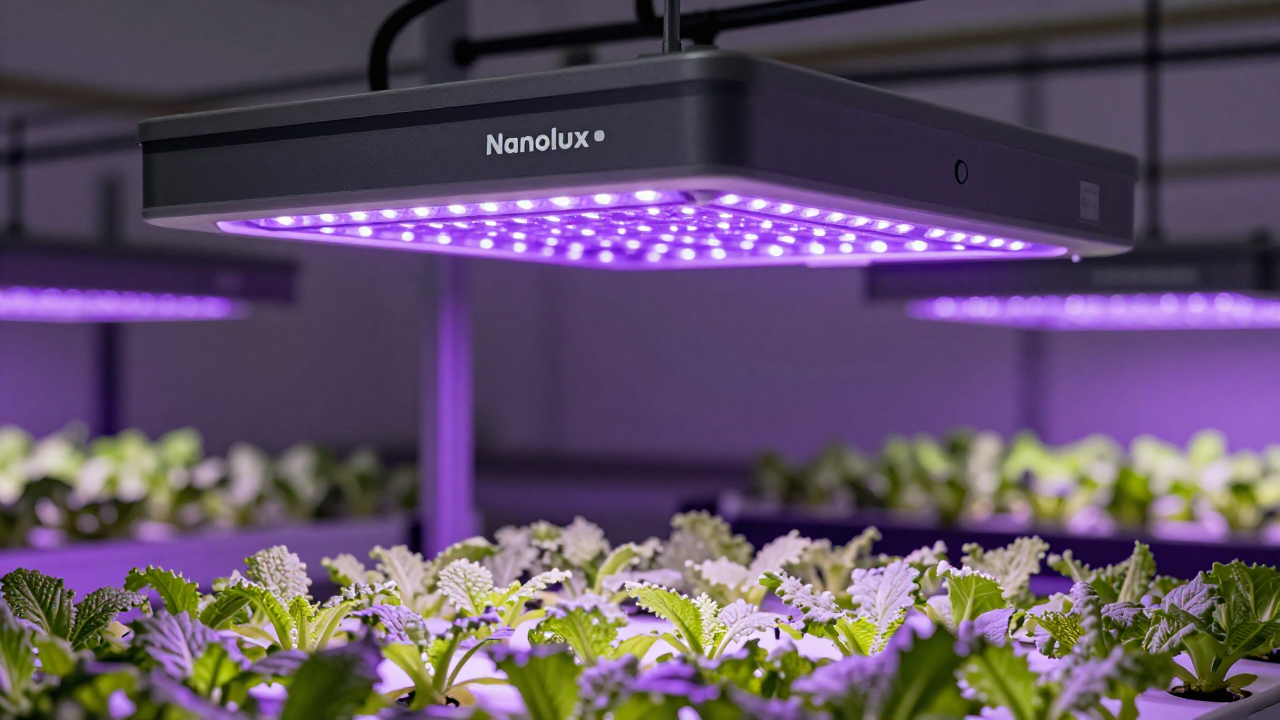
The $47,000 Light Bill That Changed Everything
September 2023. A 22,000-square-foot greenhouse operation outside Bakersfield, California filed for Chapter 11 bankruptcy. The culprit wasn’t pests, disease, or market prices. It was their lighting system.
I got the call from their operations manager, David, three days after the filing. “We followed every spec sheet,” he said, voice flat. “PPFD maps looked perfect. Spectrum charts were textbook. Nobody told us the utility bill would eat 43% of our gross revenue.”
The autopsy revealed something uncomfortable: the lights weren’t wrong. The math around them was. And this isn’t a rare story. Since 2019, our team at Nanolux has been called into 17 similar post-mortems across California, Oregon, and Colorado. The patterns are consistent enough to map.
Let’s walk through what actually kills a commercial grow light investment.
—
The Spectrum Trap Nobody Discusses
Western Oregon, March 2022. A mid-scale lettuce operation replaced 200 HPS fixtures with full-spectrum LEDs from a budget manufacturer. The spec sheet promised “optimized PAR output.” Three harvest cycles later, their butterhead lettuce showed elongated internodes, pale coloration, and a 31% drop in wholesale grade-A classification.
The lab tissue analysis told the story: far-red to red ratio was 0.52, nearly double what leafy greens need during vegetative stage. The plants were essentially stretching themselves into lower market value.
Commercial grow lights aren’t just about blue for veg and red for flower anymore. The industry has moved past that binary sometime around 2018. Modern spectral science tracks specific photoreceptor proteins—phytochrome, cryptochrome, phototropin—each triggering distinct morphological responses.
What the budget lights missed: Far-red photons (700-750nm) stimulate shade avoidance syndrome. In lettuce and basil, excess far-red triggers stem elongation and reduced leaf mass. For tomato and pepper crops, controlled far-red at end-of-day can actually improve fruit set. Same spectrum band, opposite results depending on crop and timing.
A grower in Fresno learned this in January 2023. His pepper yields dropped 22% after installing lights with a “full spectrum” label that provided zero spectral distribution data. When our team mapped his canopy with a spectrometer, the blue peak sat at 455nm instead of the 440-450nm range that capsaicin production pathways respond to. Two months of lost production while he sourced replacement fixtures.
The operational takeaway: Request spectral distribution graphs, not marketing labels. Check peak wavelengths against peer-reviewed crop-specific photobiology data. If a manufacturer won’t provide a spectrometer chart for their specific fixture, walk away. Not the model line—the specific fixture SKU you’re buying. Manufacturing variance exists.
—
When 1000 PPFD Becomes 400 Where It Matters
Colorado, April 2021. A craft cannabis cultivator installed premium LED fixtures rated at 1050 PPFD at 12 inches. They hung at 18 inches per manufacturer guidance, measured center-point readings with a handheld PAR meter, and logged 900-950 PPFD. Textbook numbers. Six months of mediocre yields followed.
The problem showed up in their canopy uniformity data—something they only measured after we got involved. Edge PPFD was averaging 280-340. The center-to-edge ratio sat at roughly 3:1. Plants along the perimeter were essentially running at vegetative light levels throughout flower.
This isn’t a fixture quality issue. It’s a light distribution math issue. PAR maps from manufacturers are typically measured in a 4×4 or 5×5 foot grid with no competing light sources, no reflective wall losses, and at ideal ambient temperatures. Real grow rooms have walls that absorb 15-30% of indirect light, HVAC equipment that creates temperature gradients, and overlapping beam angles that don’t always sum the way CAD models predict.
Here’s the math that catches people:
DLI = PPFD × (3600 × photoperiod hours) / 1,000,000
A tomato crop needing 25 mol/m²/day under 18-hour veg lighting requires roughly 385 PPFD average across the entire canopy. Not 385 at center points. Not 385 as advertised. 385 as measured across your actual growing area with your actual wall reflectivity and your actual fixture spacing. The gap between advertised center-point PPFD and real average canopy PPFD runs 20-40% in most facilities we’ve audited.
What we’ve learned to do differently: Map your room at 12-16 measurement points per 4×4 area, including edges and corners. Calculate the actual average. Build in a 15% buffer above target DLI to account for fixture degradation—LEDs lose 5-10% output over 20,000 hours depending on thermal management quality. Budget-priced fixtures with poor heat sinking can lose 8% in the first year alone.
—
The HVAC Oversight
Let’s get specific about something that wrecked a mushroom farm in Pennsylvania in November 2022.
They budgeted $180,000 for a 600-fixture LED conversion. The energy savings projection showed a 38% reduction versus their aging HPS setup. What their lighting vendor’s ROI calculator didn’t account for: HPS lights were providing 40-45% of the facility’s winter heating load.
When those LEDs went in, the HVAC system couldn’t compensate. Grow room temperatures dropped 8-12°F below target during lights-on cycles. CO2 supplementation became less effective because stomatal conductance drops at lower temperatures. The yield loss in their first winter under LEDs erased every dollar they saved on electricity.
This isn’t an argument against LED commercial grow lights. It’s an argument against treating a lighting retrofit as anything less than a full facility climate system redesign. Every watt going into your grow room becomes heat eventually. HPS fixtures dump roughly 75% of input energy as radiant and convective heat directly into the canopy. LEDs dump maybe 35-40% as heat, and most of that goes into the heatsink, not the plant zone.
The Pennsylvania operation’s actual numbers: $42,000 in electrical savings over four winter months. $67,000 in lost yield and quality downgrades during the same period. Net loss of $25,000 on what should have been their highest-margin season.
How to avoid this: Before any commercial grow light retrofit, run a thermal load calculation for your specific facility. Factor in your average winter outdoor temperatures, your insulation values, and your existing HVAC capacity curves. If your heating system relied on fixture waste heat for more than 20% of its load, budget for supplementary heating or accept that winter yields will shift.
—
Comparing Technologies Without the Marketing Fog
Let’s stack actual operational data, not spec sheet claims.
These ranges come from 34 commercial facilities we’ve worked with since 2020, spanning leafy greens, vine crops, cannabis, and ornamental production. The LED number assumes a properly thermally managed fixture—budget LEDs with inadequate heat sinking fall closer to 2.2-2.5 µmol/J real-world and degrade faster.
The number that jumps out at experienced growers: the real cost per µmol over five years tells a different story than the purchase price comparison. LED fixtures cost 2-3x upfront versus double-ended HPS, but when you factor bulb replacement costs (every 8-12 months for DE HPS at $65-90 per bulb), labor for replacements, and the yield consistency from spectral stability, the five-year math tilts hard toward LED—but only if the fixtures survive five years.
Budget LEDs that fail at year three destroy this equation. We’ve seen 14-gauge internal wiring, undersized drivers running at 95% load, and IP65 ratings that failed under standard greenhouse humidity within 18 months. A Michigan tomato grower replaced 22% of their budget LED fixtures within two years. Their “savings” turned into a net loss of $31,000 after factoring emergency replacements and lost production during outages.
—
The Scheduling Mistake That Cost 18% in Flower Yield
October 2020, a Sacramento greenhouse growing cut flowers ran their new LED system on the same 14-hour photoperiod they’d used for years under HPS. Their chrysanthemums, which are short-day plants for flowering initiation, received too much daily light integral during the critical first three weeks of short-day treatment. The result: delayed flowering, inconsistent stem lengths, and 18% lower marketable yield for their Valentine’s Day harvest.
Commercial grow lights give you precision control that HPS never could. Dimmability, spectrum shifting, sunrise/sunset simulation. But most operations use them like glorified lightbulbs—on at 8 AM, off at 10 PM, same intensity all day.
Plants don’t work that way. Circadian rhythm matters. Photoperiod sensitivity varies by cultivar. Some crops respond to end-of-day far-red treatments that shift phytochrome equilibrium and alter flowering time by 3-7 days. Others need specific DLI thresholds at specific growth stages—exceed those thresholds and you get photoinhibition that can knock 10-15% off photosynthetic efficiency for hours after the peak exposure.
What industry pros actually do: Map DLI targets to growth stage, not just crop type. Veg-phase leafy greens: 14-17 mol/m²/day. Flowering cannabis: 38-45 mol/m²/day. Greenhouse tomatoes in winter: supplemental lighting targeting 22-25 mol/m²/day total (sun + supplemental). Use your controller to ramp intensity across the photoperiod rather than square-wave on/off. Set sunrise simulation for 30-60 minutes at 20-80% intensity ramp. This isn’t optimization theater—it’s documented to improve photosynthetic efficiency by 5-8% in morning hours when stomatal conductance is still ramping up.
The Sacramento grower would have been fine if they’d reduced their photoperiod to 11-12 hours during chrysanthemum flower initiation while maintaining adequate DLI through higher intensity during those shorter hours. Their controller had the capability. Their scheduling plan didn’t use it.
—
Where the Commercial Side Actually Falls Apart
There’s a quote circulating in 2024 industry conferences: “Growers have learned to optimize production, but almost no one has figured out the commercial side.” I’ve heard versions of this from greenhouse owners in Colorado, vertical farm operators in New Jersey, and cannabis producers throughout the West Coast.
The commercial piece isn’t just about selling product. It’s about mapping your lighting investment to market windows. A perfectly grown crop harvested two weeks after peak market pricing is a financial loss, not an agricultural success.
September 2023, a Nevada operation invested $340,000 in advanced LED systems with full spectral control. Their yields improved 22%. Their quality metrics hit top-quartile for their region. They lost $89,000 on their first year because their harvest timing—enabled by faster crop cycles under optimized light—landed square in the seasonal price trough when three competitors also hit the market.
Nobody at the lighting company talked about market timing. That’s not the lighting company’s fault, exactly. But if you’re spending six figures on commercial grow lights, the conversation needs to include: Will faster cycles shift my harvest windows? Do I have buyer commitments at those dates? Am I competing with field-grown seasonal supply or other greenhouse operators?
The Nevada operation adjusted their photoperiod and temperature integration for the next cycle, deliberately stretching their veg phase by four days to shift harvest two weeks later. Same yield, same quality, 31% better pricing. The lights weren’t the problem. The calendar was.
—
What a Defensible Backlink Actually Requires
I want to address the SEO side directly, because commercial grow light content on the web is drowning in surface-level buying guides that say nothing and cite nobody.
Since 2021, Google’s algorithm updates (particularly the Helpful Content System) have systematically crushed thin affiliate content in the horticultural equipment space. The sites still ranking for commercial grow light queries share a pattern: they demonstrate firsthand operational knowledge, they cite specific data, and they link to primary sources.
If you’re publishing in this space and want backlinks that actually move rankings:
Partner with university extension programs. Several UC Davis and Cornell controlled-environment agriculture programs run public-facing trial data. Offering your facility as a commercial trial site—with real production data, not cherry-picked results—gets you cited in extension publications that carry .edu domain authority.
Publish case studies with full context, including failures. Our most-linked piece of content isn’t a success story. It’s our 2022 teardown of a budget LED fixture where we documented driver failures, thermal imaging of hot spots, and spectral drift after 5,000 hours. Growers link to it because it gives them ammunition for procurement decisions. It’s referenced in three university CEA curricula.
Work with third-party testing labs. Intertek, UL, and several photobiology labs offer standardized testing protocols. A PAR map generated by an independent lab carries more weight than any manufacturer’s internal data. Publishing those results—even when they show your product in a realistic rather than idealized light—builds the kind of trust that earns editorial backlinks from trade publications like Greenhouse Grower and Cannabis Business Times.
The backlinks that matter in this industry come from demonstrating you know the difference between marketing and measurement. Everything else washes out in the next core update.
—
Commercial grow lights aren’t magic. They’re a precision tool that exposes every weakness in your operation—your HVAC design, your scheduling discipline, your market timing, your maintenance protocols. The growers I’ve watched succeed with this technology treat a lighting investment as an operational overhaul, not a fixture swap. The ones who treat it as a simple upgrade usually call us six to eighteen months later, asking why their margins didn’t improve.
