
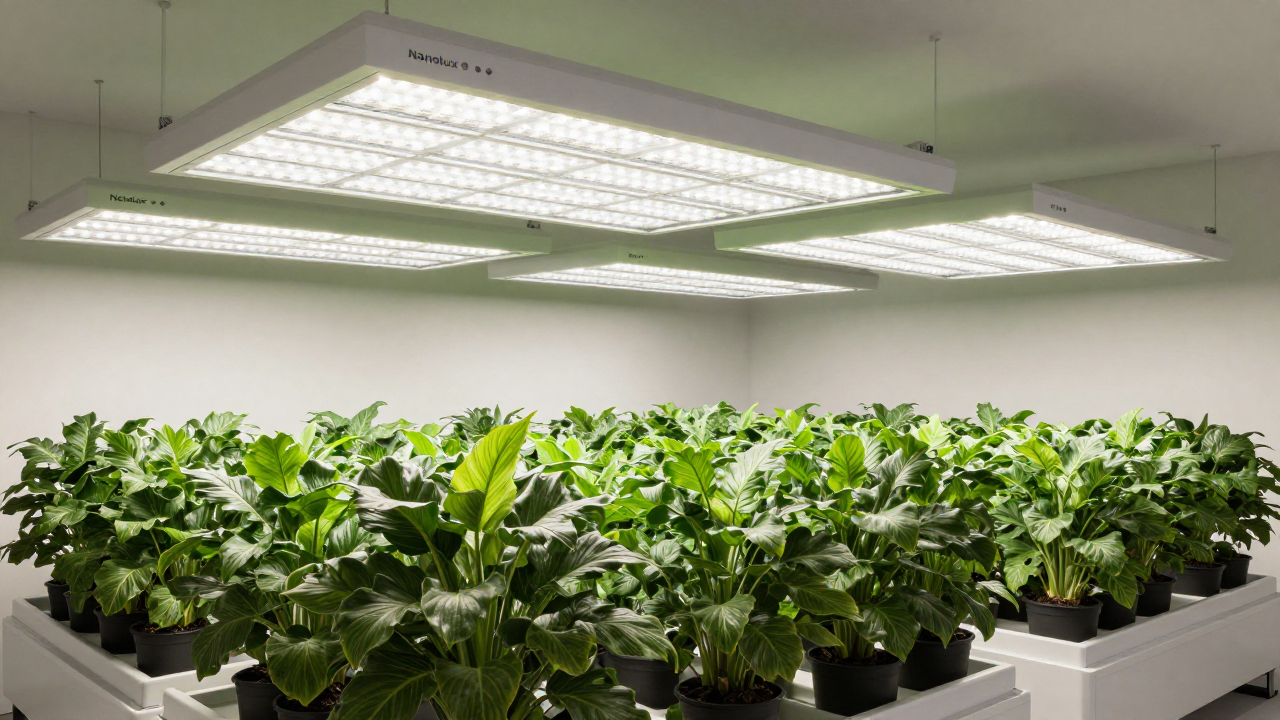
Why are farmers in 2026 still arguing about LED vs. HPS for commercial grow lights?
Walk into any cultivation conference right now and you’ll hear the same debate raging that was supposedly “settled” five years ago. On paper, it looks simple. LED efficacy has climbed past 3.5 µmol/J for top-tier fixtures, while double-ended HPS still hovers around 1.7 to 1.9 µmol/J. The math favors an immediate swap. Yet plenty of greenhouses across Michigan and New Jersey kept their HPS arrays running through the 2025 season without apology.
The friction isn’t about spectrum anymore. It’s about thermal inertia. A classic 1000-watt HPS lamp dumps roughly 40% of its energy as radiant heat onto the canopy. In a Midwest winter, that’s free heating that keeps leaf temperature where it needs to be. When growers in Ohio or Pennsylvania rip out HPS and drop in LED fixtures that convert almost all electricity into light, they discover their HVAC system suddenly has to carry the full heating load. One operator I spoke with in Akron saw his December natural gas bill climb by $2,400 after cutting his lighting wattage in half with LEDs. Nobody warned him about that.
Then there’s the startup cost story that sales reps rarely frame honestly. A high-end 650-watt LED bar with a five-year warranty might set you back around $1,200 per fixture wholesale. That same square footage covered by a 1000-watt DE HPS costs maybe $350, bulb included. If you’re expanding a 40,000-square-foot greenhouse, the capital gap stretches into six figures before you hang the first light.
And yet, the arguments for LED are just as loud. A 2023 trial at the University of Florida compared top-light HPS with intercanopy LED in a bell pepper house; the LED side produced 14% more marketable fruit per square foot because the light reached lower leaves that usually languish in shade. For a West Coast cannabis cultivator paying peak-hour electricity rates north of $0.45 per kWh, an LED retrofit can pay back in under 18 months. The conversation stops being philosophical when you’re writing that check every month.
The real answer in 2026 is hybrid, and it’s ugly because it’s situationally specific. In northern climates with cheap natural gas and expensive electricity, a dutch-style HPS house with supplemental LED intercanopy bars often crushes either extreme. Down in Arizona or Texas, where cooling spends the money, all-LED with targeted dehumidification pencils out better. There isn’t a universal winner. There’s just the light that matches your utility rate, your climate zone, and honestly, whether your accountant can stomach the upfront pain.
—
What’s the one number you should be tracking instead of “watts per square foot”?
We’ve got to kill “watts per square foot” as a benchmark. It was a useful crutch in 2005, but in 2026 it’s misleading because it ignores efficacy. Two fixtures can pull the same wattage and deliver wildly different photosynthetic photon flux density (PPFD). The number that commercial growers should tattoo on their forearm is DLI—Daily Light Integral—which packages light intensity and duration into a single metric your plants actually feel.
DLI = PPFD × (3600 × photoperiod in hours) / 1,000,000, expressed in mol/m²/d. For a typical lettuce variety, you want a DLI around 14 to 16 mol/m²/d. For flowering cannabis, it’s commonly in the 35 to 45 mol/m²/d range inside a well-managed indoor room. Sunlight in Salinas gives you roughly 40 mol/m²/d on a cloudless June day, so your fixtures need to make up the difference in a greenhouse as supplemental light.
Why does this matter in practice? In October 2024, a vertical farm in Brooklyn contacted us after seeing uneven tip burn on their butterhead lettuce despite a perfectly uniform PPFD map at the canopy. The culprit was a lighting schedule so short—only 16 hours—that their DLI was hovering around 9.8. They’d increased intensity to avoid stretching, but the duration was too short for total light accumulation. Pushing the schedule to 18 hours and lowering intensity slightly to avoid photoinhibition brought the DLI to 13.2 and eliminated the tip burn within two crop cycles. Nobody needed more watts per square foot. They needed the right integral.
For anyone still clinging to the old metric: a 35-watt-per-square-foot room using fixtures pulling 1.8 µmol/J gives you about 230 PPFD average, while the same wattage with a 3.2 µmol/J LED pushes past 400 PPFD. Same power draw. Completely different DLI. The wattage number didn’t matter; the light output did.
—
How did a tomato greenhouse in Ohio accidentally boost yield by 18% without adding more commercial grow lights?
This one still makes me laugh, because the growers didn’t plan it. In May 2025, the Miller brothers—third-generation tomato farmers outside Toledo—were struggling with powdery mildew on their indeterminate clusters. Their high-pressure sodium lights ran from 4 a.m. to 10 p.m. every day. One morning, a failed relay delayed their lights by 15 minutes in zone three of the greenhouse. Instead of a uniform dawn across the house, the middle section got a delayed start. Three weeks later, the zone with the staggered start showed noticeably less mildew on the lower leaves.
The Millers, suspicious and a little lucky, started staggering all their zones by 15 minutes each—east to west—so the greenhouse gradually “woke up” over 90 minutes. Condensation patterns changed. The sudden temperature ramp that drove moisture into the boundary layer of the leaves got softer. By August, they’d reduced their fungicide applications by roughly a third, and their yield data showed an 18% increase in marketable fruit weight compared to the same period in 2024, without hanging a single extra fixture or adding more wattage.
We’ve since replicated a version of this in our own testing, and the mechanism is more about microclimate than light itself. When you flip on several megawatts of HPS all at once, air temperature jumps quickly, but the fruit and leaf surface temperature lag behind. That gap forces condensation onto the tissue—perfect for pathogen germination. A staggered start smooths the thermal ramp. For commercial grow lights in a greenhouse setting, light scheduling isn’t just a yield lever; it’s a disease management tool hiding in plain sight.
—
What’s the mistake that even experienced growers keep making with commercial grow lights?
Honestly, it’s ignoring maintenance depreciation and thinking a five-year warranty means you don’t have to think about output after year three. Every fixture in a humid greenhouse or a dusty indoor room loses output over time. LED diodes degrade; HPS bulbs lose efficiency much faster. A 1000-watt DE HPS bulb might lose 10% of its PPF output within the first 2,500 hours, and by 10,000 hours it’s operating at 75% of original intensity even though it still draws 1,040 watts at the wall. The electric meter doesn’t care. It charges the same.
A leafy greens operation in Yuma, Arizona, we worked with in June 2025 discovered this the hard way. Their baseline PPFD readings, taken when fixtures were brand new in 2022, showed 680 µmol/m²/s at canopy center. Three years later, they were still operating on the same photoperiod and electrical load, but a spot check revealed average PPFD had dropped below 540. They’d lost over 20% of their light. Their DLI fell roughly 4 mol/m²/d—enough to explain the thinning texture and shrinking head weight their buyer started complaining about in the spring. Nobody had scheduled a mid-life light audit. The quick fix was re-cleaning refractors, repositioning a few fixtures that had drifted on the cable, and budgeting a bulb swap for half the HPS array before the next season.
The rule of thumb I keep: map your PPFD across the canopy every 2,000 operating hours, not once every two years. Write the date on the map. It’s boring, but it catches slow drift that your eyes will miss. For LED arrays, watch for drivers that allow individual diodes to fail silently—the overall fixture may still look bright, but hot spots or dark stripes start eating into uniformity. Nobody likes spending money on light meters, but losing 15% of your yield over 18 months because you didn’t check costs a lot more.
—
Can your light layout actually cost you more in HVAC? The hidden relationship between commercial grow lights and climate control
Yes. This is the conversation that makes new greenhouse investors stare at the ceiling. All electric lighting dissipates its energy eventually as heat, and where that heat goes depends on how you mount the fixture. Traditional HPS hung high above the canopy radiates heat downward onto the plants. In winter that’s useful, but in summer it forces transpiration rates up and humidity control costs through the roof. LED fixtures with remote drivers let you separate the heat load: you can place the driver outside the grow zone, dumping that heat directly into a hallway or vented plenum instead of the canopy air.
A greenhouse grower in Texas we spoke with in August 2025 switched from 1000-watt HPS to 650-watt LED with remote drivers. His cooling tonnage requirement dropped enough that he repurposed one of his two 15-ton chillers for post-harvest cooling, which eliminated a scheduling bottleneck he’d been fighting on 90-degree days. The real savings wasn’t the electricity reduction from the lights themselves; it was the cascading reduction in cooling equipment runtime that made his power bill 34% lower the following July. He was running the same target DLI. The variable he changed was where the heat landed.
If you’re designing a new facility, ask your mechanical engineer to model the lighting heat load as two separate components: radiant load to the canopy and convective load to the air. LED with a remote driver shifts a huge chunk from radiative to convective, and that changes the psychrometrics. Skip this and you’ll over-spec HVAC and never figure out why your power bill doesn’t match the payback model on the spec sheet. Trust me, I’ve seen it in our own retrofits we did back in 2021 on a central coast greenhouse that ended up paying for the upgrade from HVAC savings, not yield gains.
—
What’s the one upgrade most farmers in 2026 wish they’d made sooner with their commercial grow lights?
Every grower I ask this gives a different answer, but one thread runs through most of them: under-canopy lighting. A lot of commercial growers—whether they run tomatoes, peppers, or cannabis—still light only from the top. That means the top third of the plant gets abundant photons, but everything below the first layer of large leaves functions at a fraction of its potential. In a dense canopy, PPFD at the middle of the plant can drop below 200 µmol/m²/s even when the top is reading 800.
We started recommending under-canopy bars back around 2019, but adoption was slow because the early bars were fragile and expensive. By 2023, several brands had ruggedized them, and the ROI became undeniable. A cannabis facility in Pueblo, Colorado (yes, full legal license, not a “secret” grow) saw their lower-canopy flower density increase enough that total dry weight per square foot rose from 62 grams to 78 grams after installing LED intercanopy bars running at 120 µmol/m²/s from the bottom. That’s a 25.8% gain without changing genetics, nutrient recipe, or CO2. The owner told me in January 2026, “I spent $28,000 on those bars—why the hell didn’t I do this three runs ago? I left money on the table.”
For greenhouse produce, the gain often shows up as more uniform ripening and less sorting labor. A strawberry farm in Oxnard, California, put low-profile LED strips beneath the gutters in 2025 and reduced their “cull rate” on fruit that failed to color evenly from 12% to under 5% by harvest three. The buyer started accepting full pallets without a quality inspection—that’s a supply chain win that doesn’t show up in a simple grams-per-square-foot metric.
Before you rush into it, though, a practical caveat: under-canopy lighting adds reflective hot spots if your floor is white panda film. You might need to switch to a gray floor covering or dial back the bar intensity. We’ve seen growers ignore this, burn the underside of leaves, and then curse the technology. Fair warning.
I realize I’ve gone long on this section. But honestly, if you’re running a high-value crop with a dense canopy and you’re still lighting only from above in 2026, I’d bet my old PAR meter you’re undershooting your potential by at least 15%. That’s not a marketing claim; that’s watching the same pattern play out across five different crop types over six years.
