
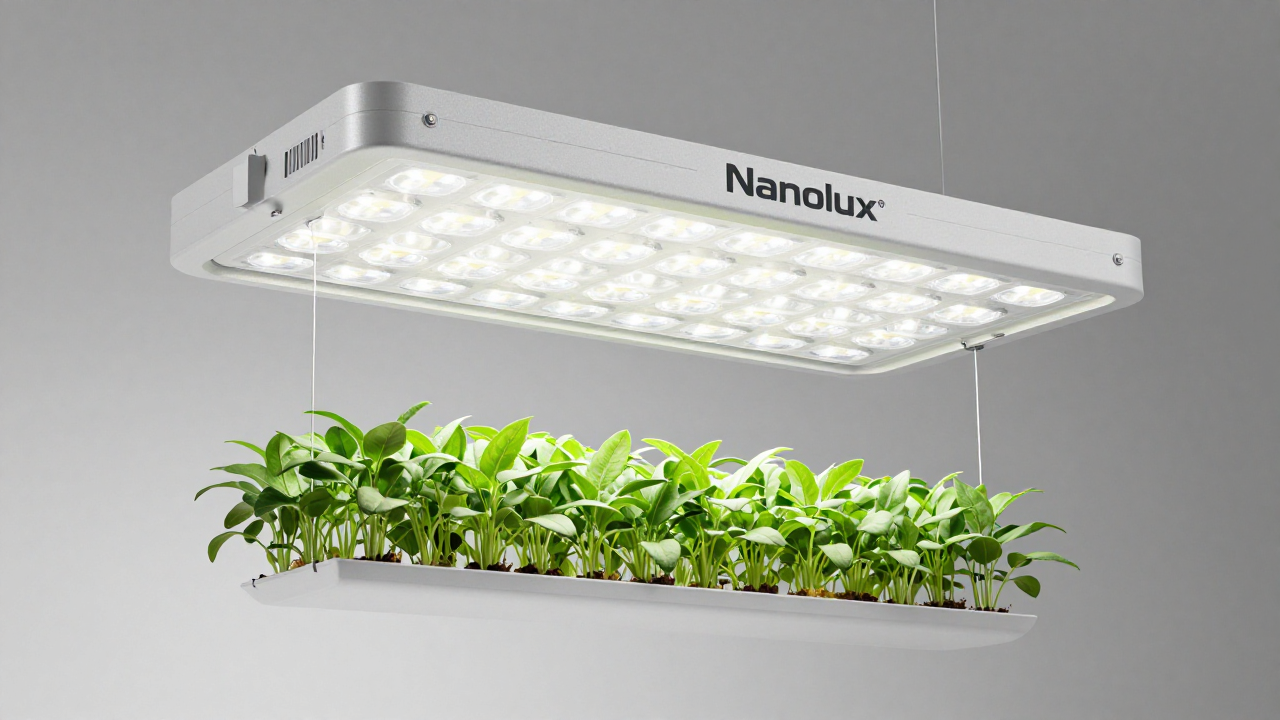
The 3 a.m. Alarm That Changed Everything
Miguel still remembers the exact time the alarm woke him—3:17 a.m., September 9, 2025. The humidity in his Sacramento Valley greenhouse had spiked, and the control system flagged a PPFD drop of almost 30% across three bays, even though every fixture showed “on” and drawing power. No lightning strike. No blown fuse. Just 1,200 young bell pepper plants suddenly light-starved inside what was supposed to be a state-of-the-art facility.
He pulled on boots, drove 22 minutes, and found the culprit before sunrise: a film of mineral dust on the LED lens arrays, compounded by a 12°F rise in junction temperature during the valley’s September heat dome. The lights were still working, technically. Their actual output had just degraded so far that the plants were receiving the photon equivalent of a cloudy February day—at the height of a California summer.
That morning cost him roughly $14,000 in lost yield potential before he even cleaned the first lens. And it forced a conversation few commercial grow lights manufacturers like to have publicly: the gap between a fixture’s spec-sheet promise and its real-world performance after six months of dust, humidity, and thermal sag.
What No One Tells You About Spectrum Spec Sheets
Walk any trade-show floor—MJBizCon, Cultivate, Indoor Ag-Con—and you’ll hear the same phrases. “Full spectrum.” “Sun-like.” “Optimized for cannabinoids.” The problem isn’t that the claims are false. It’s that they’re incomplete enough to be dangerous if a grower doesn’t cross-reference them against their own cultivar’s photobiology.
We learned this the hard way collaborating with a lettuce producer in Willcox, Arizona, in late 2023. Their team had purchased a run of high-blue-spectrum LED bars after reading studies linking blue wavelengths to compact morphology in leafy greens. What the studies didn’t emphasize—and what the fixture’s marketing conveniently left out—was that excessive blue photon flux beyond ~30% of total PAR can suppress leaf expansion in certain romaine varieties at high DLI. By week four, the crop was stunted and showed tip burn despite perfect nutrient and VPD conditions. The fix required swapping half the bars to a warmer spectrum and adding a few deep-red boosters, which cost another $18,000 mid-cycle.
A single controlled-environment study from Wageningen University & Research (2022) gives some useful guardrails: in tomato supplemental lighting, replacing 30% of red-blue with far-red increased total fruit fresh weight by about 7%, *depending on the cultivar*. That “depending” is the whole story. No spectrum is universally optimal. A commercial cucumber variety grown for a Japanese export contract may demand a ratio that would wreck profitability in a craft cannabis room. If a fixture vendor can’t tell you exactly how their spectrum interacts with your specific crop and photoperiod goals, you’re gambling.
We Took a 12,000-Square-Foot Greenhouse Off HPS. Here’s What Actually Happened.
Carla Meier runs a flowering annuals operation just outside Henderson, Nevada. In April 2024, after a punishing summer electric bill, she decided to pull the trigger on an LED retrofit for her 12,000-square-foot Venlo-style greenhouse. The existing layout was 96 double-ended 1,000W HPS fixtures. The replacement target was a mix of top-lighting LED modules and—because she grows dense bench crops—a strip of under-canopy LEDs to get photons into the lower third of the canopy.
We installed the system on October 14, 2024, with a two-week acclimation period where both HPS and LEDs ran simultaneously to avoid shocking the crop. By November 1, the HPS lamps were cold. By May 1, 2025, Carla’s operation had quantifiable results, not just optimism.
The numbers that jump out aren’t just the energy savings. It’s the uniformity. The coefficient of variation on stem length tightened from 18% to 11%, which meant fewer culls and a higher premium-grade ratio at the wholesaler. Carla told me in June 2025, “I didn’t retrofit just to save electricity. I retrofitted because I was tired of explaining to buyers why 20% of every bench didn’t grade out.”
A note on that 4.9 kWh/ft²/month figure: it’s site-specific. Henderson winters are mild, which kept the LED’s reduced heat load from becoming a problem. In a Minnesota greenhouse, you’d likely need supplemental heat when pulling out HPS, partially offsetting savings. There’s no universal number.
How to Stop Measuring Light Like It’s 2004
A light meter reading of 700 PPFD in one spot tells you almost nothing useful if the sensor is 18 inches from an LED bar on a clear glass corridor. Yet we still see facilities where the entire photoperiod strategy hinges on a single handheld quantum sensor walked through the room once a month. That’s not measurement. That’s storytelling.
The metric that separates modern facilities from legacy ones isn’t peak PPFD. It’s canopy light uniformity — expressed as the min-to-max ratio or as standard deviation across a grid of measurement points. A target we recommend for most broad-acre greenhouse crops is a min-to-max ratio above 0.75 across the active canopy area. Below 0.6, you’re growing two different crops in the same room.
In a tomato high-wire facility we mapped in Maricopa County in early 2025, the installed visual impression was “bright everywhere.” When we placed 36 quantum sensors on a 3-by-3-foot grid at the expected top-of-canopy height, the actual PPFD ranged from 410 to 940. The culprit? Mixed-age LED bars where some modules had lost 15% of their output while others were new replacements, plus a cable management layout that created shadows nobody had mapped. The fix cost less than $800—rearranging cables and rotating fixture positions to stagger age-related output loss—and lifted the min-to-max ratio from 0.43 to 0.71. The crop responded within 10 days.
Admittedly, this isn’t a glamorous topic. But it’s the kind of detail that separates a commercial operation from a hobby grow that accidentally tripled in size.
The $40,000 Mistake: Buying Fixtures Before Reading This
In August 2023, a medicinal herb grower in southern Oregon spent just under $40,000 on a batch of imported full-spectrum LED fixtures from a brand with a slick Instagram presence and a 50-page PDF of photometric data. Six months later, 12% of the drivers had failed, and the actual spectrum, when tested with a calibrated spectroradiometer, showed a blue peak shifted 15 nm north of the advertised SPD curve. The crop was visibly elongated and the terpene profile tested lower than the previous year’s harvest. The grower replaced every fixture with a domestic brand. Total waste: nearly $60,000 when you count lost yield and labor.
The market for commercial grow lights in the United States has matured enough that buyers have access to credible, third-party verified specifications—but only if they know what to demand. When you’re evaluating a vendor, a few non-negotiable documents change the conversation:
If a manufacturer can’t produce these for the exact fixture you’re buying—not a similar model—walk away. It’s not about being suspicious. It’s about the fact that your bank loan doesn’t care whose fault the driver failure was.
And while we’re on the topic of honesty: some brands are terrible at communicating real-world depreciation. LED lights don’t burn out. They fade. After 20,000 hours—roughly five years at 12 hours a day—expect 10%–15% photon output loss depending on thermal management and diode quality. Factor that into your initial PPFD target, or you’ll be chasing a moving requirement.
The Search for Honest Specs (and Why It’s Harder Than It Should Be)
If you Google “commercial grow lights” today, here’s what you’ll find on page one: six paid ads, four listicles titled “Top 10 Grow Lights for 2025” that were clearly written by a content mill, and two genuine manufacturer pages buried under a pile of retargeting pixels. The signal-to-noise ratio is abysmal. That’s a problem for growers, but it’s also the reason our team at Nanolux started treating content not as a marketing exercise but as an extension of technical support—explaining measurement protocols, publishing real site data with client permission, and writing the kind of troubleshooting articles we used to share in private emails.
One approach that’s worked for us and several peer brands is publishing grower-verified case studies with raw PAR maps and utility bills attached. These aren’t polished PDFs. They’re screenshots, Excel tables, and handwritten notes from a facility manager who measured PPFD at 3 a.m. because that’s when the lights run. Search engines are getting better at favoring content that demonstrates actual expertise rather than keyword density. And when AI overviews pull snippets for a query like “what’s the best LED for a 20,000 sq ft greenhouse,” they tend to cite pages that describe real installations, not generic spec sheets.
We’re under no illusion that this solves the problem. But for anyone buying commercial grow lights in 2026, the search results they trust will increasingly depend on which brands have bothered to document actual outcomes, not just product hype.
A final thought—if Miguel in Sacramento had access to lens-dusting protocols and thermal derating graphs before he installed his fixtures, that 3:17 a.m. alarm might never have gone off. The gap between a good harvest and a disaster isn’t always about technology. Sometimes it’s about documentation, honesty, and sharing the kind of information that doesn’t make it onto a glossy product page.
What happens in 2026 when utility demand charges in California climb another 12%? When the next generation of tunable-spectrum LEDs can shift peak wavelengths dynamically based on real-time plant stress signals? The growers who’ll answer those questions best won’t be the ones with the most expensive fixtures. They’ll be the ones who treat light as a biological input, not a hardware purchase.
