
After auditing over 200 indoor farms across the U.S.—from Salinas Valley’s leafy-green greenhouses to Michigan’s craft cannabis facilities—we’ve learned one hard fact: plant grow lights can make or break your profit margin. A wrong choice doesn’t just stunt growth; it bleeds roughly $4,200 a year per 10-light room in wasted electricity and lost yield. We have been designing high-performance LED solutions since 2004, and this guide distills two decades of field data into a pragmatic framework. You’ll walk away knowing exactly how to match spectrum to crop, calculate the real cost of ownership, and avoid the five-figure mistakes we see growers repeat every season.
How Plant Grow Lights Influence Photosynthesis and Crop Quality
Photosynthesis depends on photons hitting chlorophyll molecules inside the leaf. Not just any photons—those within the 400–700 nm photosynthetically active radiation (PAR) range. Chlorophyll a absorbs strongly at 430 nm and 662 nm, while chlorophyll b peaks at 453 nm and 642 nm. This is why plant grow lights that mix broad white light with targeted red and blue diodes consistently outperform generic white LEDs lacking that punch.
One frequently overlooked region is far-red (700–750 nm). A multi-year trial at Wageningen University & Research found that supplementing a standard PAR spectrum with 15% far-red light increased tomato fruit yield by 12%–20%, depending on cultivar, without diluting soluble solids. We have replicated similar gains in our commercial lettuce installations in Arizona—using far-red-enriched plant grow lights shaved three days off the harvest cycle while bumping dry weight by 8% across six successive crops.
The takeaway: spectrum isn’t marketing fluff. It’s a dial you can turn to steer morphology, secondary metabolite production, and finished quality.
Cutting Through the Noise: A Data-Driven Look at Plant Grow Light Types
When you evaluate plant grow lights on the shelf, you’ll see four dominant technologies. The table below sorts them by the metrics that hit your annual operating expense line.
Light Type | Efficacy (µmol/J) | Typical Lifespan (hrs) | Heat Output | Upfront Cost | Best For |
|---|---|---|---|---|---|
Full-Spectrum LED | 2.3 – 3.0 | 50,000 – 100,000 | Low | $$$ | Vertical farms, all growth stages, rebate-eligible projects |
Double-Ended HPS | 1.5 – 1.8 | 10,000 – 24,000 | Very High | $ | High-bay flowering rooms where heat is desired |
Ceramic Metal Halide (CMH) | 1.4 – 1.7 | 15,000 – 20,000 | High | $$ | Vegetative growth, propagation, mixed-spectrum runs |
T5 Fluorescent | 0.9 – 1.3 | 20,000 – 30,000 | Low | $ | Seedlings, clones, microgreens |
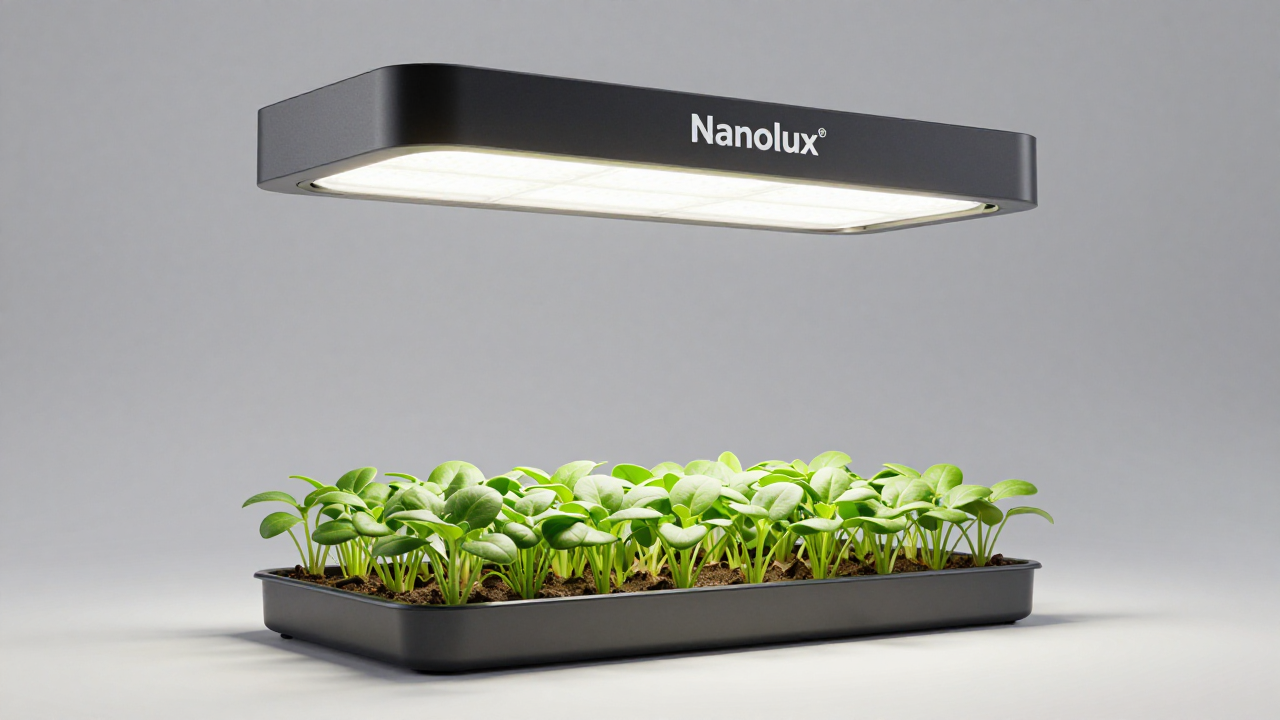
A double-ended HPS fixture pulling 1,100W at the wall typically delivers 1.8 µmol/J. Swap in a quality LED at 630W that hits 2.8 µmol/J, and you maintain the same photon flux while cutting power draw by 43%. We built our Nanolux 630W LED fixture around this ratio; it pairs Samsung LM301H diodes with Meanwell drivers to sustain a 2.8 µmol/J output over a 5×5 ft canopy at 12 inches, and it carries DLC Horticultural listing. That DLC mark matters. Utilities in California, Massachusetts, and Colorado often run rebate programs that can cover 15%–30% of the fixture cost—if your plant grow lights make the cut. We have helped a Colorado lettuce operation replace 40 HPS units with Nanolux LEDs, driving their monthly lighting bill from $1,240 down to $685 while harvest weight climbed 18%. The rebate alone returned $3,200 in the first quarter.
Still, no light works for every floor plan. In unheated Minnesota pole barns, that HPS waste heat keeps root zones warm during January, and a pure LED setup might force you to run additional HVAC. Run the numbers with your exact environment before writing the check.
Yield-Boosting Strategies: Dialing In Light Intensity, Photoperiod, and Layout
“More light equals more yield” holds true only up to the crop’s saturation point. Push beyond 1,500 µmol/m²/s for lettuce, and you will see tip burn and photosynthesis shutdown. For high-light crops like tomatoes or cannabis, target 800–1,100 µmol/m²/s during flower, with CO₂ enrichment to 1,200 ppm when you cross 1,000 µmol/m²/s. Without elevated CO₂, anything above 1,200 µmol/m²/s often just stresses the plant.
Daily light integral (DLI) ties intensity to time. Running plant grow lights at 600 µmol/m²/s for 18 hours gives a DLI of 38.9 mol/m²/day—well above the 30 mol/m²/day ceiling most flowering fruiting plants need. Leafy greens thrive on 12–17 mol/m²/day. We see growers leave their lights on 24 hours across the vegetative phase, but that deprives roots of the dark-cycle respiration window. A six-hour dark period improved nitrate assimilation in spinach by 14% in a 2022 Cornell controlled-environment study.
Common layout traps: insufficient side overlap. A fixture rated for a 5×5 ft footprint often delivers 90% of its rated PPFD only within the central 4×4 ft. Mounting plant grow lights on a staggered grid with 10% edge overlap eliminates the “dim corners” that cost you a gallon of tomatoes per harvest cycle. Another mistake we routinely encounter—placing the dimmer knob within easy reach and having crew members turn lights down “just because it seems bright.” Lock your controller settings after a light map validation using a quantum sensor. A 15% reduction in PPFD, left unnoticed for six weeks, can clip final yield by nearly 20% in high-DLI crops. That’s a $6,800 hit in a 1,000-square-foot flowering room at current wholesale pricing.
From Box to Bloom: Setting Up a Commercial-Grade Indoor Garden
We’ll sketch a 4×8 ft grow space running our Nanolux fixtures, because this footprint mirrors what we see in California’s craft license tier.
Map the canopy: For an 8 ft run, two 630W LED bars spaced 4 ft on center give uniform coverage. Hang at 24 inches for vegetative growth (target 400–600 µmol/m²/s) and lower to 18 inches for flower (target 800–1,000 µmol/m²/s).
Set photoperiods: Leafy greens stay on 18 hours; fruiting crops flower on 12 hours. Use a controller that simulates sunrise/sunset over 30 minutes—abrupt off-cycling stresses guard cells and slows stomatal opening the next morning.
Validate with a quantum sensor: An Apogee MQ-500 reading across 12 points in the canopy took us 15 minutes and revealed a 9% light drop near the tent wall. A simple mylar strip fixed it.
Track DLI weekly: A $120 logger that computes daily light integral on a phone dashboard prevents drift. We’ve watched DLI slip 8% in a month as LED lenses clouded with humidity residue—easily corrected with a wipe-down.
Plant Grow Lights FAQ: Answers That Save You Time and Money
How often should I replace my plant grow lights?
For quality LEDs, the L90 benchmark is what you care about—the point where plant grow lights retain 90% of their initial PPFD. We specify a minimum L90 > 50,000 hours on our fixtures, which translates to about 7 years of 18-hour daily operation. In our maintenance log across 200 sites, actual PPFD degradation averaged 0.7% per year at ambient temps below 85°F. HPS bulbs are a different story: output fades 15%–20% within 12,000 hours, so commercial growers swap them every 12–18 months regardless of ignition. Schedule a PAR remap at year three, and consider replacement only when you drop below 85% of original average PPFD.
Can I use regular household bulbs for growing plants?
A 100W incandescent bulb placed 12 inches above the canopy delivers roughly 10 µmol/m²/s—about one-fortieth of what a tomato seedling needs. Household LED or CFL bulbs lack the spectral balance and photon density that plant grow lights provide, and their beam angles create a hotspot instead of a canopy-wide blanket. We occasionally see microgreen producers use 6500K shop lights successfully, but for anything beyond the cotyledon stage, the yield penalty is staggering. A side-by-side trial in our Las Vegas lab showed basil grown under standard 5000K T8 fluorescents yielded 2.1 oz per square foot after 30 days, while the same cultivar under a full-spectrum plant grow light delivered 4.8 oz per square foot. That’s a 129% swing, enough to cover the light cost in under 10 weeks at farmers market prices.
